
The interpretation that says the wavefunction is your betting odds, and whose real achievement is forcing everyone else to say what they think it is instead.
QBism says the wavefunction is your betting odds. It is a description of one agent’s expectations, not a thing in the world. Two observers can hold different wavefunctions for the same system and both be right.
That dissolves the measurement problem rather than solving it. If the wavefunction was never physical, its collapse needs no mechanism. The cost is accepting that quantum states are personal.
It grew through a mailing list, not a paper. The interpretation spread among a small group in correspondence before it had a canonical statement. That history shows in how loosely the label is used.
Its founders disagreed about their own idea. Caves, one of the three founding authors, no longer counts himself a QBist, while Fuchs and Schack carried the reading forward and Mermin converted later. There is no single QBist position to argue against.
There is a technical programme underneath it. Work on symmetric informationally complete measurements tries to rebuild the Born rule from a probability rule. It is real mathematics rather than only philosophy.
It changes nothing about building a machine. An engineer calibrating a qubit uses the same equations whatever they think the wavefunction is. The argument matters for what physics means, not for what hardware does.
- A probability is one person's degree of belief
- Why your physics is none of my business
- An interpretation propagated by mailing list
- The founders fell out over their own idea
- The technical programme nobody mentions
- Wigner's friend is the serious objection, not solipsism
- The objection that has not been answered
- The objections QBism has to answer
- How it sits against the other readings
- Bell's theorem began as a foundations question
- Frequently asked questions
The most useful thing about QBism may have nothing to do with whether it is true. A century after quantum mechanics was written down, physicists who use it every day still cannot agree on what its central object is, and for most of that century the disagreement was polite enough to be ignorable. QBism made it unignorable by taking the least popular option and pushing it to its limit, and in doing so it forced everybody else to state, out loud and in print, what they think a wavefunction is.
The claim itself is easy to state and hard to swallow. A quantum state is not a description of an electron. It is a description of a person, specifically of one agent’s personal expectations about what they will experience if they act on the world in a particular way. Move the observer and the state moves with them, because it was never sitting on the electron. Christopher Fuchs, who named the position, has described quantum theory in exactly those terms, calling it “a users’ manual that any agent can pick up and use to help make wiser decisions in this world of inherent uncertainty.”
Whether you find that liberating or evasive is a matter of temperament, and the argument has been running for more than twenty years. What is not a matter of temperament is that the position is precisely specified, has produced real mathematics, and has been attacked by serious people on grounds that are still open. This is what a live problem in the foundations of physics looks like from the inside.
A probability is one person's degree of belief
The Bayesian half of the name is doing real work. There are broadly two ways to read a probability, and the split is old. One camp holds that probabilities are objective features of the world, the long-run frequencies you would see if you could repeat an experiment forever. The other, the personalists, hold that a probability is a number expressing how strongly one particular person believes something, and that it has no existence independent of that person.
QBists take the second reading and apply it to quantum probability without exception. On this account the Born rule, the equation that converts a wavefunction into predicted probabilities, stops being a law of nature and becomes a rule of rational betting. Fuchs makes the point with an analogy to the Ten Commandments rather than to Maxwell’s equations, on the grounds that a normative rule can be disobeyed while a physical law cannot, and he writes that with the Born rule “The agent is free to ignore the advice, but if he does so, he does so at his own peril.”
Why collapse stops being an event
Once a quantum state is a set of personal expectations, the collapse of the wavefunction stops being a physical process and becomes an ordinary act of learning. You performed an action, something happened to you, and you revised your expectations in the light of it, exactly as you would after turning over a card. Nothing lurched anywhere in space, because there was nothing out there to lurch.
No experiment distinguishes a QBist laboratory from any other, because the mathematics is untouched and the Born rule returns the same numbers it always did. What changes is the account of why those numbers are the ones to bet on. The whole dispute is over whether that account is an explanation or a refusal to give one, and that question is philosophical rather than experimental.
Why your physics is none of my business
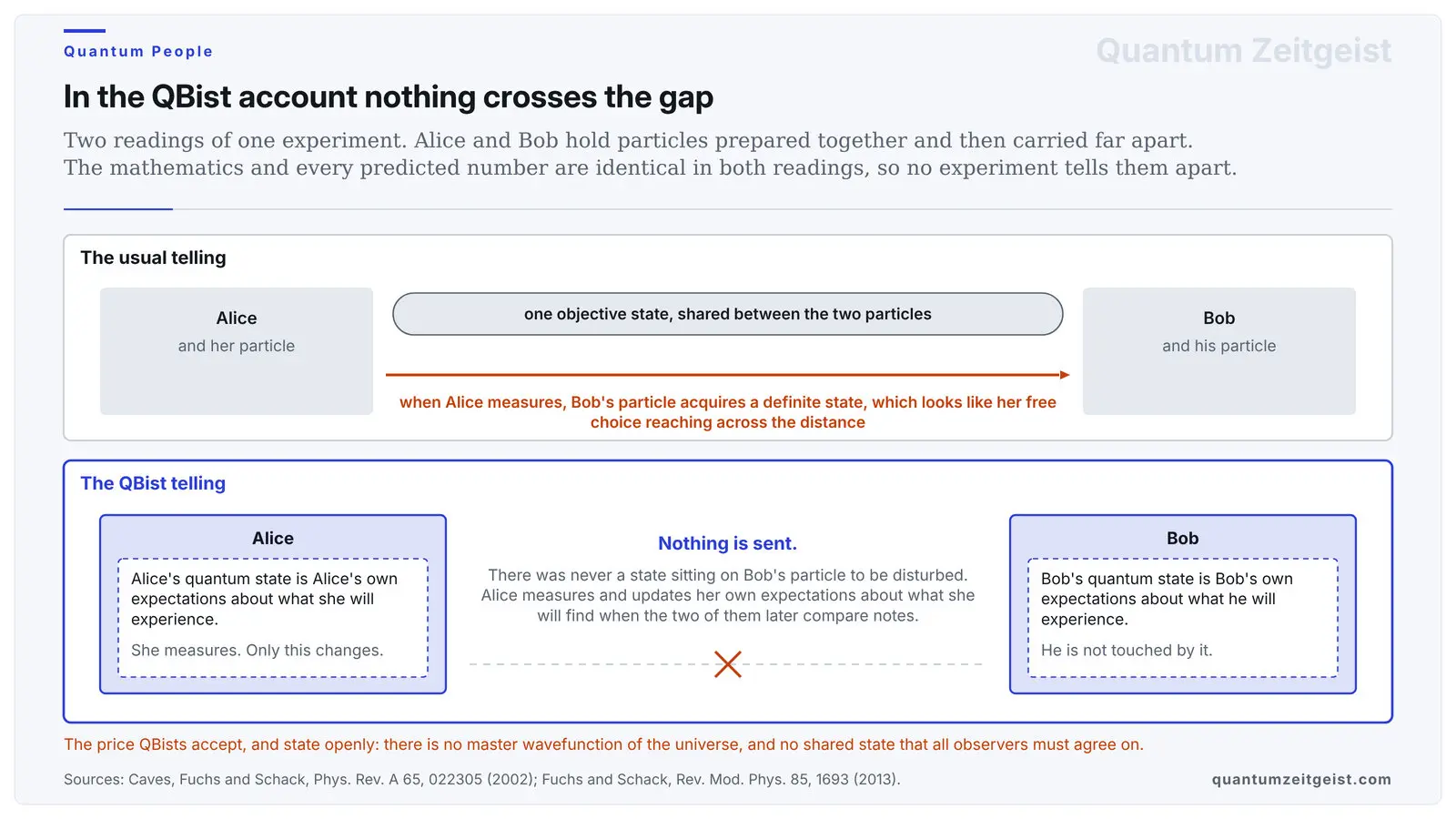
QBism’s most persuasive move is what it does to entanglement. Take the standard arrangement in which two particles are prepared together and carried far apart, one to Alice and one to Bob. On the conventional telling, the moment Alice measures her particle, Bob’s acquires a definite state, which looks uncomfortably like Alice’s free choice reaching across a great distance faster than light.
For a QBist nothing is sent, because there was never an objective state sitting on Bob’s particle to be disturbed. Alice’s quantum state was Alice’s expectation all along, and when she measures, she updates her own expectations about what she will find when she eventually compares notes with Bob. The update happens inside Alice. The apparent nonlocality dissolves into a confusion about whose beliefs were under discussion.
The price is steep and QBists pay it in public. There is no master wavefunction of the universe, no view from nowhere, and no shared quantum state that all competent observers must agree on. Each agent has their own, built from their own history. For a great many physicists that is not a solution but a surrender, and this is the fault line along which the whole argument runs.
An interpretation propagated by mailing list
The way QBism spread is almost as strange as what it says. Fuchs, now at the University of Massachusetts Boston, has for decades circulated enormous collections of his own email correspondence, edited and indexed and posted publicly, as the primary vehicle for developing the idea. The second of them, My Struggles with the Block Universe, is described in its own abstract as a collection of letters written to various friends and colleagues, unified only by the fact that each has something to do with the quantum, and it runs to a length no journal would ever accept.
Why the letters matter
These volumes are not vanity. They are an argument about how foundational work should be done, namely in the open, in dialogue, with the false starts left in. Along the way they preserve a good deal of the oral history of quantum information theory, including, by Fuchs’s own account, the story of where the word qubit came from, told by the man who coined it. A position in the foundations of physics that propagates by mailing list is a genuinely unusual object, and the volumes are the reason so many people in the field have a first-hand impression of what QBists think rather than a second-hand caricature.
The habit extends to the naming. Fuchs has toyed publicly with the label quantum bettabilitarianism, borrowed from the American jurist Oliver Wendell Holmes Jr and meaning that the world is loose at the joints and an agent can do nothing but bet on it, before rejecting his own coinage with the words “But what an ugly, ugly word, bettabilitarianism!” He also records that Mermin suggested the B should stand for Bruno, after the personalist probabilist Bruno de Finetti, and that this too was abandoned because QBism carries metaphysical commitments de Finetti might have refused.
The founders fell out over their own idea
QBism began as a collaboration between three people, and the reason it has a separate name is that the collaboration stopped agreeing with itself. The founding paper is Carlton Caves, Christopher Fuchs and Rudiger Schack, Quantum probabilities as Bayesian probabilities, published in Physical Review A in 2002, which argued that quantum probabilities should be read as personal degrees of belief. That paper is the common ground. Everything afterwards is the disagreement about what follows from it.
Fuchs said so himself, in the first footnote of the 2010 paper that introduced the name. He noted there that the present work “goes far beyond those statements in the metaphysical conclusions it draws”, and gave as his reason for inventing a new label that “the author cannot comfortably attribute the thoughts herein to the triumvirate as a whole.” The word QBism exists because one of the three authors could no longer put his own conclusions in the mouths of the other two.
Where the three of them ended up
The split hardened. The Stanford Encyclopedia of Philosophy records flatly that Caves no longer considers himself a QBist, while Fuchs and Schack carried the personalist reading forward, and Mermin, the Horace White Professor of Physics Emeritus at Cornell, arrived later as a convert and became its most lucid public advocate. Three people wrote a paper, two of them followed it somewhere the third would not go, and the name marks the place where they parted.
The technical programme nobody mentions
Popular accounts of QBism almost always stop at the philosophy, which does the position a disservice, because a substantial part of the effort has gone into mathematics that stands or falls independently. The programme is to rewrite quantum mechanics entirely in the language of probability, with no amplitudes and no Hilbert-space operators, so that the Born rule appears as an addition to ordinary probability theory rather than as an alien import.
The object that makes this look possible is the symmetric informationally complete quantum measurement, universally abbreviated to SIC. A SIC is a set of measurement outcomes arranged with maximum symmetry in the space of quantum states, and if one exists in a given dimension it can serve as a reference measurement against which every other measurement is expressed. Fuchs’s 2010 paper calls it a mysterious entity, and the mystery is genuine, since whether SICs exist in every finite dimension remains an unsolved problem in mathematics rather than in physics.
Written in the SIC representation, the Born rule turns into something that looks almost like the classical law of total probability, but rescaled. Fuchs puts it with an exclamation mark, writing that “The Born Rule is nothing but a kind of Quantum Law of Total Probability!” and noting that the expression contains no complex amplitudes and no operators, only probabilities going in and probabilities coming out. That rescaling is the whole quantum content, isolated in one equation, and it is a real result whatever one makes of the philosophy attached to it. Fuchs and Schack set out the mature form of this programme in Quantum-Bayesian coherence in Reviews of Modern Physics in 2013.
Wigner's friend is the serious objection, not solipsism
The serious technical challenge to QBism, and to any single-agent reading of quantum theory, is not solipsism. It is the family of thought experiments descended from Wigner’s friend, in which one observer performs a quantum measurement inside a sealed laboratory while a second observer, outside, treats that entire laboratory, friend included, as a quantum system to be described by a wavefunction. The two accounts do not obviously agree about whether a measurement outcome has occurred.
Daniela Frauchiger and Renato Renner sharpened this into a no-go theorem in Nature Communications in 2018, under the title Quantum theory cannot consistently describe the use of itself. Their argument constructs a scenario containing agents who are themselves using quantum theory, and shows that one agent, on seeing a particular outcome, must conclude that another agent predicted the opposite outcome with certainty. All the conclusions are derived within quantum theory, and they are mutually inconsistent, which is a far more serious problem than any complaint about the wavefunction being subjective.
The QBist reply to the no-go theorem
QBism has an answer and it is worth stating fairly. John DeBrota, Fuchs and Schack replied in Foundations of Physics in 2020, arguing that the paradox dissolves once Wigner and his friend are treated as agents on an equal footing, each entitled to use quantum theory and each a physical system from the other’s point of view.
They call this a quantum Copernican principle, and its content is that no user of quantum theory is more privileged than any other. Wigner’s action on his friend therefore becomes, from the friend’s side, an action the friend takes on Wigner. Whether the reply settles the matter is disputed, but it is a technical response to a technical objection rather than an appeal to taste.
The objection that has not been answered
The charge most often thrown at QBism is solipsism, and it is the weakest one. Mermin has dealt with it directly in a 2014 paper prepared for a conference marking fifty years of Bell’s theorem. He states the empiricism first, writing that “QBism maintains that my understanding of the world rests entirely on the experiences that the world has induced in me throughout the course of my life”.
He then turns on the accusation itself. “Facile charges of solipsism miss the point. My experience of you leads me to hypothesize that you are a being very much like myself, with your own private experience.” Science, on his account, is the collaborative business of finding what is common to all our privately constructed worlds, and conferences and papers are part of the physics rather than incidental to it.
The objection that bites hardest came from the Oxford philosopher of physics Christopher Timpson, in a 2008 study of the position. His complaint is about explanation. Quantum mechanics is generally credited with explaining why matter is stable and why some solids conduct electricity while others insulate, and those explanations proceed by talking about band gaps and Fermi surfaces, which are claims about sodium rather than about anybody’s beliefs concerning sodium. Timpson put it plainly, writing that “Ultimately we are just not interested in agents’ expectation that matter structured like sodium would conduct; we are interested in why in fact it does so.”
That is a hard objection because it does not depend on disliking subjective probability. It asks what a theory of personal expectations can possibly be explaining when it explains conductivity, and the QBist answer, that quantum explanations have the same character as explanations elsewhere in decision theory, has not persuaded the philosophers who raised the question. Fuchs is plainly stung by the associated label, and in a 2016 paper he broke off the argument to address the reader directly.
So, I write all these words to say, PLEASE don’t call us “non-realist” in print. We have endured enough hardship because of that damned label.
Christopher A. Fuchs, On Participatory Realism, arXiv:1601.04360
He prefers participatory realism, on the grounds that the world is entirely real and pushes back on us, but contains more than any single third-person description can hold. The label matters to him because it determines whether the position is engaged with or dismissed, and two decades of being filed under anti-realism have evidently cost him readers he wanted.
Which leaves the question of what QBism is for. It may turn out to be right, wrong, or right about the wrong thing, and no experiment will decide. What it has already done is drag a hundred years of unexamined assumption into the light and require its opponents to be specific, and in a field where vagueness has been comfortable for a very long time, that is a substantial contribution on its own.
The objections QBism has to answer
An account of any interpretation is incomplete without the case against it, and QBism attracts a specific and repeated criticism. If the quantum state is one agent’s personal degree of belief, the obvious question is what the physics is describing when nobody is looking, and critics argue the answer amounts to abandoning the job physics is supposed to do.
The charge is usually framed as solipsism or instrumentalism, and its defenders reject both. Their position is that there is a world, that it is not made of quantum states, and that the formalism is a tool an agent uses to place bets on the consequences of its own actions. Whether that counts as an interpretation of the physics or a decision to stop interpreting it is exactly what the argument is about.
A second objection concerns the Wigner’s friend scenario, in which one observer measures a system and a second observer treats the first observer and the system together as one quantum system. Interpretations divide sharply on what is happening, and the subjective reading handles it comfortably by allowing two agents to hold different states for the same situation. Critics see that comfort as the problem, since it purchases consistency by declining to say what occurred.
The third objection is the most practical. If the state describes belief rather than a physical thing, an account is still owed of why the Born rule works so well and why every agent who applies it correctly agrees. Substantial technical work has gone into deriving the rule as a consistency requirement on rational betting, and how far that work succeeds is a live question rather than a settled one.
How it sits against the other readings
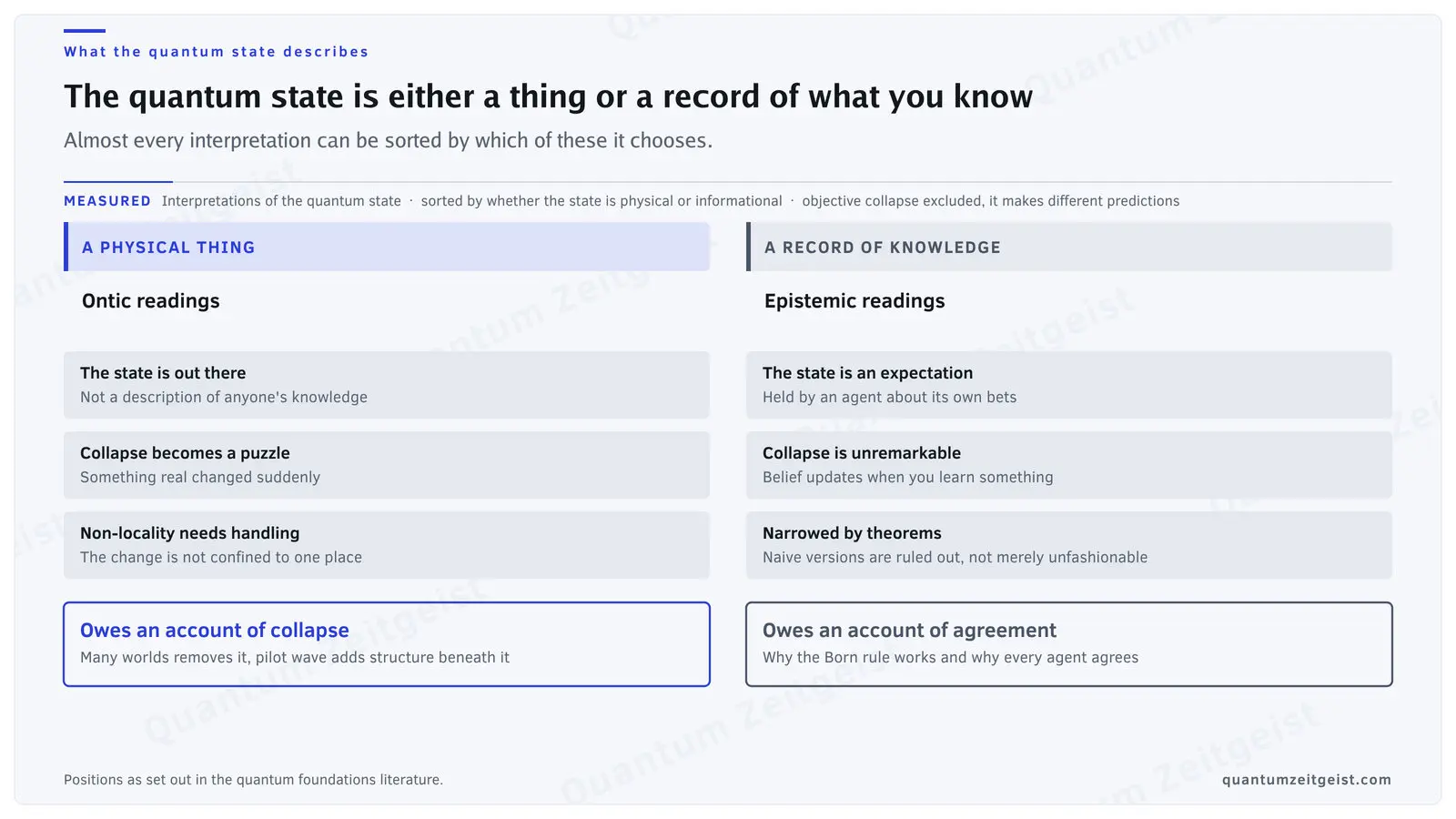
Placing QBism among the alternatives makes what is distinctive about it clearer. The Copenhagen tradition also declines to say what the state describes and locates the mystery at a boundary between quantum and classical, without specifying where that boundary sits. The subjective reading removes the boundary by making the state belong to an agent rather than to the world, which is a sharper position rather than a softer one.
Many-worlds goes the opposite way entirely, treating the state as maximally real and accepting every outcome. Pilot-wave theories add a definite particle position underneath the wave, restoring determinism at the cost of an explicit non-locality. Objective collapse models change the equation itself so that collapse becomes a physical process with parameters that experiments can constrain and eventually rule out.
The useful axis to sort them on is what each takes to be real. Many-worlds says the wavefunction. Pilot-wave says the particles. Collapse models say the wavefunction plus a new physical mechanism. The subjective reading says none of the above, and that the formalism is about an agent’s expectations rather than about any of these things.
Only one of those families makes different experimental predictions. Objective collapse models can be tested and are being tested, since a physical collapse mechanism leaves traces that increasingly sensitive experiments can look for. The rest predict identical results, which is why the disagreement between them has lasted and will not be settled in a laboratory.
Bell's theorem began as a foundations question
An engineer calibrating a processor can ignore all of this and lose nothing, and the interpretations still earn their place for a reason worth stating. Several ideas that are now practical engineering began as attempts to think clearly about what quantum states are, and the people doing that thinking were not aiming at applications.
Bell’s theorem is the clearest case. It came from taking seriously a question about whether hidden variables could underlie quantum mechanics, a question widely regarded at the time as philosophy rather than physics, and it produced a testable inequality. That work is now the basis of device-independent cryptography and the security arguments for quantum key distribution, which are commercial concerns.
Quantum information theory has a similar heritage. Treating the quantum state as information, and asking what can and cannot be done with it, produced the no-cloning theorem, the analysis of entanglement as a resource and eventually the whole framework in which quantum computing is described. Those are foundational questions that turned into a field.
The pattern suggests a modest conclusion about QBism and its rivals rather than a grand one. Interpretive work does not usually produce applications and occasionally produces the concepts a later generation builds on, and there is no reliable way to tell in advance which is which. That is an argument for tolerating the discussion rather than for expecting anything from it.
Frequently asked questions
What is QBism?
Who created QBism?
Why did the founders separate?
How does QBism handle the measurement problem?
How does QBism explain entanglement?
What is a SIC and why does QBism care about it?
What is the Frauchiger and Renner objection?
Is QBism anti-realist?




See today’s quantum computing news on Quantum Zeitgeist for the latest breakthroughs in qubits, hardware, algorithms, and industry deals.