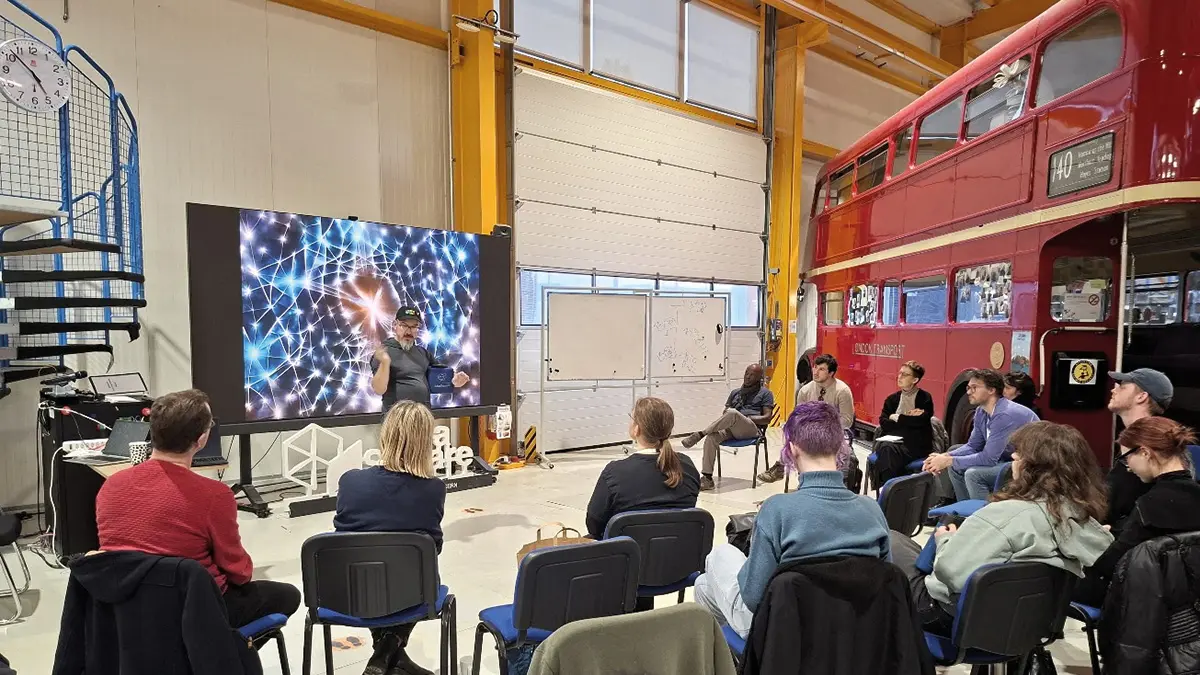
Thirty-six students, researchers, artists, and educators converged at CERN’s IdeaSquare from January 11 to 18, 2026, for a unique event timed to the centenary of the quantum wave function. The SciArtDialogue Week, supported by institutions across Austria, Germany, the US, and Australia, brought together disparate fields to explore a foundational question in quantum physics: whether the wave function describes reality itself or simply our understanding of it.
Organised by art@CMS/ORIGIN, the workshop immersed participants in CERN’s infrastructure, prompting reflection on the interplay between scientific ingenuity and artistic expression, with resulting works to be exhibited at the ORF festival in Graz this October.
CERN’s IdeaSquare Connects Artists with Particle Physics Infrastructure
The centenary of Erwin Schrödinger’s wave function served as the catalyst for an unusual convergence at CERN’s IdeaSquare, where 36 participants from diverse backgrounds explored the enduring philosophical questions at the heart of quantum mechanics. This collaborative effort, organised by art@CMS/ORIGIN, extended beyond CERN’s typical European collaborations, signalling a growing international interest in bridging the gap between science and art. The event’s timing was deliberate, coinciding with the 100th anniversary of Schrödinger’s reformulation of quantum theory in early 1926.
While Schrödinger initially envisioned the wave function as a physical wave describing matter, Max Born quickly proposed its connection to probabilities of measurement, a concept that became the standard interpretation. ORF Ö1 journalist Susanna Niedermayr documented these exchanges, observing how concepts from quantum physics permeated artistic practices across fine arts, musicology, and religious studies.
Participants gained firsthand exposure to CERN’s infrastructure, including large-scale experiments and data processing techniques, fostering connections with the scientific community. These experiences were coupled with in-depth explorations of quantum mechanics, the historical context of Schrödinger’s work, and the evolution of contemporary scientific thought. The Austrian contingent, in particular, benefitted from the workshop serving as the launchpad for a semester-long university course, culminating in an exhibition of their resulting works, spanning sound, performance, visual media, and conceptual installations, at the ORF festival in Graz from October 8 to 11.
The organisers stated that the initiative exists to test whether art can bring an advanced scientific idea to a wider public, framing the festival as a public demonstration of the program’s impact. CERN’s increasing engagement with interdisciplinary initiatives like SciArtDialogue Week reflects a broader trend within the organisation.
Founded in 1954 and headquartered in Geneva, Switzerland, CERN operates the Large Hadron Collider, a machine reliant on quantum physics and superconducting magnet technology, and is now actively pursuing quantum computing applications. The CERN Quantum Technology Initiative, launched in 2020, investigates how quantum computing can accelerate data analysis and simulation by using partnerships with companies like Qilimanjaro Quantum Tech, IBM Quantum, and Google Quantum AI.
This commitment is further evidenced by CERN’s deployment of IBM quantum computers for LHC data analysis and participation in quantum simulation programs through Amazon Braket and the IBM Quantum Network. The openlab at CERN actively collaborates with technology companies on quantum algorithm development for high-energy physics, resulting in 10 patent families and 5 publications in the last twelve months.
This focus on quantum technologies extends beyond computation; CERN’s expertise in superconducting magnets, important for both the LHC and qubit development, is being transferred to advance quantum computing hardware. Geneva is establishing a citywide quantum network, connecting institutions including CERN and Rolex, demonstrating a regional commitment to fostering quantum innovation. CERN’s recent findings, including the observation of in particle collisions, underscore the ongoing relevance of quantum mechanics and the potential for further breakthroughs.
The SciArtDialogue Week is slated to return to CERN IdeaSquare in February 2027, coinciding with the centenary of the fifth Solvay Conference, promising continued exploration of the intersection between scientific inquiry and artistic expression. The programme’s success in fostering dialogue and creative output suggests a valuable model for communicating complex scientific concepts to broader audiences, and for enriching scientific research through artistic perspectives. The resulting exhibition in Graz will provide a tangible assessment of this approach, demonstrating whether art can be an effective conduit for advanced scientific ideas.


See today’s quantum computing news on Quantum Zeitgeist for the latest breakthroughs in qubits, hardware, algorithms, and industry deals.