- The paper that costed the dream
- The tool that made noisy machines computable
- The published record in one place
- How a theorist ended up holding the pen
- The building at Harwell
- Knighted in 2005 for optical physics
- What the programme still has to prove
- A contribution to the toolkit, not to one result
- Frequently asked questions
In 1996, two years after Peter Shor showed that a quantum computer could break the encryption underpinning the internet, and while the field was still enjoying the discovery, two theorists at Imperial College London sat down and worked out how long it would actually take. Martin Plenio and Peter Knight published the answer in Physical Review A under a title that gives away the mood, Realistic lower bounds for the factorization time of large numbers on a quantum computer, and it consisted of arithmetic rather than enthusiasm.
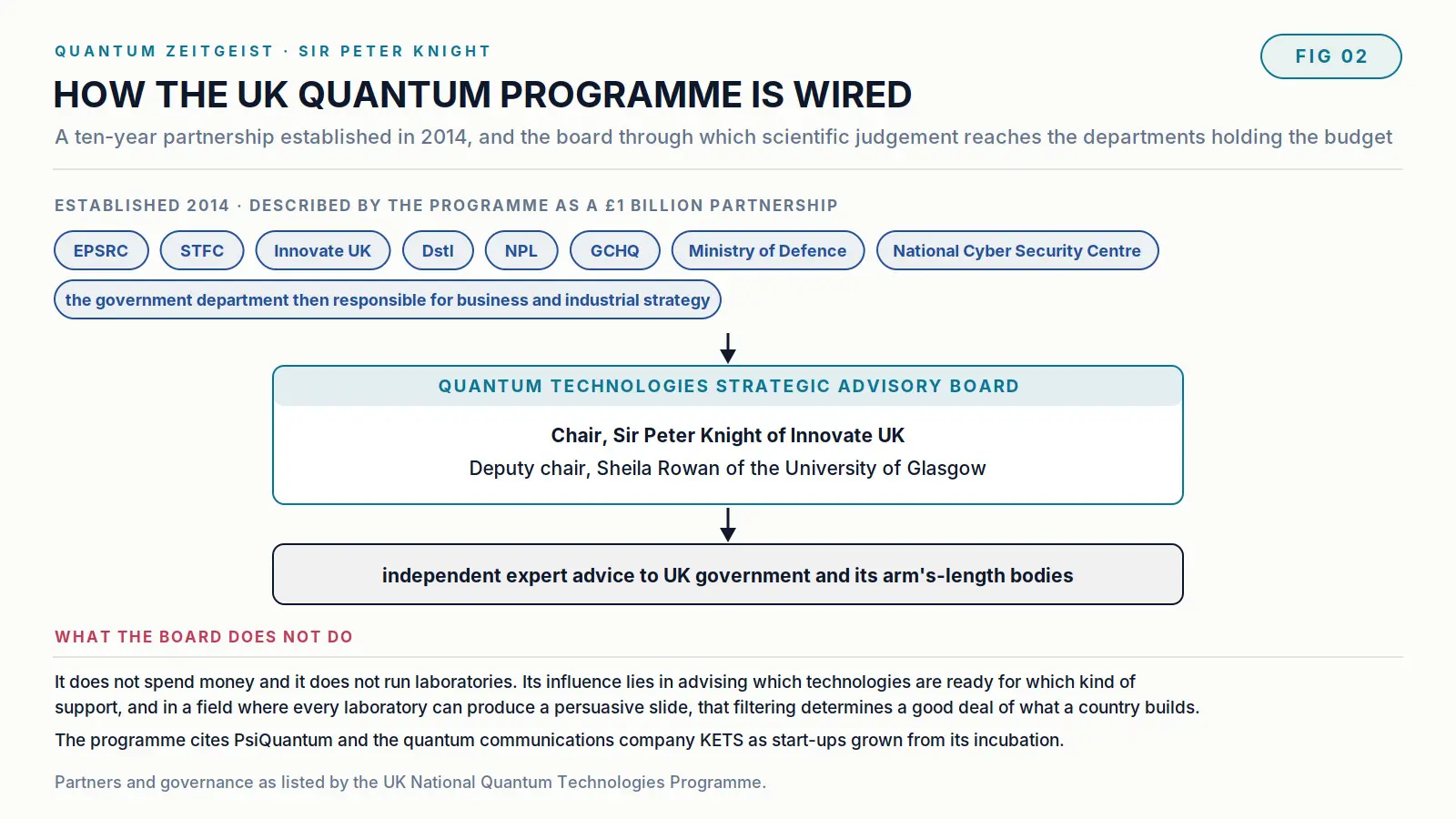
Thirty years later Knight chairs the Strategic Advisory Board of the United Kingdom’s National Quantum Technologies Programme, the body through which scientific judgement reaches the departments that hold the money, and the money is now considerable. The programme’s own governance pages describe the board as advising on the implementation of a ten-year National Quantum Strategy worth £2.5 billion. Those two facts are the same fact.
A government deciding how much to spend on an emerging technology needs somebody who can tell it what the technology will cost before it works, and that is a rarer skill than being able to say what it will do once it does. Knight spent his research career building the instruments that let quantum physics price itself, first by computing what decoherence takes away and then by giving the field a practical way to simulate noisy machines. The advisory chairs are the consequence, not the achievement.
His 1996 paper with Martin Plenio set realistic lower bounds on the time a quantum computer would need to factor large numbers once decoherence was included, which is an early attempt to cost the field’s headline application honestly. Estimates of that cost have fallen a great deal since, and the discipline of making one at all was the contribution.
With Plenio he wrote the 1998 Reviews of Modern Physics article on the quantum-jump approach to dissipative dynamics, which became a standard way of simulating open quantum systems and therefore of predicting how real, noisy processors behave. A review article that becomes the standard method is a quieter kind of influence than a discovery, and often a longer-lived one.
He chairs the Strategic Advisory Board of the UK National Quantum Technologies Programme, which advises on a ten-year National Quantum Strategy the programme values at £2.5 billion, and he chairs the Quantum Metrology Institute at the National Physical Laboratory. Holding both roles places him across the research and the measurement sides of the same national effort.
He led the breaking-ground ceremony in September 2021 for the National Quantum Computing Centre at Harwell, a £93 million UKRI investment that is now the visible test of the programme he advises. A national centre is the point at which a strategy stops being a document and becomes a building with a budget.
Optica named him an Honorary Member in 2024, a category limited by its own rules to two-thousandths of the society’s membership, having elected him its president twenty years earlier. Recognition from the optics community rather than the quantum computing one reflects where the work began.
The paper that costed the dream
Shor’s factoring algorithm arrived in 1994 and its implication was immediate and dramatic, since the security of most digital commerce rests on large numbers being hard to factor. The question nobody had answered was what the algorithm would cost on hardware whose qubits forget. A quantum computer holds its information in fragile superpositions that the surrounding world steadily degrades, and an algorithm that needs more time than the hardware can hold its state is not an algorithm at all.
Plenio and Knight took a specific physical implementation, worked through the arithmetic of how long the computation would take against how quickly the coherence decayed, and published bounds. The result was not a refutation, and the distinction matters. A bound tells you what has to improve and by how much, which is exactly the information an engineer needs and exactly the information an enthusiast prefers not to have.
Sceptical arithmetic is not scepticism
Papers of this kind are sometimes read as attacks on a young field, and they are more usefully read as the moment the field acquires an engineering discipline. Establishing what decoherence costs is the first step towards quantum error correction, which is the machinery around which the entire industry now organises itself and on which billions of dollars of private capital currently rest.
It is also a statement of temperament, and the temperament is the point of this profile. A theorist who publishes a careful calculation of why his own field’s headline application is harder than advertised has demonstrated, in the permanent public record, that he will say inconvenient things about work he is close to. That is the qualification a government is actually shopping for when it appoints a scientific adviser, whether or not anyone puts it in those words.
The tool that made noisy machines computable
Simulating a quantum system that leaks energy and information into its surroundings is expensive, because the object you have to track is a density matrix whose size grows as the square of the state space. For anything beyond a handful of levels the direct approach outruns the computer you are running it on, which leaves you unable to predict how your own hardware will behave.
The quantum jump approach replaces that calculation with an average over many individual trajectories, each following a single state vector punctuated by random jumps corresponding to detected emissions. Think of it as the difference between tracking the probability distribution of every raindrop in a storm and simply following a few thousand individual drops and averaging. Each trajectory is cheap, and enough of them reproduce the matrix you could not afford to compute directly.
The 1998 Reviews of Modern Physics article The quantum-jump approach to dissipative dynamics in quantum optics, by Martin Plenio and Peter Knight, is the review that consolidated the method and made it usable by people who had not invented it. It has been cited steadily ever since across quantum optics, quantum computing and chemical physics, which is the unglamorous form of influence that review articles have and individual results usually do not.

Why it matters for quantum computing specifically
Every real quantum computer is an open system, which means that any question about how a noisy processor will actually perform requires precisely this kind of simulation. A review that made the method accessible therefore ended up serving an industry that barely existed when it was written, and it is still the route by which most people first learn to model a decohering qubit.
The published record in one place
The table lists the works most often attached to his name, each verified against publisher metadata. It is deliberately short, since four decades of output does not compress into six rows and the point here is the shape of the career rather than its volume.
| Work | Where published | What it did | His role |
|---|---|---|---|
| The Rabi frequency in optical spectra | Phys. Rep. 66, 21 (1980) | Review of atomic response to strong driving fields | First author, with Peter Milonni |
| Thermofield analysis of squeezing and statistical mixtures | J. Opt. Soc. Am. B 2, 467 (1985) | Brought thermal field methods into quantum optics | Co-author with Stephen Barnett |
| Realistic lower bounds for the factorization time of large numbers | Phys. Rev. A 53, 2986 (1996) | Costed Shor’s algorithm against physical decoherence | Co-author with Martin Plenio |
| The quantum-jump approach to dissipative dynamics | Rev. Mod. Phys. 70, 101 (1998) | Consolidated trajectory methods for open quantum systems | Co-author with Martin Plenio |
| Entanglement by a beam splitter | Phys. Rev. A 65, 032323 (2002) | Showed nonclassical input is required to entangle at a beam splitter | Last author, with Myungshik Kim, Wonmin Son and Vladimir Bužek |
| Introductory Quantum Optics | Cambridge University Press (2004) | The standard first textbook in the subject | Co-author with Christopher Gerry |
The last row is easy to underrate. Introductory Quantum Optics, written with Christopher Gerry, is the book a large part of the field learned the subject from, and a first textbook does something no research paper can. A paper reaches the people already working on the same problem, while a textbook reaches everyone who will work on any problem in the subject for the next twenty years and quietly decides which concepts they will treat as fundamental.
How a theorist ended up holding the pen
The UK government announced the National Quantum Technologies Programme in 2013 and it started in earnest a year later, a sequence Knight himself set out in a 2019 open-access perspective article written with Ian Walmsley, UK national quantum technology programme, for Quantum Science and Technology. That article is worth reading as a statement of method rather than of results, because it explains what had to be true before a treasury would write the cheque. “It was clear not only to the scientists but also to UK funding agencies and policy makers that UK quantum science had matured sufficiently for us to know what was feasible in technology commercialisation.”
That sentence is the argument of this profile in the authors’ own phrasing. The programme was not built on a claim that quantum technology would work. It was built on a claim that the community had become able to say which parts were ready and which were not, which is the skill the 1996 factorization paper demonstrated in miniature twenty-three years earlier.
The structure that resulted was a hub and spoke model, with four research hubs covering imaging, sensors and metrology, communications and computing, chosen by peer review and involving nearly thirty universities alongside industry and government partners. The same article records that the programme’s Strategic Advisory Board was led for its first five years by David Delpy, the outgoing chief executive of EPSRC. The chair is now Knight’s, and the programme’s governance page lists Sir Peter Knight of Innovate UK in the role, with Sheila Rowan of the University of Glasgow as deputy chair and the board’s secretariat provided by the Office for Quantum within the Department for Science, Innovation and Technology.
What a strategic advisory board actually does
The board spends no money and runs no laboratories, and its power lies entirely in advising which technologies are ready for which kind of support. In a field where every laboratory in the country can produce a persuasive slide, that filtering determines a great deal of what a nation ends up building, and it does so before any of it is visible to the public.
The programme’s own account claims that its method of threading together science, innovation and industry has been adopted as a model elsewhere, and that the UK is now the third largest quantum developing country after the United States and China. Those are the programme’s claims about itself, made on its own website, and they should be read as such rather than as an independent assessment.
For his pioneering research and international leadership in the field of quantum optics and quantum information science.
Royal Society citation for the Royal Medal awarded to Peter Knight
The building at Harwell
The most concrete thing the programme has produced is a building, and Knight put a spade in the ground for it. On 20 September 2021 he led the breaking-ground ceremony for the National Quantum Computing Centre at the Rutherford Appleton Laboratory on the Harwell Campus in Oxfordshire, a £93 million investment through UK Research and Innovation delivered jointly by EPSRC and STFC. It is the piece of the programme a taxpayer can actually go and look at.
Knight’s own description of why the building exists is notably unhedged for a man whose reputation rests on hedging carefully. Speaking after breaking the ground, he set out the case in terms of computational tasks that current machines cannot handle rather than in terms of any particular hardware roadmap.
One of the most exciting things about quantum computing is that it will revolutionise the way that we can do all sorts of computational tasks, which at the moment are really limiting us. There are many examples of how we can use a quantum machine, for example, it is going to transform logistics and the simulation of important chemical processes.
Professor Sir Peter Knight, in the NQCC breaking-ground press release, 21 September 2021
The centre has since done the thing that makes it a genuine test rather than a monument. Seven companies were awarded contracts to build and deploy quantum computing testbeds inside it, and the machines now installed run on deliberately incompatible physics, including trapped ions from Oxford Ionics, photonics from ORCA Computing and Aegiq, silicon from Quantum Motion, superconducting circuits from Rigetti and SEEQC, and neutral atoms from Infleqtion. Putting rival modalities on one floor and benchmarking them against each other is the physical expression of an advisory philosophy that declines to pick a winner before the evidence is in.
Knighted in 2005 for optical physics
The list is long and mostly uninformative. He was elected a Fellow of the Royal Society in 1999 and knighted in the 2005 Birthday Honours for work in optical physics, and Optica’s 2024 announcement records the Thomas Young Medal, the Glazebrook Medal, the Faraday Medal, the Royal Medal of the Royal Society, the Herbert Walther Award and the Frederic Ives Medal with the Jarus W. Quinn Prize.
One of them is worth pausing on, because its scarcity is defined rather than implied. Optica made him an Honorary Member in February 2024, a category the society describes as its most distinguished, awarded by unanimous vote of its board and limited by rule to two-thousandths of total membership. On a society of tens of thousands that is a few dozen people alive at any time, which is a scarcer thing than most medals and explains why it appears last in his own listings rather than first.
What the honorary membership citation actually says is more useful than the count of medals. Optica recognised him for varied contributions to quantum optics ranging from foundations to applications, and for a combination of educational, organisational and globally active leadership skills. He had already served as president of the Optical Society of America in 2004, so the society had two decades of evidence to draw on. Gerd Leuchs, Optica’s 2024 president, put the same thought in plainer words in the announcement, saying that Knight’s influence on the field has extended well beyond his research and describing him as bridging the gaps between academia, organisations and governments. That is a professional society noticing the same pattern this profile is about.
What the programme still has to prove
A national programme is judged on outcomes and the outcomes are not yet in. The stated aim is a quantum-enabled economy, and the test of that is whether British companies build durable businesses rather than whether British laboratories publish good papers, which they have never had difficulty doing. Twelve years in, the honest position is that the inputs are documented and the returns are not.
The programme’s own material cites PsiQuantum and the quantum communications company KETS as start-ups that grew from its incubation, and the first of those needs an asterisk. PsiQuantum is headquartered in Palo Alto, and its own website states that its first sites are planned for the City of Moreton Bay in Queensland and for Chicago, so the question of where the value from British research finally lands is live rather than settled. Naming a spin-out is not the same as retaining one.
The judgement that cannot be made yet
Whether the advisory structure Knight chairs picked the right technologies at the right moment is a question that becomes answerable in roughly a decade, once the testbeds at Harwell have been benchmarked against each other for long enough to separate the promising from the merely funded. Anything said about it today is a forecast rather than an assessment. The honest course is to name the criteria now and wait, which is, appropriately enough, the method of the 1996 paper.
A contribution to the toolkit, not to one result
His scientific contribution is to the toolkit rather than to any single headline result, and that is a compliment. The quantum jump review gave the field a practical way to simulate the noisy systems it actually has, and the textbook he wrote with Christopher Gerry taught a generation the vocabulary in which such questions get posed at all.
His second contribution is institutional and produces no papers. Chairing the advisory board of a programme now attached to a £2.5 billion national strategy is a form of scientific work with no citation count attached to it, and somebody has to do it if laboratory results are ever to become companies. The people best qualified for it are usually too busy doing research to accept.
The thread connecting the two halves runs back to that 1996 calculation. A field prone to enthusiasm needs people willing to publish the arithmetic that constrains it, and a government funding that field needs advisers who have already demonstrated in print that they will do so. Knight did the constraining first and got the pen afterwards, and that order is the whole of the story.
- UK quantum computing companies
- What is a qubit, a beginner’s guide
- What is quantum error correction
- What is quantum entanglement
- What are quantum algorithms
- Chris Ballance, a British founder the programme helped produce
- PsiQuantum, cited by the UK programme as a spin-out it incubated
- A commercial history of quantum computing
Frequently asked questions
Who is Sir Peter Knight?
What did the 1996 factorization time paper argue?
What is the quantum jump method?
What role does Peter Knight play in UK quantum policy?
What is the National Quantum Computing Centre?
What is the UK National Quantum Technologies Programme?
What honours has Peter Knight received?
What is Introductory Quantum Optics?
Why does Peter Knight matter in quantum computing?



See today’s quantum computing news on Quantum Zeitgeist for the latest breakthroughs in qubits, hardware, algorithms, and industry deals.