Pasqal began trading on Nasdaq on 28 August 2026 under the ticker PSQL, with its warrants under PSQLW. The company reached the public market by merging with Bleichroeder Acquisition Corp. II, a shell company created to take a private business public, whose shareholders approved the deal on 25 August 2026.
The combination left about $360 million of cash on the balance sheet at closing, according to the company. That is the number that matters most, because it sets how long Pasqal can fund a hardware roadmap before it needs to raise again.
Pasqal builds quantum computers out of neutral atoms. It was founded in France in 2019, it has seven machines deployed and three more being built, and one of its co-founders won the Nobel Prize in Physics in 2022. This page traces how a spin-out from a French optics laboratory became a Nasdaq-listed company, and what the filings and the science actually say.
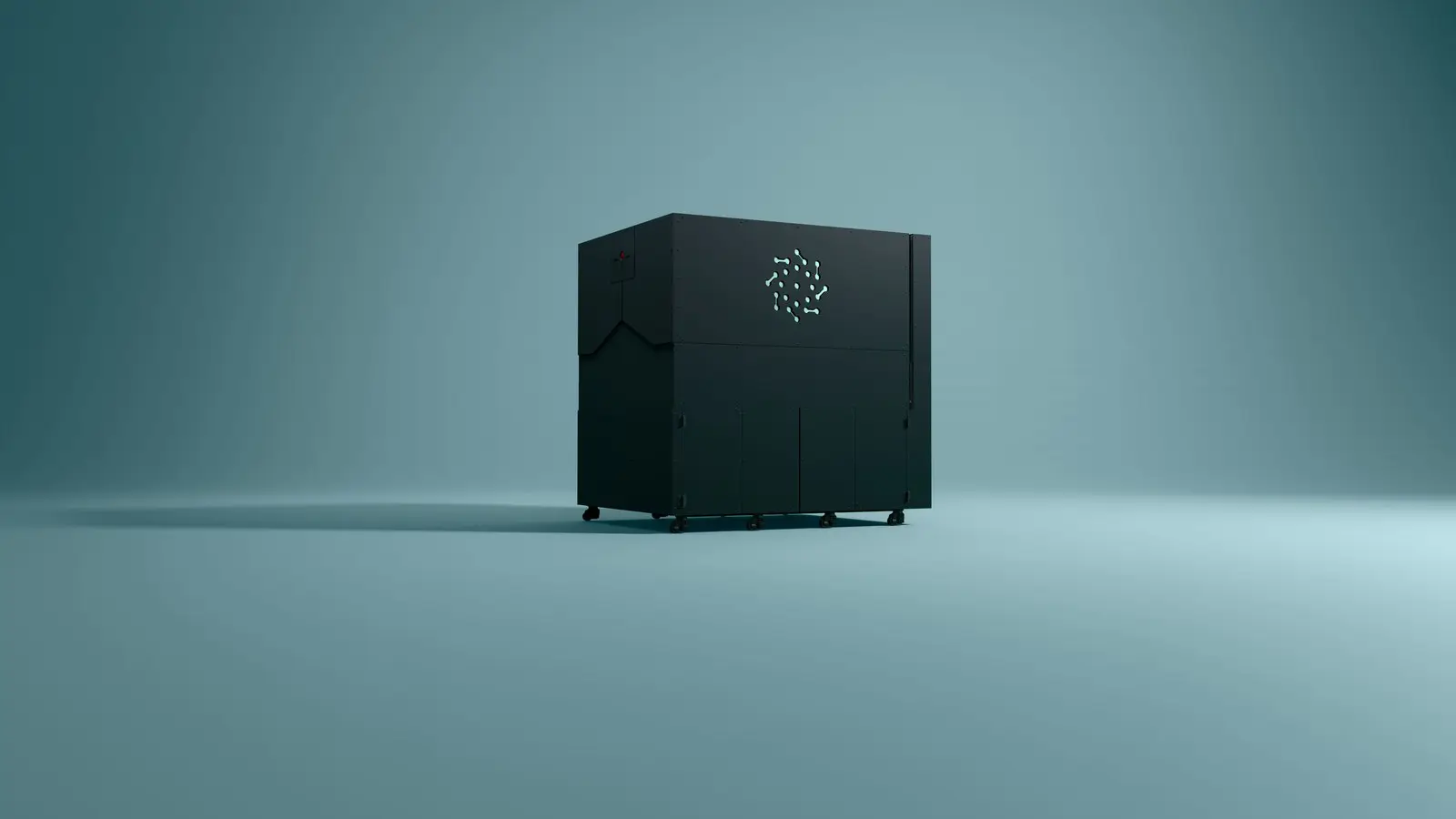
1. A neutral-atom quantum computer company. Pasqal holds individual atoms in place with focused laser beams and uses them as qubits. Every atom of a given element is identical, so there is no manufacturing variation between qubits to calibrate away. The machines need no dilution refrigerator, which is why the company sells them as data centre equipment.
2. Founded in 2019 out of the Institut d’Optique. Thierry Lahaye, Antoine Browaeys, Georges-Olivier Reymond and Christophe Jurczak founded the company south of Paris. The science behind it was published over the preceding four decades in Nature, Nature Physics and Physical Review X. The founders are the people who produced those papers.
3. A Nobel laureate chairs the board. Co-founder Alain Aspect shared the 2022 Nobel Prize in Physics for his experiments on entangled photons, including the 1982 test of Bell’s inequalities. He chairs the board of the listed company without holding an executive job. That keeps the founding science visible without putting a physicist in charge of operations.
4. Listed by merger, not by flotation. The company combined with Bleichroeder Acquisition Corp. II rather than holding a conventional initial public offering. Regulators cleared the registration statement on 6 August 2026 and the deal closed on 27 August. About $360 million of cash came with it.
5. Seven machines out, three being built. Pasqal states seven quantum processing units deployed and three more in production as of August 2026. Named customers include Saudi Aramco, Crédit Agricole CIB and LG Electronics. Aramco put one inside its own Dhahran data centre in November 2025, which is a harder commitment than cloud access.
- What Pasqal actually builds
- The physics that arrived before the company
- How the company was assembled in 2019
- The machines Pasqal sells today
- From one laboratory machine to a working fleet
- Why Saudi Arabia matters more than its size suggests
- The route to Nasdaq, step by step
- The board of the public company
- What the money is meant to do
- Where the risks sit
- What to watch over the next year
- Pasqal by the numbers
- Pasqal FAQ
What Pasqal actually builds
A quantum computer needs something physical to hold each bit of quantum information, and most of the industry uses superconducting circuits chilled to near absolute zero, or single ions held in electric fields. Pasqal uses neutral atoms instead. These are ordinary uncharged atoms, held in place by tightly focused laser beams called optical tweezers.
The appeal is that atoms are free and identical. Every atom of a given element is exactly like every other one, so there is no manufacturing variation to calibrate away. Adding qubits means trapping more atoms rather than fabricating a larger chip, and the machines run without the dilution refrigerators superconducting systems need, which is why Pasqal sells them as data centre equipment.

Atoms are made to interact through the Rydberg blockade, an effect where pushing one atom into a very large orbit stops its neighbour doing the same. That interaction is the mechanism behind the company’s quantum gates. It is also the effect that one of its own founders first demonstrated between individual atoms in 2009, a full decade before there was a company to use it.
Pasqal sells a single hardware platform that runs in two modes, and analog operation, where the atoms are arranged to imitate the physics of a problem directly, works today. Digital, error-corrected operation is the roadmap. The company is explicit that it is a future capability rather than a current one.
The physics that arrived before the company
Pasqal is unusual among quantum hardware firms because its founding science is documented and decades old. The company’s own history page traces a line from 1982 to 2021, and the papers behind it were published in Nature, Nature Physics and Physical Review X.
In 1982 Alain Aspect ran the experiment that broke Bell’s inequalities. It showed that quantum correlations cannot come from particles carrying fixed values set in advance, and the work earned a share of the 2022 Nobel Prize in Physics forty years later.
In 2001 Georges-Olivier Reymond trapped a single atom in an optical tweezer and held it there. Nature published the work. That is the technique the whole platform rests on, and Reymond went on to become the company’s founding chief executive.
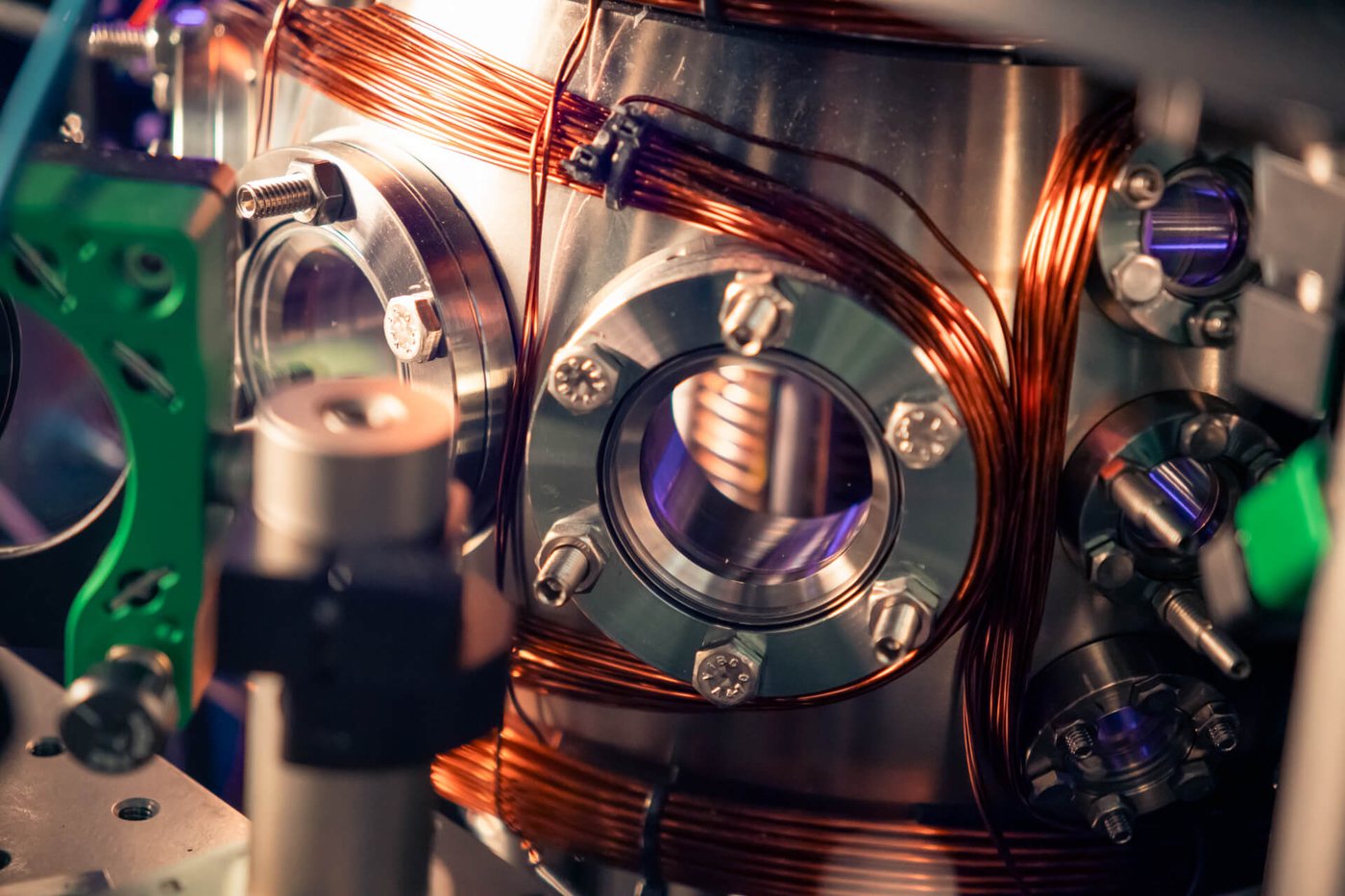
Antoine Browaeys showed the first Rydberg blockade between single atoms in 2009. Nature Physics carried the result. Thierry Lahaye and Browaeys then ran a 30-qubit quantum simulation in 2016 and a 49-qubit, 72-atom three-dimensional arrangement in 2018, published in Nature and Physical Review X.
The pattern is worth noticing. Each step was a laboratory result with a named paper behind it. The company was assembled from the people who produced them, not from a business plan that went looking for a technology.
How the company was assembled in 2019
Pasqal was founded in 2019 as a spin-out from the Institut d’Optique, by Thierry Lahaye, Antoine Browaeys, Georges-Olivier Reymond and Christophe Jurczak. Alain Aspect is a co-founder and chairs the scientific advisory board.
Reymond was chief executive from 2019 to 2025. Those six years covered the move from lab bench to shipped machines. He remains on the board and is now chief strategic alliances officer, which is a more orderly founder transition than this industry usually manages.
Wasiq Bokhari is the current chief executive. He previously served as the company’s president and executive chairman, and before that held leadership roles at Amazon and Google. The sequence matters because it means the person who took the company public had already been inside it, rather than being recruited for the listing.
- 1982Alain Aspect demonstrates a violation of Bell’s inequalities, work that shares the 2022 Nobel Prize in Physics.
- 2001Georges-Olivier Reymond traps a single atom in an optical tweezer and holds it there.
- 2009Antoine Browaeys shows the first Rydberg blockade between two single atoms.
- 2016Lahaye and Browaeys run a 30-qubit quantum simulation on an atom array.
- 2018A 49-qubit, 72-atom three-dimensional arrangement is published.
- 2019Pasqal is founded as a spin-out from the Institut d’Optique, south of Paris.
- 2024An Orion machine, named Jade, is deployed at the Jülich Supercomputing Centre in November.
- 2025Aramco switches on Saudi Arabia’s first quantum computer at Dhahran in November. Wasiq Bokhari becomes chief executive.
- 2026Shares begin trading on Nasdaq under PSQL on 28 August, two days after the merger closed.
The machines Pasqal sells today
The company sells three named systems, and only one of them exists as a product a customer can buy and run now. Reading the roadmap in that order is the quickest way to see what is real and what is still a promise.
Orion Gamma is the machine in production. It is the system behind the deployed fleet and the one reachable through the company’s cloud, and Pasqal puts it at more than 140 qubits for production testing and early utility work.
Vela is the next step, at more than 200 qubits, aimed at analog simulation, optimisation and materials work. The company is taking orders during 2026 and says deliveries start in 2027, but nothing has shipped yet, so the qubit count is a specification rather than a measurement.
Centaurus is the one that carries the error-correction claim, at more than 500 qubits, blending analog work with early fault-tolerant operation. Pasqal targets availability in 2028. That is far enough out that it should be read as a direction of travel.
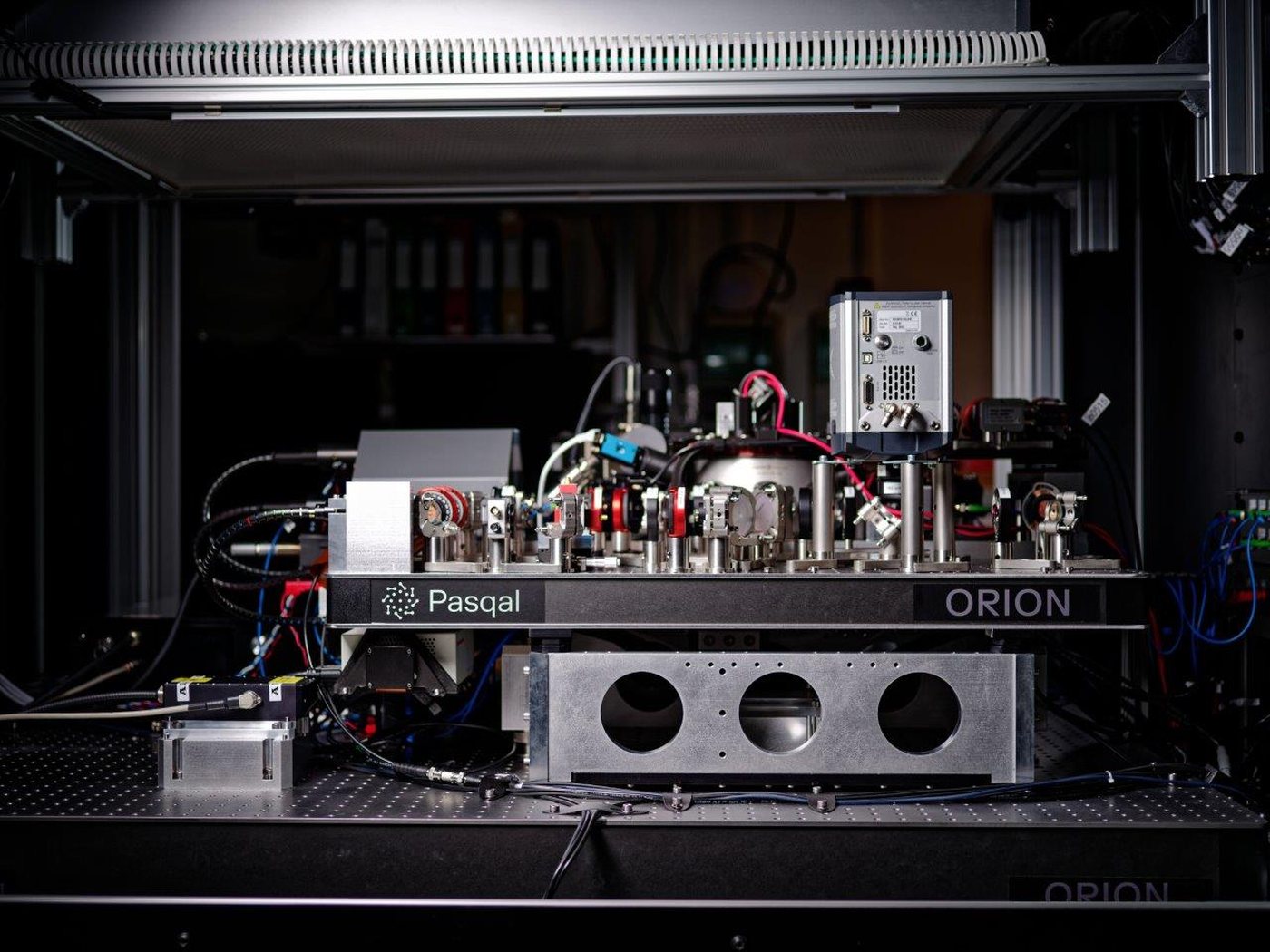
Two integration claims sit alongside the hardware and are easier to check than qubit counts. Pasqal says jobs are submitted through Slurm, the scheduler most supercomputing centres already run, and that the machines support Qiskit and CUDA-Q, so a customer’s existing staff can operate the machine without learning a new stack.
The scaling claim is the one to hold lightly. The company says it anticipates no major near-term obstacle to reaching 10,000 physical qubits and beyond. That is a statement about its own engineering roadmap, not a published result, and the honest way to read it is as the company’s view of its own risk.
From one laboratory machine to a working fleet
The company states seven quantum processing units deployed and three more in production as of August 2026, and says it supports more than 25 commercial and research applications. Those run across energy, financial services and materials science.
Those machines are reachable two ways. Some sit on a customer site, and others are available through cloud access, which lets an organisation run work on a quantum computer without owning one. Pasqal describes its installed base as among the largest of any pure-play quantum computing company. That claim rests on how you count a complex machine, so treat it as the company’s own framing.
The European public sector took delivery early. An Orion machine named Jade went into the Jülich Supercomputing Centre in Germany in November 2024 and was formally inaugurated a year later, as the HPCQS project that funded it wound up. A machine installed inside a national supercomputing centre is a different kind of customer from a bank running a pilot.
Named commercial customers include Saudi Aramco, Crédit Agricole CIB and LG Electronics. Pasqal also lists work with Thales, Sumitomo, BMW Group, Capgemini and KAIST, and has partnerships with NVIDIA and IBM as part of the IBM Quantum Network. Quantum Zeitgeist has covered several of these individually, including work with Aeponyx to move qubit control onto a chip and a training programme sponsored with CERN.
Why Saudi Arabia matters more than its size suggests
On 24 November 2025 Aramco and Pasqal switched on the first quantum computer in Saudi Arabia. It sits in Aramco’s data centre in Dhahran, and both companies described it as the first quantum computer in the region dedicated to industrial applications rather than research.
That deployment is a reference customer in the strictest sense. An oil and gas major put a quantum computer inside its own data centre rather than accessing one remotely, which is a harder commitment and a more useful proof than a cloud pilot.
The relationship then widened. On 24 August 2026 Pasqal and Eleven Ventures announced a commercial joint venture, covering quantum and artificial intelligence computing across Saudi Arabia and the wider Middle East. Quantum Zeitgeist covered the plan to build machines in the Kingdom. The company now runs a Middle East headquarters in Riyadh alongside its French base.
The route to Nasdaq, step by step
Pasqal did not hold a conventional initial public offering. It merged with Bleichroeder Acquisition Corp. II, a special purpose acquisition company, which is a listed shell that raises money from investors and then finds a private business to combine with. Bleichroeder’s own initial public offering closed on 8 January 2026.
The final steps ran fast. Regulators cleared the registration statement on 6 August 2026, the vote was called on 20 August and carried on 25 August, and the combination completed two days after that. Three weeks, start to finish.
After a series of mergers between Bleichroeder and Pasqal Holding SAS, the surviving company became Pasqal Holding SA and kept the Pasqal name. Bleichroeder’s Class A ordinary shares, warrants and units ceased trading, and the new shares and warrants were expected to start on 28 August 2026.
Quantum Zeitgeist tracked the closing stages, including the shareholder vote and the first day of trading. The compressed timetable is normal for this kind of deal, where the disclosure work happens months before the vote and the final steps run in days.
The board of the public company
The board has nine members, a majority of them independent under Nasdaq and regulator rules according to the company, and Alain Aspect chairs it without holding an executive job. That keeps the founding science visible while the operating decisions sit elsewhere.
Michel Combes is lead independent director. He runs Lambda and chairs Brightspeed, and before that he led SoftBank Group International, Sprint, Altice and Alcatel-Lucent in turn. That is a telecoms career rather than a quantum one, which is probably the point of the appointment.
Three directors chair the committees. Jean Raby takes audit, Andrew Gundlach takes compensation, and Barbara Dalibard takes nominating and governance. Raby is a partner at Astorg and once ran Natixis Investment Managers, while Dalibard chairs the Michelin supervisory board and has led SITA, SNCF Voyageurs and Orange Business Services. Gundlach heads Bleichroeder LP, the firm behind the shell company that brought Pasqal to market.
Two seats reflect the company’s European public funding. Nicolas Berdou sits for Bpifrance, the French state investment bank, and Jean Raby is the designee of the EIC Fund, which is the European Innovation Council’s investment arm. Michael Blitzer, who founded and chairs Inflection Point Asset Management, and Georges-Olivier Reymond complete the board.
What the money is meant to do
The company named five uses for the money. It wants to build and deploy more processors, push the roadmap toward error-corrected machines, and widen access to its cloud platform. The last two are tying the hardware more closely to conventional supercomputers, and growing the commercial side worldwide.
Read plainly, four of those five are about selling more of what already exists, and only one is about building something that does not yet work. That split is the honest shape of a quantum hardware business in 2026. It is more candid than a roadmap that presents error correction as a delivery date with a quarter attached.
Chief executive Wasiq Bokhari called the listing an acceleration point rather than a finish line, and pointed to systems already running on customer sites. The test over the next several quarters is whether the fleet grows past ten machines. It has to reach a number that makes the manufacturing argument real.
Where the risks sit
The technology risk is narrow, not general. Neutral atoms already work well for analog simulation. The open question is whether the same hardware reaches error-corrected digital computing, which is where the whole industry is headed and where Pasqal says one platform will do both. Results have not settled that yet.
The commercial risk is concentration. A small number of large customers, one of them an oil major and one a regional joint venture, produce a revenue base that moves sharply when a single relationship changes. Concentration is normal at this stage and it is still concentration.
The third risk is the listing itself. Reaching the public market through a shell company brings a shareholder base that was assembled for a transaction rather than for a decade of patient hardware development. The reporting duties start immediately. Quantum hardware timelines do not.
What to watch over the next year
The first thing to watch is the fleet. Pasqal says seven machines are deployed and three more are being built. If that ten becomes fifteen or twenty over the next four quarters, the claim that this is a manufacturing business rather than a research one starts to hold up on its own evidence.
The second is whether Vela ships. The company is taking orders in 2026 for delivery from 2027, so the first customer installation is a dated commitment that can be checked rather than argued about. A slip there matters more than a slip in the 2028 roadmap.
The third is where the machines go. A quantum computer installed inside a customer data centre is a far stronger signal of commitment than one reached over the cloud, because somebody has to house it, power it and staff it. Aramco and Jülich took that first kind. Watch whether anyone else does.
The fourth is the cash. About $360 million is real money for a hardware company and it is also not unlimited, so the useful question at each quarterly report is how fast the balance falls and what arrived in exchange for it.
The last one is quieter. Two board seats belong to European public investors, Bpifrance and the EIC Fund, and the company now answers to a Nasdaq shareholder register as well. Those two groups do not always want the same thing, and how that tension resolves will show up in where the machines are built.
Pasqal by the numbers
| Figure | Value | As stated |
|---|---|---|
| Nasdaq ticker | PSQL | Ordinary shares, from 28 August 2026 |
| Warrant ticker | PSQLW | Same date |
| Cash at closing | about $360m | Company statement, 27 August 2026 |
| Shell company | Bleichroeder II | Traded as BBCQ; its IPO closed 8 January 2026 |
| Registration effective | 6 August 2026 | Declared effective by the SEC |
| Shareholder approval | 25 August 2026 | Bleichroeder shareholders |
| Completion | 27 August 2026 | Business combination closed |
| Founded | 2019 | Spin-out from the Institut d’Optique |
| Machine in production | Orion Gamma | More than 140 qubits, company specification |
| Next machine | Vela | More than 200 qubits, orders 2026, deliveries from 2027 |
| Machine after that | Centaurus | More than 500 qubits, targeted for 2028 |
| Processors deployed | 7 | Plus 3 in production, August 2026 |
| Applications supported | more than 25 | Commercial and research, company statement |
| Employees | 275+ | Of whom 70 hold doctorates |
| Board | 9 directors | Majority independent under SEC and Nasdaq rules |
Every figure above is dated because most of them will move. A cash balance, a fleet count and a headcount are all snapshots, and a page that states them without a date becomes wrong quietly.
Pasqal FAQ
What is Pasqal’s stock ticker?
Pasqal Holding SA trades on Nasdaq under the ticker PSQL. Its warrants trade separately under PSQLW. Both were expected to begin trading on 28 August 2026.
How did Pasqal go public?
It merged with Bleichroeder Acquisition Corp. II, a special purpose acquisition company, rather than holding a conventional initial public offering. Shareholders approved the deal on 25 August 2026 and it completed on 27 August.
How much money did Pasqal raise?
The company stated that approximately $360 million of cash was available at closing. That figure is the combined result of the transaction rather than a single funding round.
Who founded Pasqal?
Thierry Lahaye, Antoine Browaeys, Georges-Olivier Reymond and Christophe Jurczak founded the company in 2019. Alain Aspect is a co-founder and chairs the scientific advisory board.
Is Pasqal connected to a Nobel Prize?
Yes. Co-founder Alain Aspect shared the 2022 Nobel Prize in Physics for experiments with entangled photons, including his 1982 test of Bell’s inequalities. He chairs the company’s board in a non-executive capacity.
What quantum computers does Pasqal sell?
Orion Gamma is the system in production, which the company puts at more than 140 qubits. Vela follows at more than 200 qubits, with orders in 2026 and deliveries from 2027. Centaurus is targeted for 2028 at more than 500 qubits.
What makes neutral-atom quantum computing different?
Neutral atoms are held in place by focused laser beams rather than fabricated on a chip. Every atom is identical, so there is no manufacturing variation between qubits, and the machines do not need the dilution refrigerators that superconducting systems require.
How many quantum computers does Pasqal have?
The company stated seven quantum processing units deployed and three more in production as of August 2026. Some sit on customer sites and others are reachable through cloud access.
Who are Pasqal’s customers?
Named customers include Saudi Aramco, Crédit Agricole CIB and LG Electronics. Aramco installed Saudi Arabia’s first quantum computer at its Dhahran data centre in November 2025, and a machine named Jade runs at the Jülich Supercomputing Centre in Germany.
Who runs Pasqal?
Wasiq Bokhari is chief executive, having previously been president and executive chairman. Georges-Olivier Reymond was the founding chief executive from 2019 to 2025 and remains a director and chief strategic alliances officer.
Disclaimer. This article is for informational purposes only and does not constitute investment, financial or professional advice. The quantum technology industry evolves rapidly and information may become outdated. Always conduct your own research and consult qualified advisers before making investment decisions. Investing in quantum computing companies involves significant risk, including the potential loss of your entire investment, and past performance is not indicative of future results.



See today’s quantum computing news on Quantum Zeitgeist for the latest breakthroughs in qubits, hardware, algorithms, and industry deals.