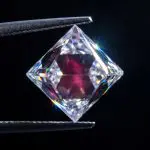
Tohoku University researchers are using a flaw in diamond to precisely measure stress within microscopic devices. The team intentionally created nitrogen vacancy centers, defects in a diamond crystal lattice, and integrated them directly into a micro-electromechanical system (MEMS) cantilever.
This approach utilizes optically detected magnetic resonance, a technique sensitive to both magnetic fields and mechanical stress, to track bending in the tiny structure; the researchers report the NV centers reacted to changes in cantilever vibrations, probing the changing stress state. “The most exciting aspect of this work is that the quantum sensor is formed as part of the MEMS fabrication process itself,” says Masaya Toda of Tohoku University.
Integrated Diamond Cantilever Measures Dynamic Bending Resonance
The ability to measure stress within microscopic mechanical systems has taken a step forward through the integration of diamond defects as sensors; researchers demonstrated that nitrogen-vacancy centers respond dynamically to cantilever vibrations, not just static deformation. This responsiveness allows for probing the changing stress state of a vibrating microelectromechanical system, or MEMS, structure, a capability previously limited by sensor attachment methods. The team fabricated a single-crystal diamond MEMS cantilever incorporating an ion-implantation-induced defective layer and a graphite sacrificial layer, creating a structure where the quantum sensor is integral to the device itself.
Changes in cantilever vibration directly influence the resonance frequency of the NV centers, shifting them in opposite directions; this effect was observed under both tensile and compressive stress, confirming the sensor’s functionality. “We were able to show that this integrated NV-center region functions as an effective stress sensor, responding as expected to both tensile and compressive bending,” said a member of the research team. The ODMR technique, or optically detected magnetic resonance, is central to this achievement, as its resonance frequency is sensitive to magnetic fields, temperature, and mechanical stress, providing a multi-parameter detection method. Detailed analysis revealed a clear relationship between bending stress and the observed ODMR frequency shift, further validating the sensor’s precision. The study, published in Functional Diamond on August 28, 2026, details the observed resonance frequency shifts under both tensile and compressive stress, demonstrating the sensor’s ability to detect dynamic bending.
Researchers synchronized periodic frequency shifts with the vibration phase, confirming the sensor’s responsiveness to the cantilever’s movement. Future work will focus on improving the accuracy of the system, potentially opening avenues for real-time monitoring and control of microscopic devices in diverse applications. The team hopes to refine the technique for broader implementation in MEMS technology, offering a new approach to stress analysis at the microscale.
The most exciting aspect of this work is that the quantum sensor is formed as part of the MEMS fabrication process itself.
Masaya Toda, Tohoku University
These NV centers form the core of a new stress sensor, using a flaw to achieve precision measurement, and are crucial for detecting not just the presence of stress, but also if that stress is changing and its type. Optically detected magnetic resonance, or ODMR, is the detection method, revealing shifts in resonance frequency correlated to both tensile and compressive bending stress. The team intends to refine the system’s accuracy in future studies, potentially opening avenues for real-time monitoring of stress states in increasingly compact and integrated devices, and the researchers can be contacted via email at toda@tohoku. ac. jp or through the website https://www. nme. mech. tohoku. jp/index_e.html.
We were able to show that this integrated NV-center region functions as an effective stress sensor, responding as expected to both tensile and compressive bending.


See today’s quantum computing news on Quantum Zeitgeist for the latest breakthroughs in qubits, hardware, algorithms, and industry deals.