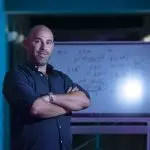
University of Chicago Professor David Awschalom received the Falling Walls Science Breakthrough of the Year award in Physical Sciences for work bridging quantum technology with molecules and proteins. The Berlin-based Falling Walls Foundation recognized Awschalom’s nearly decade-long effort to create qubits from biological building blocks, a project that could refine disease detection and treatment.
This research overcomes a significant hurdle by uniting the atomic precision demanded by quantum technology with the inherent unpredictability of biology and chemistry. “This research highlights the immense potential at the intersection of quantum science and molecular biology,” said Julian Solway, MD, of the University of Chicago.
Molecular and Protein Qubits: Bridging Quantum Tech and Biology
Creating qubits from genetically encodable proteins represents an advancement in the field, allowing for the development of quantum systems directly within living systems. This innovation, spearheaded by David Awschalom and Peter Maurer of the University of Chicago Pritzker School of Molecular Engineering, circumvents traditional qubit fabrication methods by using biological processes for qubit generation. The cell itself produces these proteins, designed to bind to specific targets inside living systems, opening possibilities for precision in biomedical imaging and sensing.
Awschalom’s approach deliberately shifted away from conventional “top-down” solid-state qubit manufacturing, which relies on refining bulk materials, toward a “bottom-up” strategy. “You simply change the factory,” Awschalom said, explaining the move to build qubits like growing plants rather than meticulously processing existing materials.
This transition, initiated with a 2017 Vannevar Bush Faculty Fellowship, required bridging synthetic chemistry with quantum engineering, a challenge Danna Freedman, now at the Massachusetts Institute of Technology, described as demanding but ultimately rewarding. “Creating molecular qubits required us to bridge synthetic chemistry with quantum engineering in ways that hadn’t been done before, but seeing these risks pay off opens extraordinary new frontiers for physics, biology, and medicine.” The initial 2020 breakthrough involved engineering synthetic molecules controllable as qubits, followed by molecular qubits that integrated magnetism, light, and telecommunications wavelengths through collaboration with Jeffrey Long at the University of California, Berkeley. The nearly decade-long effort involved significant persistence, with years often passing between experimental setbacks and key achievements.
Awschalom credits the dedication of his graduate students and the strength of interdisciplinary collaborations for overcoming these hurdles. “It’s a testament to our extraordinary graduate students who had the courage to stick with projects that failed for years, the strong interdisciplinary collaborations that bring together a wide variety of expertise, and the funding avenues that allowed us to really explore the possibilities.” Julian Solway, Emeritus Professor of Medicine at the University of Chicago, highlighted the potential for observing cellular dynamics and disease processes at a new scale.
Awschalom emphasized the necessity of diverse skillsets in modern scientific discovery. “One could never accomplish this without strong collaborations.
In modern science, you need many different skillsets to make boundary-pushing discoveries.” He further noted the increasing prevalence of impactful science emerging from the intersections of traditionally separate fields, such as physics, chemistry, and biology.
“These days a great deal of important science emerges from the areas between the traditional spaces—for instance, where physics intersects chemistry, which intersects biology, and so on.” Awschalom will present these findings at the Falling Walls Science Summit in Berlin this November, recognizing the research as a demonstration of how a willingness to take risks and collaborate can lead to significant breakthroughs.
Creating molecular qubits required us to bridge synthetic chemistry with quantum engineering in ways that hadn’t been done before, but seeing these risks pay off opens extraordinary new frontiers for physics, biology, and medicine.
See today’s quantum computing news on Quantum Zeitgeist for the latest breakthroughs in qubits, hardware, algorithms, and industry deals.