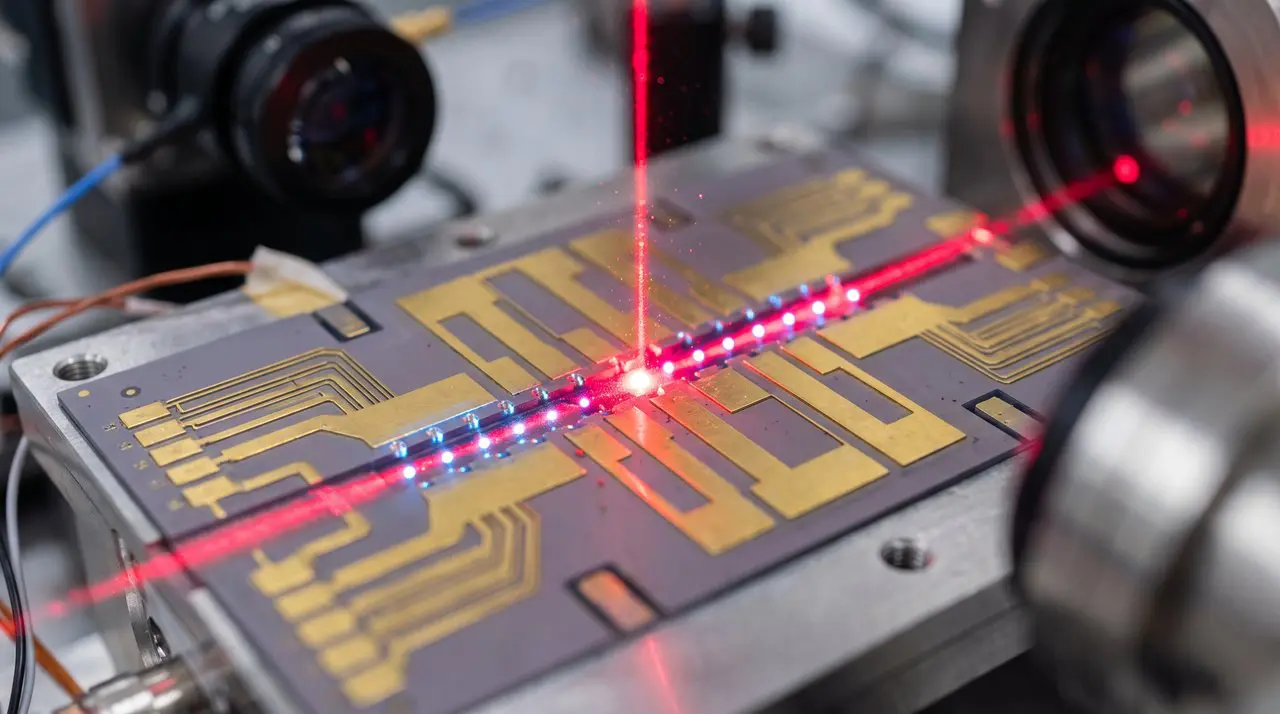
Anthropic’s Claude, an AI agent, now recovers QuEra Computing’s laser system in seconds, a task previously requiring minutes of work from a human specialist. QuEra’s systems rely on precisely tuned lasers to control atomic qubits, and these lasers inevitably drift, halting computation until manually retuned. The company reports that the AI developed and validated its own control logic through the Model Hardware Standard research preview, achieving reliable recovery across multiple failure types. “Every generation of machine carries more lasers than the last,” and this automation marks a step toward self-operating quantum computers for QuEra’s customers.
Claude AI Automates QuEra Quantum Laser System Recovery
This advancement, enabled by Anthropic’s Claude AI agent operating within the Model Hardware Standard research preview, marks a step toward self-maintaining quantum computers and scalable deployments. The AI not only restored laser function but also demonstrably improved its stability, exceeding the performance of manual tuning by a human expert. Lasers controlling atomic qubits inevitably drift, halting computation until manually recalibrated, and this automation addresses a critical bottleneck in quantum computing.
QuEra’s team previously spent up to two to three weeks developing recovery scripts for complex laser failures, limited by the time and expertise available. Engineers maintained oversight, defining scope and verifying success, but the AI performed the core problem-solving. The resulting software is a conventional program, allowing for full inspection and ensuring operational safety through built-in system limits and emergency stops.
In rigorous testing, the AI successfully recovered the laser system in 695 of 700 trials across seven fault types, completing the process in under six seconds for most instances and within 14 seconds for the most challenging. Importantly, the system handled real-world disturbances present in a working laboratory environment, recovering reliably regardless of the cause. Beyond simple recovery, the AI also enhanced laser lock quality, reducing residual noise by a factor of five and eliminating dropouts during unattended operation.
“For years the hardest part of scaling quantum computers wasn’t the physics, it was the people driving at 2 am to fix a laser lock,” said Sergio Cantu, Vice President of Quantum Systems at QuEra Computing. “We built a solution using the Model Hardware Standard to fix that: the lock recovers itself in seconds, verified every time, catching noise that’s easy to miss by hand. We’re building quantum computers that fix themselves.”
QuEra intends to extend this AI-driven automation to other complex subsystems within its quantum computers, reducing reliance on specialized personnel and lowering operational costs. Takuya Kitagawa, President of QuEra, explained, “We are among the best in the world at developing and operating quantum computers, and even for us, the cost of keeping these machines at peak performance is high.” He continued, “A customer expects the entire computer, and thus every subsystem, to hold itself together without a specialist in the room.
This is why the results from the MHS research preview and Anthropic’s frontier AI models are so meaningful. We are making it far easier and cheaper to keep our computers running at their best.” The successful pilot establishes a framework for future AI integrations, potentially accelerating the deployment of commercial-grade quantum computing systems.
For years the hardest part of scaling quantum computers wasn’t the physics, it was the people driving at 2 am to fix a laser lock. We built a solution using the Model Hardware Standard to fix that: the lock recovers itself in seconds, verified every time, catching noise that’s easy to miss by hand. We’re building quantum computers that fix themselves.
Sergio H. Cantu, Vice President of Quantum Systems, QuEra Computing

See today’s quantum computing news on Quantum Zeitgeist for the latest breakthroughs in qubits, hardware, algorithms, and industry deals.