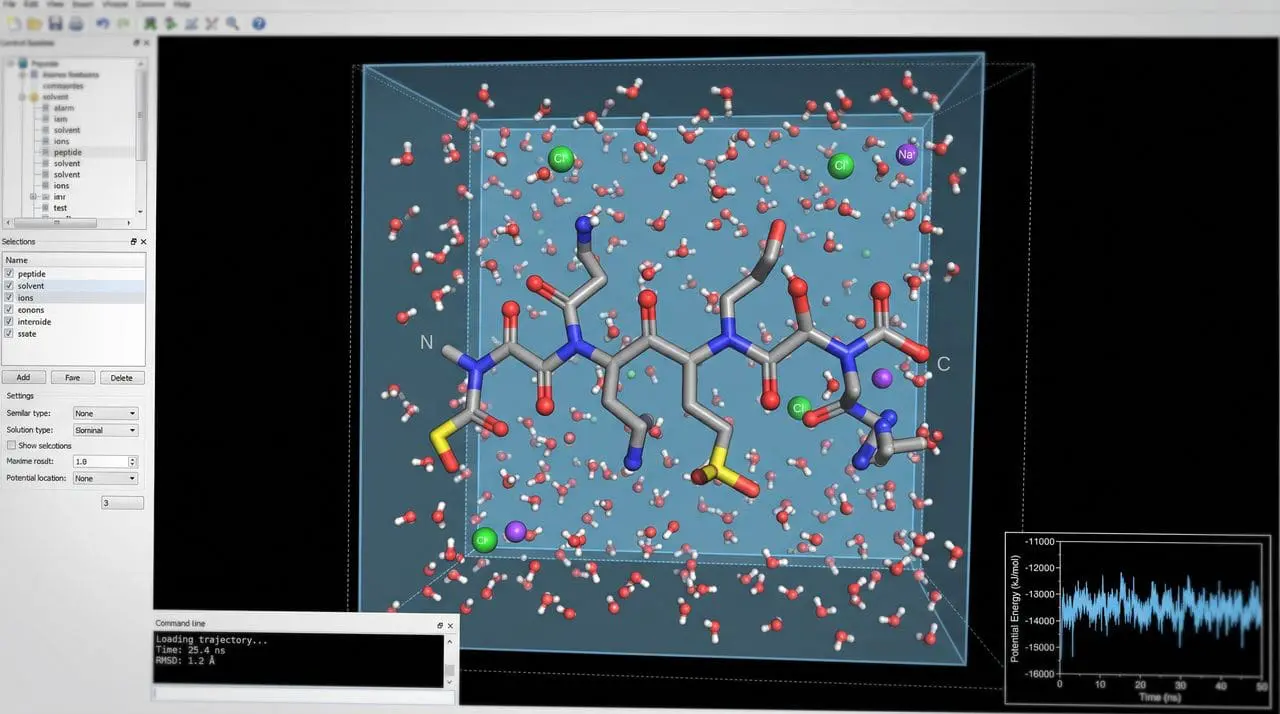
Researchers at Soongsil University and collaborating institutions have demonstrated a hybrid quantum-classical approach for calculating molecular ground-state energies using Sample-Based Quantum Diagonalization (SQD). The study evaluates the molecular systems HeH⁺, ArH⁺, and H₂O, showing that the technique can accurately reproduce potential-energy curves while operating within the capabilities of today’s quantum hardware. The results demonstrate that SQD can achieve accuracy comparable to established quantum chemistry methods, highlighting its potential as a practical tool for studying increasingly complex molecular systems on near-term quantum computers.
Until now, accurate ground-state energy calculations for molecules required computationally demanding methods like coupled-cluster singles and doubles (CCSD). The deviations from complete active space configuration interaction references were as low as 0.00 mHa for HeH^+, demonstrating the accuracy of this new approach for benchmark systems. The team successfully applied SQD to helium hydride ion, argon hydride ion, and water, validating its potential for broader use in understanding molecular behaviour and astrophysical systems.
Unlike traditional methods, such as coupled-cluster singles and doubles (CCSD), which are akin to painstakingly assembling a complex jigsaw puzzle requiring significant computational resources, SQD builds up a picture of a molecule’s lowest energy state by taking many ‘snapshots’ from a quantum computer and combining them, much like creating a detailed mosaic from individual tiles. This is particularly significant as CCSD, while highly accurate, scales poorly with system size, becoming intractable for all but the smallest molecules.
The team successfully applied SQD to helium hydride ion, argon hydride ion, and water, achieving deviations from benchmark calculations as low as 0.00 mHa for helium hydride ion. This demonstrates the potential of SQD for complex systems and offers a pathway to overcome the limitations of classical methods. These calculations are crucial for understanding molecular behaviour in fields like astrophysics, where accurate knowledge of molecular energies is vital for modelling interstellar environments. However, can SQD scale to tackle even larger and more intricate molecules, pushing the boundaries of what’s possible with near-term quantum devices.
Highly accurate molecular energies computed via quantum hardware demonstrate scalable potential
Deviations from complete active space configuration interaction (CASCI) references reached as low as 0.00 mHa for , a level of accuracy previously unattainable without computationally expensive methods like coupled-cluster singles and doubles (CCSD). Ground-state potential-energy curves for , and H2O were successfully computed, validating SQD’s feasibility for increasingly complex molecular systems and opening avenues for advancements in fields like astrophysics and quantum chemistry.
The method achieved deviations of 2.51 milli-Hartree (mHa) for and 6.34 mHa for H2O when compared to CASCI references, utilising the cc-pVDZ basis set. The choice of the cc-pVDZ basis set represents a balance between accuracy and computational cost, providing a reasonable level of description for these relatively small molecules. CASCI, while considered a ‘gold standard’ for accuracy, is also computationally demanding, making SQD a potentially valuable alternative for larger systems where CASCI becomes impractical.
The calculations closely mirrored the energies obtained using CCSD, validating its applicability beyond simple diatomic ions to more complex polyatomic systems like water. Bitstrings, the fundamental units of quantum information, were generated on IBM quantum hardware using shallow circuits, reducing the demands on current quantum technology. Shallow circuits are crucial for near-term quantum devices as they minimise the impact of decoherence, a major source of error in quantum computations.
However, these results are currently limited to small molecular systems and do not yet demonstrate scalability to the larger, chemically relevant molecules needed for practical applications. Further research will need to focus on optimising the SQD algorithm and exploring techniques to reduce the number of quantum bits (qubits) required to achieve a given level of accuracy. This hardware-assisted technique offers a flexible alternative to traditional methods, promising more efficient and accurate molecular simulations, and potentially enabling the study of chemical reactions and molecular properties that are currently beyond the reach of classical computers.
Hybrid quantum-classical method streamlines molecular energy calculations
Molecular simulations underpin advances across diverse fields, from designing novel materials to understanding the origins of life in interstellar space. Accurate molecular energies are fundamental to these simulations, influencing predictions of reaction rates, molecular structures, and material properties. The technique accurately models small but important molecules such as helium hydride and water, and paves the way for tackling more complex chemical systems with future quantum hardware improvements.
Helium hydride ion (HeH^+) is of particular interest to astrophysicists as it is believed to have played a crucial role in the formation of the first molecules in the early universe. Water, of course, is essential for life as we know it, and accurate modelling of its properties is vital for a wide range of applications.
While classical computations initiate the process, presenting a fundamental tension between classical pre-processing and quantum computation, this does not diminish the significance of the work; it represents a pragmatic approach to leveraging the strengths of both classical and quantum computing.
This hybrid approach bypasses the need for complex quantum circuits favoured by some approaches like Variational Quantum Eigensolver (VQE), which often require deep, parameterised circuits and extensive optimisation, but isn’t yet a fully self-contained quantum solution, offering a viable pathway towards fully quantum calculations of molecular energies. VQE, while promising, can be susceptible to issues like barren plateaus, where the optimisation landscape becomes extremely flat, making it difficult to find the optimal parameters.
Using this new method, ground-state potential-energy curves for helium hydride ion, argon hydride ion, and water were successfully computed. It reconstructs essential molecular energy information directly from data gathered on quantum hardware, differing from other approaches requiring complex quantum circuits. Deviations of up to 6.34 milli-Hartree from benchmark calculations confirm its accuracy for these systems and validates its potential beyond simple diatomic molecules, demonstrating its ability to accurately predict molecular properties.
The ability to accurately predict molecular properties is crucial for a wide range of applications, including drug discovery, materials science, and environmental modelling. Results closely matched those from established computational methods, with deviations of up to 6.34 milli-Hartree, validating the technique for systems beyond simple diatomic molecules. The authors suggest this work represents a pragmatic step towards fully quantum calculations of molecular energies, utilising both classical and quantum computing strengths.
👉 More information
🗞 Ground-State Energy Estimation of HeH+, ArH+, and H_2O via Sample-Based Quantum Diagonalization
✍️ Jubin Park, Chae-Hyun Yoon, Minkyu Lee and Myung-Ki Cheoun
🧠 ArXiv: https://arxiv.org/abs/2608.06415



See today’s quantum computing news on Quantum Zeitgeist for the latest breakthroughs in qubits, hardware, algorithms, and industry deals.