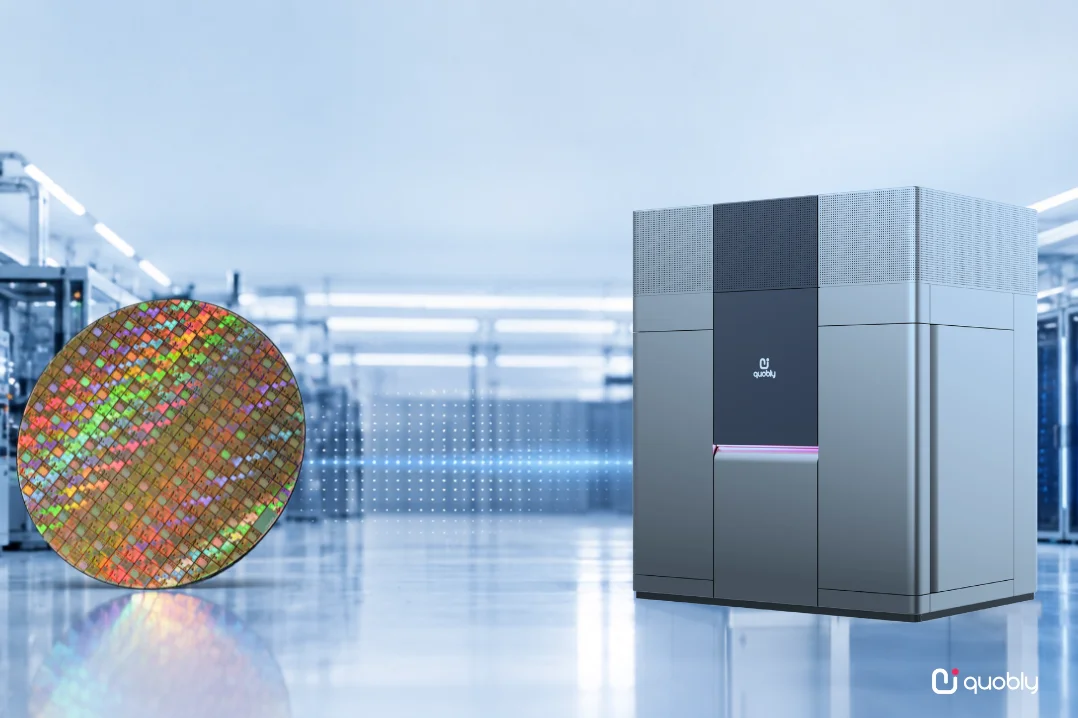
Quobly has demonstrated key quantum operations, single-qubit gates, two-qubit gates, and qubit readout, on a single quantum chip fabricated within STMicroelectronics’ 300 mm manufacturing facilities in Crolles, France, the company says. This achievement marks a step toward scalable quantum computing by proving these operations are possible within a standard semiconductor production environment.
The company’s QSOI technology combines silicon spin qubits with FD-SOI transistors, designed from the outset for industrial manufacturing and large-scale integration. “Having these three basic operations demonstrated on a single QSOI chip is an important step,” said Tristan Meunier, Chief Scientific Officer and co-founder of Quobly, “This validates key elements of the technology transfer and gives us a solid basis for further integration and scaling.”
QSOI Technology Demonstrates Single-Chip Quantum Operations
Silicon spin qubits achieved two-qubit gate operations on a Quobly QSOI chip fabricated within STMicroelectronics’ 300mm production line in Crolles, France, marking a shift toward quantum device manufacturing at a standard semiconductor scale. This fabrication process uses fully depleted silicon-on-insulator (FD-SOI) CMOS technology, integrating silicon spin qubits directly with FD-SOI transistors for on-chip control electronics, a design choice intended to streamline scaling and reduce complexity.
Quobly’s approach differs from superconducting and trapped-ion quantum computing methods by utilizing existing semiconductor infrastructure, potentially lowering production costs and accelerating timelines. The successful demonstration of one- and two-qubit gates alongside qubit readout signifies progress beyond basic qubit control, enabling the execution of more complex quantum computations. Reproducibility across the manufacturing process is paramount for building quantum processors with a high qubit count, and Quobly’s use of an established semiconductor platform addresses this critical need.
The company’s QSOI technology is specifically designed to support consistent device fabrication, manage manufacturing expenses, and facilitate the production of larger processors as the technology matures. “These results are another concrete step in executing our product roadmap,” said Maud Vinet, CEO and co-founder of Quobly.
“We are building QSOI and our Alloy systems to deliver high-performance, large-scale quantum computers that can integrate seamlessly into existing data-center infrastructure and provide a predictable path to scale and return on investment.” Founded in 2022 as a spin-off from CEA-Leti and CNRS in Grenoble, Quobly currently employs approximately 70 people and has secured over €160 million in funding, including a recent €115 million Series A round co-led by Bpifrance, SEALSQ, and STMicroelectronics, according to the company.
Strategic partnerships further bolster Quobly’s development; a collaboration with Entropica Labs focuses on fault-tolerant quantum computing, while an agreement with SEALSQ integrates post-quantum security technologies into silicon quantum computing platforms, demonstrated by a $200M MOU and a $5 million commercial agreement announced in 2026.
The company’s wafers, created with custom 28Si FD-SOI technology from Soitec, entered STMicroelectronics’ 300mm production line in Crolles in December 2025, solidifying the integration of quantum device fabrication into a conventional semiconductor environment. “When we proposed spin qubits in quantum dots in 1998, the open question was never whether one qubit could work; it was whether millions of identical ones could be made,” said Daniel Loss, President of Quobly’s Scientific Advisory Board.
“That is a manufacturing question, and it can only be answered on a production line. Readout, single-qubit and two-qubit gates on one chip from a 300 mm FD-SOI process is the step that moves the spin qubit from the laboratory into the process flow. Reproducing it wafer after wafer is now the task, and it is the right task.”
FD-SOI CMOS Manufacturing Enables Scalable Qubit Production
This achievement bypasses the need for specialized, bespoke fabrication facilities, a critical hurdle for scaling quantum processors beyond experimental prototypes. The technology aims to manage manufacturing variations and ensure consistent device performance across large wafers, a necessity for industrial-scale production. Quobly’s participation in the SPINS EU pilot line consortium, alongside Imec, targets volume production of silicon spin qubits at a CMOS-compatible scale.
Two-Qubit Gates and Readout Validated on QSOI Devices
Fabrication at STMicroelectronics’ 300 mm facilities in Crolles, France, confirmed the viability of quantum operations within a standard semiconductor production environment, a crucial step for scaling quantum computing beyond research labs. Quobly’s QSOI devices built using fully depleted silicon-on-insulator (FD-SOI) CMOS technology, successfully demonstrated two-qubit gates alongside previously validated single-qubit gates and qubit readout, progressing beyond basic qubit control toward functional quantum computations, the firm reports.
This combination on a single chip signifies a move toward more complex quantum algorithms and processing capabilities. The company’s approach prioritizes repeatable fabrication, essential for building processors containing millions of qubits, and utilizes existing semiconductor infrastructure to control manufacturing costs. These partnerships and a $200M MOU with SEALSQ for quantum computing development and a $5 million commercial agreement to integrate post-quantum security technologies position Quobly to deliver high-performance, large-scale quantum computers, integrating advanced control electronics with its QSOI platform.


See today’s quantum computing news on Quantum Zeitgeist for the latest breakthroughs in qubits, hardware, algorithms, and industry deals.