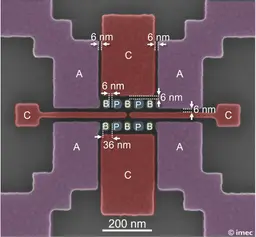
Imec has fabricated a functioning network of qubits with gaps of just 6 nanometers using High NA EUV lithography. This advanced lithography, currently crucial for developing future memory and computer chips, now demonstrates a pathway toward scalable quantum technology. The nanoscale hardware component allows for the theoretical integration of millions of quantum bits onto a single chip, a significant leap toward practical quantum computing scale. “We can leverage decades of semiconductor innovation and reuse the entire ecosystem of silicon scaling, moving quantum devices beyond lab experiments to large-scale, manufacturable systems,” explains Sofie Beyne, project leader and quantum integration engineer at Imec. This development suggests a viable route to utilize existing semiconductor manufacturing for quantum computing, potentially accelerating its progress.
High NA EUV Lithography Fabricates Quantum Dot Qubits
Achieving a functional qubit network with 6 nanometer gaps between components, Imec has demonstrated a significant advance in quantum hardware fabrication using High NA EUV lithography; this precision surpasses previous limitations in qubit density and connectivity. The successful fabrication of this quantum dot qubit device represents a crucial step toward building more reliable qubits, the fundamental building blocks of quantum computers that excel at complex calculations like drug discovery and physical simulations. Imec’s achievement isn’t simply about shrinking qubit size; it’s about establishing a viable route to mass production using established industrial techniques. With revenues of €1.2 billion, Imec’s expertise in semiconductor research and development is now focused on powering breakthroughs across multiple industries, including computing and health, and this latest demonstration underscores the potential for silicon-based qubits to become a dominant force in the future of quantum technology.
Imec Advances Silicon-Based Qubit Scaling for Manufacturability
The pursuit of scalable quantum computing has long faced hurdles in qubit fabrication and integration; current methods often struggle to balance qubit quality with the density needed for practical processing power. Imec’s recent demonstration of a quantum dot qubit device fabricated using High NA EUV lithography addresses this challenge by leveraging technology already central to modern semiconductor manufacturing. This approach bypasses the need for entirely new fabrication facilities, potentially accelerating the timeline for quantum computer development. By achieving 6 nanometer gaps between qubits, a precision previously difficult to attain, Imec has created a functioning network at an incredibly small scale, enabling denser qubit arrays. This advancement isn’t simply about shrinking device dimensions; it’s about establishing a pathway toward mass production, and this reuse of existing infrastructure is a critical factor because building entirely new fabrication plants for quantum devices would be prohibitively expensive and time-consuming.
Imec, a research and innovation hub reporting revenues of €1.2 billion, has demonstrated the potential to bridge the gap between quantum research and industrial production. The company’s expertise in advanced semiconductor technologies, coupled with its collaborative network of global leaders, positions it as a key player in the emerging quantum landscape. This successful application of High NA EUV lithography, a technology crucial for future advanced memory and computer chips, suggests a future where quantum and classical computing technologies are increasingly intertwined and benefit from shared manufacturing processes.
We can leverage decades of semiconductor innovation and reuse the entire ecosystem of silicon scaling, moving quantum devices beyond lab experiments to large-scale, manufacturable systems. This is where silicon-based qubits have a clear advantage”, explains Sofie Beyne, project leader and quantum integration engineer at imec.
Sofie Beyne, project leader and quantum integration engineer at imec



See today’s quantum computing news on Quantum Zeitgeist for the latest breakthroughs in qubits, hardware, algorithms, and industry deals.