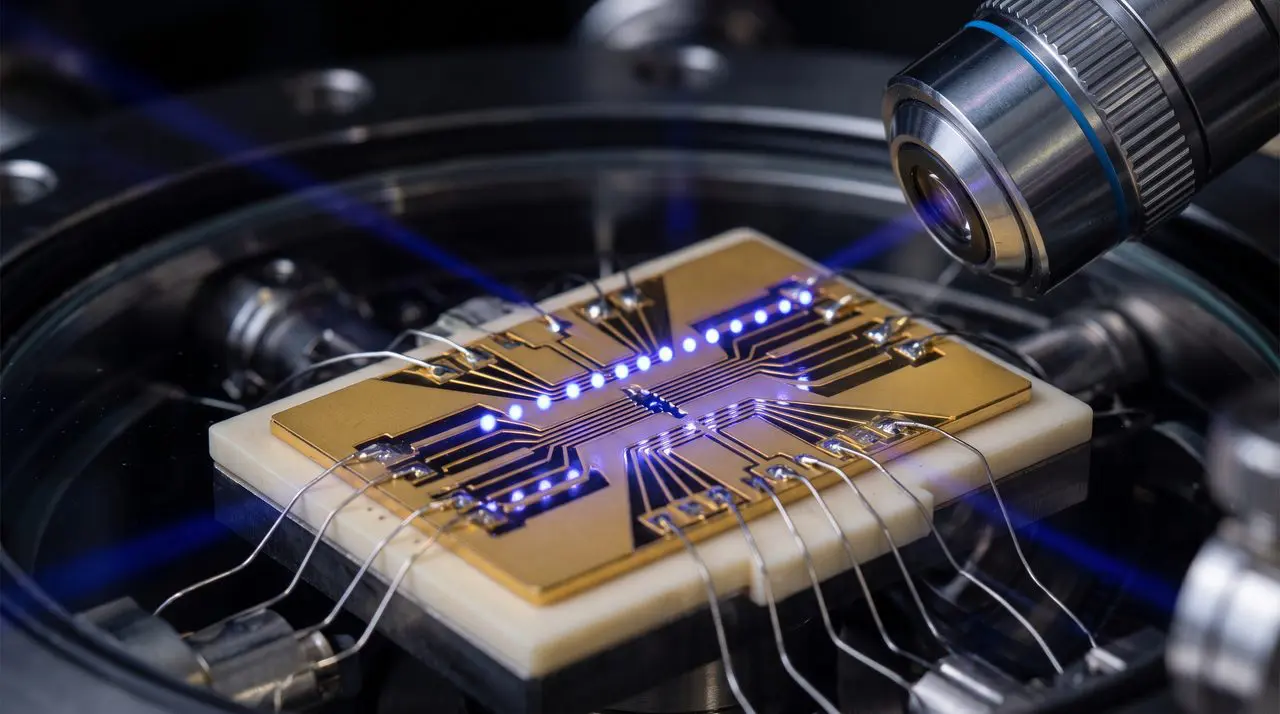
Researchers at Cornell University, led by Professor Karan Mehta, have achieved the first experimental demonstration of standing-wave electromagnetically-induced-transparency (EIT) cooling for trapped ions using Nullspace ES software, building on theoretical work from 1992, the company says. Nullspace ES simulated the electrostatic fields generated by the chip surface electrodes, providing voltage calculations critical for axial confinement, radial mode rotation, and precise ion positioning.
This new cooling approach delivered higher cooling rates and addressed a broader range of modes than conventional methods; Masha Petrova, CEO of Nullspace, states that Cornell’s work demonstrates why simulation must advance alongside hardware, if not ahead of it.
Nullspace ES Simulates Electrostatics for Precise Trapped-Ion Control
The Mehta Group previously relied on COMSOL and a custom Python toolkit, but these proved insufficient. COMSOL’s comprehensive physics modeling slowed iteration, while the toolkit lacked the fidelity required for the experiment’s precision. The successful demonstration builds on theoretical predictions for standing-wave EIT cooling first made in 1992, realizing a long-sought advancement in trapped-ion technology.
These improvements are not merely incremental; they represent a step toward faster and more scalable quantum systems, facilitated by the ability to simulate increasingly complex chip-scale architectures. Petrova also noted that the need for advanced simulation tools is driven by the accelerating pace of quantum hardware development, explaining that as quantum hardware grows more complex, researchers are under pressure to iterate at a faster pace, emphasizing the importance of simulation keeping pace with, or even exceeding, hardware advancements.
Cornell Professor Karan Mehta, principal investigator of the study, affirmed the value of Nullspace ES in streamlining the research process. He stated that Nullspace ES has proven valuable in allowing his team to carry out accurate trap simulations efficiently, which is essential to effective design and simulation of devices at the precision important for these kinds of experiments. The Mehta Group integrated Nullspace ES into an automated pipeline, linking chip design directly to experimentally usable voltage sets, a workflow that significantly reduced development time, according to the company.
This integration highlights a broader trend toward tighter coupling between simulation and fabrication in quantum computing, where rapid prototyping and optimization are paramount. The software’s ability to deliver high-fidelity simulations with faster iteration times positions it as a key enabler for future advancements in trapped-ion quantum computing and beyond.
Nullspace ES has proven highly valuable in allowing us to carry out accurate trap simulations efficiently, which is essential to effective design and simulation of devices at the precision important for these kinds of experiments.
Cornell Professor Karan Mehta, principal investigator of the study




See today’s quantum computing news on Quantum Zeitgeist for the latest breakthroughs in qubits, hardware, algorithms, and industry deals.