For over 225 years, scientists have struggled to pinpoint the value of big G, the universal gravitational constant, despite its fundamental role in governing the cosmos. Now, after a decade-long effort, NIST physicist Stephan Schlamminger has unveiled results from a painstaking measurement of this elusive constant.
“The time had come to open the envelope,” Schlamminger admitted, unsure of the secret number his team’s work would reveal. Despite gravity’s constant presence, big G remains the least well-known of the four fundamental forces, a disparity researchers hope to resolve with increasingly precise experiments using masses small enough to move by hand.
NIST Replicates 2007 BIPM Experiment to Measure “Big G”
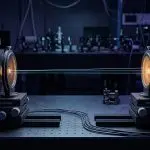
The NIST team’s replication of the 2007 BIPM experiment employed a torsion balance featuring eight cylindrical metal masses, a design rooted in the landmark 1798 experiment conducted by Henry Cavendish, to refine the measurement of the gravitational constant. This approach demanded extreme precision given the inherent weakness of gravity and the minuscule scale of the forces being measured, forces exerted by masses some 500 billion trillion times smaller than Earth.
Researchers meticulously controlled for environmental variables, including temperature and pressure fluctuations, to minimize potential sources of error in the delicate measurement process. To ensure the objectivity of their decade-long undertaking, NIST physicist Stephan Schlamminger enlisted colleague Patrick Abbott to introduce a concealed variable into the data analysis, a technique designed to prevent unconscious bias in aligning the NIST results with the previously established value from the French experiment.
Abbott subtracted a number, known only to himself, from the weights of select masses, creating a blind spot in the initial data interpretation. This elaborate safeguard underscored the team’s commitment to rigorous scientific methodology and their awareness of the subtle psychological influences that can affect even the most careful measurements. “For me, making an accurate measurement is a way of bringing order to the universe, whether or not the number agrees with the expected value,” Schlamminger stated, reflecting the team’s dedication to the pursuit of truth regardless of outcome.
The NIST experiment, like its BIPM predecessor, utilized an electrostatic force to counteract the gravitational torque on the torsion balance, allowing researchers to determine big G by precisely measuring the voltage required to maintain equilibrium. This technique, building upon Cavendish’s original concept, involved suspending a horizontal beam with thin wire and positioning heavier masses nearby to induce a gravitational attraction.
The resulting rotation of the beam, measured with a mirror and light pointer, provided a direct indication of the gravitational force, and consequently, the value of big G. Schlamminger’s team expanded on this method by conducting measurements with copper masses, seeking to determine if the material composition of the masses influenced the results. The team found virtually identical results regardless of the material used, adding another layer of confidence to their findings.
Despite the meticulous preparation and execution, the initial analysis revealed a discrepancy between the NIST results and those of the 2007 BIPM experiment, prompting further investigation and refinement of the data. Schlamminger recounted the moment of revelation at the annual Conference on Precision Electromagnetic Measurements in Aurora, Colorado, on July 11, 2024, when he unveiled the secret number Abbott had concealed.
The team’s final report published in Metrologia, contributes to the growing body of evidence surrounding big G, even if it doesn’t fully resolve the existing discrepancies among different measurements. NIST’s expertise in precision measurement is underscored by its recent advancements in post-quantum cryptography, having published the world’s first finalized PQC standards (FIPS 203/204/205) in August 2024 and selected HQC as a backup KEM in March 2025.
This commitment to securing data in the quantum era reflects a broader dedication to fundamental scientific research and its practical applications. The agency’s success in transmitting entangled photons over 62 kilometers between its Gaithersburg campus and the University of Maryland reported on August 5, 2026 demonstrates its capabilities in quantum communication and sensing.
This work builds on NIST’s long history of innovation, dating back to its founding in 1901 and its current operation under the Department of Commerce with campuses in Gaithersburg, Maryland, and Boulder, Colorado. The agency’s partnerships further amplify its research capacity. A strategic alliance with General Dynamics Information Technology, formalized in 2026, focuses on migration to post-quantum cryptography, while a commercial partnership with SRI International has established the Quantum Manufacturing Engineering Center with an initial $20 million investment.
Collaborative efforts with ARLIS, through the SEQCURE program, advance quantum computing security using Zero Trust Architecture defined by NIST standards. These collaborations, alongside eight patent families held by NIST demonstrate a commitment to translating research into tangible technological advancements.
Schlamminger, after completing this intensive study, expressed a willingness to pass the torch to the next generation of scientists. “I’ll leave it to younger generations of scientists to work on the problem,” he stated, acknowledging the ongoing nature of the quest to precisely define this fundamental constant. While the NIST study does not definitively resolve the existing discrepancies in measurements of big G, it provides a valuable contribution to the scientific community, reinforcing the importance of independent verification and rigorous analysis.
Every measurement, Schlamminger believes, holds intrinsic value. “Every measurement is important, because the truth matters,” he concluded, encapsulating the driving force behind this decade-long pursuit of a more precise understanding of gravity’s fundamental constant.
Every measurement is important, because the truth matters.
Stephan Schlamminger, Physicist at the National Institute of Standards and Technology (NIST)
Torsion Balance Method Detects Gravity Between Microscopic Masses
The precision required to detect gravitational force between microscopic masses necessitated a novel approach to data validation within the NIST study; colleague Patrick Abbott obscured the true weights of certain masses by subtracting a confidential value from each, ensuring Schlamminger’s team could not unconsciously bias results toward existing measurements. The team’s commitment extended beyond simply replicating the 2007 BIPM experiment; it involved a layered strategy to assess the integrity of the data and the potential for systematic errors.
The resultant near-identical findings from both sets of masses reinforced the reliability of the torsion balance method and narrowed the scope of potential error sources. This dual-material approach, coupled with the BIPM replication, provided a robust cross-validation, increasing confidence in the final result despite the ongoing mystery surrounding variations in previously published values of big G.
NIST’s dedication to isolating and accounting for every variable underscores the challenges inherent in measuring such a fundamentally weak force. The experiment itself relied on a modern iteration of a technique pioneered by Henry Cavendish in 1798, utilizing a torsion balance to detect the minuscule attraction between masses so small they are easily manipulated by hand. Unlike Cavendish’s original setup with lead balls and a wooden beam, the NIST apparatus employed eight cylindrical metal masses arranged in a carousel configuration, enhancing sensitivity and precision.
Four masses rotated on the carousel, while four smaller masses suspended beneath exerted a gravitational pull, twisting a delicate copper-beryllium ribbon. Precise measurement of this torsion, or twisting, provided one pathway to calculating big G. However, the team didn’t rely on a single measurement technique.
This dual-method approach, combining mechanical and electrical measurements, offered a critical redundancy, allowing researchers to cross-validate their findings and identify any inconsistencies. The sophistication of this technique, building upon centuries of refinement, highlights the ongoing pursuit of ever-greater precision in fundamental physics. NIST’s expertise in precision measurement, honed over a century of operation, was instrumental in the successful execution of this complex experiment. This focus on future-proof security demonstrates a broader dedication to safeguarding critical infrastructure and data in an era of rapidly evolving technological threats.
The agency’s partnerships with organizations like TechCreate Group, SRI International, and General Dynamics Information Technology further solidify its position as a leader in scientific innovation and technological advancement. The NIST team’s meticulous approach to error analysis extended beyond the experimental setup itself. They carefully considered potential sources of error stemming from environmental factors, such as temperature fluctuations and seismic vibrations.
The laboratory was meticulously shielded and controlled to minimize these disturbances, ensuring that any observed variations in the gravitational force were attributable to the masses themselves, and not external influences. The agency’s Gaithersburg campus, equipped with facilities, provides an ideal environment for conducting this type of precision measurement. The team’s findings align with the results of the 2007 BIPM experiment, suggesting that the discrepancies may stem from systematic errors in other measurements.
The implications of this finding extend beyond fundamental physics, potentially impacting fields such as astrophysics and cosmology, where the precise value of big G is crucial for modeling the universe. The equation governing gravitational force, force equals Gm1m2/r2, underscores the fundamental role of big G in determining the attraction between any two masses. Even slight variations in its value can have significant consequences for calculations involving celestial bodies or the behavior of matter at extreme scales.
The ongoing effort to refine the measurement of big G is therefore not merely an academic exercise; it is a quest to deepen our understanding of the universe and its underlying laws. NIST’s contribution to this effort, characterized by meticulousness, innovation, and a commitment to rigorous scientific inquiry, underscores the agency’s vital role in advancing the frontiers of knowledge. The team’s work, published in Metrologia, adds to a growing body of evidence that may eventually unlock the mystery surrounding this elusive fundamental constant.
I had really dotted all the i’s and crossed all the t’s of the experiment.
NIST’s Measured Value of G: 6.67387×10⁻¹¹ m3/kg/s2
The National Institute of Standards and Technology (NIST) has determined the value of the gravitational constant, often called big G, to be 6.67387×10⁻¹¹ meters³ /kilogram/second², a figure slightly lower than previous measurements and contributing to a longstanding scientific puzzle. This result, the culmination of a decade-long effort led by Stephan Schlamminger, represents a meticulous refinement of a measurement that has challenged physicists for over 225 years, demanding an extraordinary commitment to precision.
The team employed a novel approach to data validation, utilizing a scrambled dataset to mitigate potential unconscious bias in the final result, a strategy designed to ensure objectivity in a notoriously difficult measurement. This technique, while adding complexity, allowed Schlamminger to assess the data without knowing the expected outcome, a critical step in ensuring the integrity of the experiment.
The team’s value differs from the result obtained by the Bureau International des Poids et Mesures (BIPM) by 0.0235%, a discrepancy that, while small, is significant considering the precision with which other fundamental constants are known. The experiment itself builds on the legacy of Henry Cavendish’s 1798 torsion balance, a device that detects gravitational forces by measuring the minuscule twisting of a suspended fiber.
NIST’s iteration utilized eight cylindrical metal masses, arranged to maximize sensitivity, and incorporated an innovative electrostatic counterbalancing technique. By applying a precisely controlled voltage to electrodes near the masses, the researchers created an opposing electrostatic force that neutralized the gravitational pull, allowing for a more accurate determination of G. This method, combined with the use of copper masses in separate trials, aimed to eliminate potential systematic errors arising from the materials themselves, a critical consideration given the subtle nature of the gravitational force being measured.
Finding virtually identical results with this material strengthened confidence in the accuracy of the measurement process. The distinction between big G and little g is important for understanding the implications of this measurement; little g, the acceleration due to Earth’s gravity, varies depending on location, while big G is a universal constant, theoretically the same throughout the cosmos. Calculating the gravitational force between two masses, m1 and m2, relies on Newton’s law: force equals Gm1m2/r², where r is the distance between the masses.
The precision of big G directly impacts the accuracy of these calculations, influencing everything from orbital mechanics to cosmological models. The agency’s quantum sensors, recently used to verify nuclear safeguards internationally, exemplify the advanced technology developed at NIST and applied to fundamental measurements.
This expertise, combined with the agency’s long history of precision metrology, founded in 1901, positions NIST as a leading institution in the quest to understand the fundamental constants of nature. A $4 million NIST grant, awarded on September 18, 2026, will fund quantum researchers at the EPB Quantum Center, further bolstering the nation’s capabilities in this critical field.



See today’s quantum computing news on Quantum Zeitgeist for the latest breakthroughs in qubits, hardware, algorithms, and industry deals.