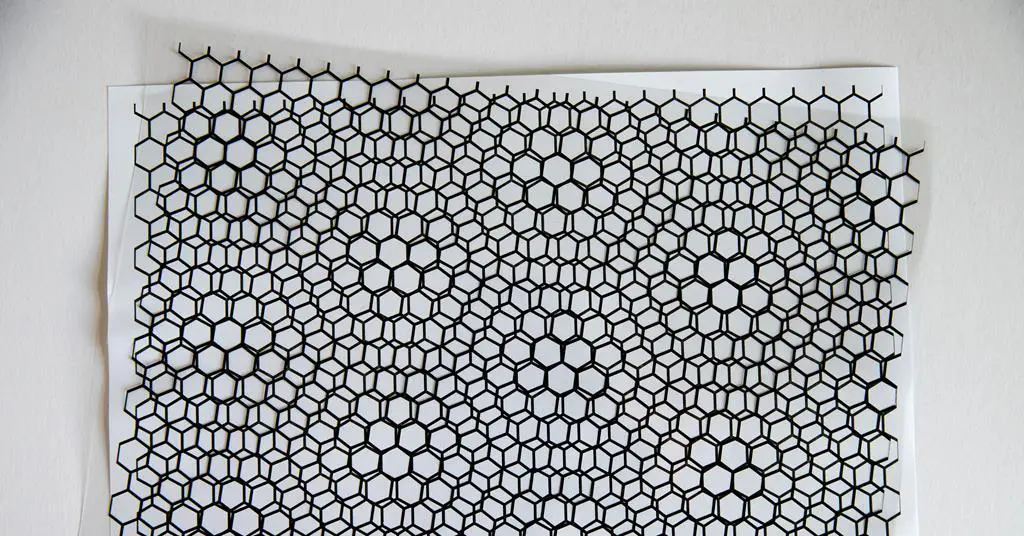
A twist of just 1.1 degrees unlocked a surprising property in bilayer graphene, and the field gained major attention after this discovery. Researchers are extending this exploration beyond graphene to materials like halide perovskites and MXenes, observing altered exciton transport and unexpected superconductivity.
New experimental tools, including quantum twisting microscopes that can vary twist angles in situ, are helping scientists explore previously inaccessible quantum states without strong magnetic fields, a development materials chemist Yury Gogotsi from Drexel University describes as capturing the imagination after the discovery that “you could take two layers of non-superconducting material, twist it by roughly one degree and it becomes superconductor.”
Twistronics Emerges: 2D Materials and Moiré Superlattices
The ability to finely control the stacking and rotation of two-dimensional materials is revealing unexpected quantum phenomena, with recent work demonstrating fractional quantum anomalous Hall states without the need for strong magnetic fields. This advancement stems from the manipulation of moiré superlattices, periodic patterns formed when two layers of material are slightly misaligned, and allows scientists to explore exotic electronic behaviors previously inaccessible.
These states, where electrons appear to fractionate their charge, were observed in topological moiré materials featuring flat bands, marking the first instance of this behavior outside of high-magnetic-field experiments. Beyond graphene, the initial focus of twistronics, halide perovskites, transition metal dichalcogenides, and MXenes are now under intense scrutiny for their unique responses to twisting.
The University of Chicago, through partnerships with institutions like Fermilab and IBM Quantum, is actively contributing to this expansion, using its expertise in quantum materials and engineering to investigate these novel systems. This collaborative effort, supported by the Chicago Quantum Exchange, aims to help twisted structures benefit future quantum technologies. The scale of the moiré pattern’s unit cell, potentially containing 10,000 atoms, allows for the introduction of charge carriers in ways impossible in conventional crystals.
As explained by a researcher, “You can’t add that much charge to a material, it wouldn’t hold it,” in a standard crystalline structure, but the broadened periodicity of twisted moiré materials circumvents this limitation. This capability is being actively explored using quantum twisting microscopes, experimental tools that allow scientists to vary twist angles in situ, enabling the mapping of a material’s full phase diagram with precise control.
The emergence of superconductivity in twisted bilayers of tungsten diselenide and molybdenum ditelluride has further fueled interest in twistronics. These observations, while difficult to explain, suggest the possibility of genuinely exotic pairing mechanisms driving the superconducting behavior. “If we can understand these properties in a clean system, it could help us engineer an actual room temperature superconductor,” one researcher suggests, highlighting the potential long-term implications of this research.
Chemists are now playing a significant role in advancing twistronics, focusing on improving synthesis techniques for high-quality thin film material growth and exploring novel 2D nanomaterials. Yury Gogotsi from Drexel University and his team recently discovered three moiré patterns in MXenes, one of which exhibited hints of unusual electronic behavior.
Controlling surface functionalization in MXenes, an area of recent progress, is believed to be key to maximizing electronic coupling between twisted bilayers. The ability to manipulate these materials at the atomic level is not merely a scientific curiosity; it represents a shift in materials design.
Conventional materials have properties dictated by their chemical bonds, but moiré superlattices offer a new degree of freedom, the twist angle, to tailor electronic properties. This control opens the door to creating materials with functionalities not achievable through traditional methods, potentially leading to breakthroughs in areas such as energy storage, sensing, and quantum computing.
The University of Chicago’s recent development of LASSQD, a method for molecular insights using hybrid classical and quantum computing, exemplifies this convergence of disciplines, offering new tools to analyze and understand these complex materials. The university’s work on improving entanglement fidelity with shuffling, and the discovery that slow electrons stay quantum coherent, further demonstrate its commitment to advancing the field of quantum materials and technologies.
If we can understand these properties in a clean system, it could help us engineer an actual room temperature superconductor.
Flat Electronic Bands Drive Exotic Quantum Phase Discovery
Previously observed only under intense magnetic fields, these states, where electrons appear to fragment and carry only a fraction of their usual charge were detected in twisted molybdenum ditelluride in 2023. This discovery opened new avenues for topological quantum computing. The realization of FQAH states in twisted materials offers a pathway toward creating more compact and energy-efficient quantum technologies. Following the observation of FQAH, researchers quickly identified a related fractional quantum spin Hall (FQSH) phase in the same material, a phenomenon predicted years prior but never before observed.
“The FQSH effect was predicted some years back, but no one had predicted that this material would host it,” highlighting the unpredictable nature of discoveries within twistronics. The underlying mechanism driving this behavior remains a subject of intense debate, underscoring the need for further investigation into the fundamental physics of these systems.
The foundation for these recent advancements lies in the understanding of flat electronic bands, a key characteristic of materials at specific twist angles. As the atoms in stacked layers are rotated, the material’s electronic structure undergoes a transformation, culminating in a “flat band” state at angles like the “magic angle” of 1.1° in bilayer graphene. “Graphene only has a flat band at 1.1°, and that’s where all the magic happens,” explains a researcher familiar with the work.
In a flat band, the velocity of electrons slows dramatically leading to strong interactions and the emergence of exotic quantum phenomena. Eva Andrei and her team at Rutgers University were the first to systematically investigate how twist angles affect the properties of graphene, revealing the link between moiré patterns and electronic structure.
The IonQ Center for Engineering and Science, established in 2025, is a platform for deploying production-grade quantum computers and entanglement distribution networks, facilitating the exploration of quantum phenomena at unprecedented scales. Researchers believe that a deeper understanding of these exotic quantum phases could help create room-temperature superconductors, materials that conduct electricity with no resistance. While the path toward achieving this goal remains challenging, the recent breakthroughs in twistronics offer a promising new direction for materials science and quantum technology.
Beyond Graphene: Extending Twistronics to Novel 2D Materials
These materials exhibit altered exciton transport and novel electronic effects unattainable in conventional crystals, pushing the boundaries of materials science. While graphene’s “magic angle” of 1.1° gained major attention by inducing superconductivity, researchers are discovering that the optimal twist angles vary significantly depending on the material composition. This necessitates a broader exploration beyond the well-trodden path of graphene-based systems. The repeating structural motif inherent in graphene translates to moiré patterns when layers are twisted, but the scale and impact of these patterns differ across materials.
Yury Gogotsi from Drexel University notes that these moiré patterns are not limited to the nanoscale, also appearing at macroscopic levels, yet their influence on material properties is profoundly amplified when 2D nanomaterials are involved. The ability to invert material properties, transforming magnets into insulators, for example, through simple rotation is a central focus of current investigations.
The exploration of twisted perovskite bilayers represents a significant expansion of twistronics beyond traditional materials. Producing ultrathin sheets of methylammonium lead iodide perovskite, however, presents a unique challenge compared to graphene exfoliation. Researchers at Emory University developed an equilibrium-based process utilizing a bulky organic surfactant to trigger exfoliation, ultimately enabling the creation of perovskite sheets just a few nanometers thick for stacking and coupling studies.
“Once we remove that surfactant, we can make perovskite sheets with a few nanometres thickness, and stack them to study the coupling,” explains Letian Dou, a materials chemist at Emory University. This innovative approach demonstrates a commitment to overcoming fabrication hurdles in pursuit of novel moiré materials. MXenes, consisting of a transition metal core layered with carbon, nitrogen, and surface-terminating functional groups, offer another promising avenue for twistronics research.
Gogotsi, who co-led the discovery of MXenes in 2011, points to their inherent complexity as an advantage over graphene. This complexity allows for greater control over the electronic properties of the resulting moiré superlattices. The emergence of unexpected quantum phenomena in these twisted systems continues to challenge existing theoretical frameworks. “With some of these phases, there is no existing framework to even describe it,” says Klein, underscoring the need for new theoretical models to explain the observed behaviors.
Superconductivity signatures observed in twisted molybdenum ditelluride, for example, “may point to a genuinely exotic pairing mechanism,” according to Klein, suggesting that the underlying physics driving superconductivity in these materials may differ from conventional mechanisms. Chemists are increasingly focused on developing methods to streamline the fabrication of moiré superlattice materials, both to accelerate research and to help twisted structures benefit potential real-world applications.
Researchers are not simply twisting materials at random; they are systematically exploring chemical space to identify combinations that exhibit the most pronounced and controllable effects. This methodical approach, combined with advanced characterization techniques, is important for unraveling the complex interplay between twist angle, material composition, and emergent quantum phenomena. The university’s 2026 findings that slow electrons stay quantum coherent also contribute to understanding the behavior of electrons in these twisted systems.
Quantum Twisting Microscopes Reveal Inaccessible Quantum States
Prior observation of these states required substantial magnetic fields, limiting both experimental accessibility and potential applications; the emergence of FQAH in moiré materials bypasses this constraint. Researchers are now using this capability to investigate materials exhibiting these properties, with the goal of realizing robust quantum bits. This shift is facilitated by advancements in experimental tools, notably the development of quantum twisting microscopes capable of manipulating twist angles in situ.
These microscopes allow scientists to map the complete phase diagram of moiré materials by precisely controlling the angle between layered two-dimensional materials, a capability previously unavailable. The University of Chicago’s custom cryogenic scanning probe microscope built by Klein’s research group starting in early 2026, exemplifies this technological advancement. By varying the applied voltage, researchers can systematically explore the effects of different twist angles on the material’s electronic properties, revealing previously inaccessible quantum states.
Beyond graphene, materials like halide perovskites and MXenes are also under intense scrutiny, despite the challenges in their fabrication and stability. Methylammonium lead iodide perovskite, for example is notoriously unstable in ultrathin forms, prompting researchers to focus on creating intrinsically more stable structures. This pursuit of material diversity is driven by the desire to expand the range of accessible quantum phenomena and tailor materials for specific applications.
The University of Chicago’s commitment to advancing quantum science is evident in its numerous partnerships, including collaborations with IonQ, Duality Quantum Accelerator, IBM Quantum, Fermilab, and the University of Illinois. These partnerships foster interdisciplinary research and accelerate the development of quantum technologies. The university’s work spans quantum computing, quantum networks, quantum sensing, and quantum materials, all supported by the Chicago Quantum Exchange, a collaborative initiative bringing together researchers from multiple institutions.
This collaborative environment, combined with 17 patent families in the field, positions it as a key player in the ongoing quantum revolution. While the path to realizing such a breakthrough is undoubtedly challenging, the ability to actively manipulate and explore these materials at the nanoscale offers unprecedented opportunities for discovery.
The development of the quantum twisting microscope, and similar instruments is not merely a technological advancement but a fundamental shift in how scientists approach the study of quantum materials. The exploration of these materials is not limited to simply identifying new phases; researchers are actively investigating how to control and manipulate these states for potential applications in quantum information processing.
The ability to create and manipulate fractional charges, for instance could lead to the development of more robust and efficient quantum bits. the absence of a required magnetic field in FQAH states simplifies the design and operation of quantum devices, potentially paving the way for scalable quantum computing architectures. The University of Chicago’s recent findings regarding the coherence of slow electrons reported in August, also contribute to this understanding, suggesting that these electrons can maintain their quantum properties for longer periods, enhancing the fidelity of quantum operations. The ongoing research into twisted materials represents a convergence of chemistry, physics, and materials science, driven by the promise of unlocking new quantum states and potentially revolutionizing fields ranging from computing to energy.
The ability to systematically explore these materials with tools like the quantum twisting microscope is not just revealing fundamental insights into the behavior of matter but also laying the groundwork for a future where quantum technologies become a reality. The field is rapidly evolving, with new materials and phenomena being discovered at an accelerating pace, and the University of Chicago, through its research and partnerships, remains at the forefront of this exciting frontier.


See today’s quantum computing news on Quantum Zeitgeist for the latest breakthroughs in qubits, hardware, algorithms, and industry deals.