He turned entanglement into the thread that may stitch spacetime together, and made quantum information a language for gravity itself.
Who Leonard Susskind is
Leonard Susskind is an American theoretical physicist whose work connects gravity, quantum mechanics, and quantum information. He holds the Felix Bloch Professorship of Theoretical Physics at Stanford University, and he is widely counted among the founders of string theory. His career has reshaped how physicists think about black holes, information, and the structure of space itself.
Born in New York City on 16 June 1940, Susskind came to physics from a working background, having trained as a plumber before turning to science. That unusual path is part of his public legend, and it colors a teaching style that prizes plain language over jargon. Over six decades he has combined deep technical results with an unusual gift for explaining them.
Susskind is also one of the most recognizable physics communicators alive. His popular books and his long-running lecture series have introduced a global audience to ideas that were once confined to specialist seminars. He is both a working researcher and a teacher of the wider public.
Education and an unlikely path into physics
Susskind grew up in the South Bronx, where his father worked as a plumber and assumed his son would eventually take over the family trade. He worked alongside his father as a teenager, learning to sweat pipes and read blueprints years before he ever opened a physics textbook, and that early apprenticeship in a practical craft left a permanent mark on how he later approached theoretical work.
He enrolled at the City College of New York originally intending to study engineering, a sensible and affordable choice for a working-class student who already knew how to build things with his hands. Physics pulled him away from that plan, and he graduated with a B.S. in physics in 1962, a late and unconventional start compared with many of his eventual colleagues.
Cornell and the strong interaction
Susskind went on to Cornell University for his PhD, completing it in 1965 under the particle theorist Peter A. Carruthers, with doctoral research on the quantum theory of strong interactions. In the early 1960s the strong force was still governed by no accepted theory of its own, and physicists reached for whatever mathematical picture seemed to fit the data coming out of particle accelerators, much like Richard Feynman’s parton model, one of several competing pictures physicists floated before quantum chromodynamics took hold.
That grounding in an unsettled, improvisational corner of physics turned out to be exactly the right preparation for what came next. Strings were first proposed as a phenomenological picture of the strong interaction, not as a theory of gravity, and Susskind’s Cornell training put him directly among the physicists wrestling with the data that string theory was originally invented to explain.
A blue-collar route to theoretical physics
Susskind has often described working in the family plumbing business as formative, a detail that has become part of his public identity as a physicist who talks like a tradesman rather than a professor. It shaped a teaching philosophy built around plain language and physical intuition rather than abstraction pursued for its own sake.
That background also helps explain why his popular writing and lecture series later resonated so widely with readers who had no formal training in physics. He spent much of his career translating some of the most abstract ideas in the field, from string theory to holography, into terms a technically curious outsider could actually follow, a skill that traces back to a childhood spent explaining plumbing fixes to customers rather than physics to colleagues.
From plumbing to string theory
In the late 1960s Susskind helped lay the foundations of string theory, the idea that elementary particles can be understood as vibrating states of tiny relativistic strings. He arrived at this picture independently alongside Yoichiro Nambu and Holger Bech Nielsen, working from the strange mathematics of the strong interaction. That early insight grew into one of the dominant research programs in modern theoretical physics.
Why strings mattered
The string picture offered a way to think about quantum gravity, a goal that had resisted physicists for decades. By replacing point particles with extended objects, the theory softened the infinities that had plagued earlier attempts to quantize gravity. Susskind has remained engaged with these questions long after string theory became a large and crowded field.
His contributions did not stop at the original idea. In 2003 he introduced the notion of the string theory landscape, the vast space of possible vacuum states that the theory seems to allow. That proposal sparked years of debate about what physics can and cannot predict, and it remains contested today.
The BFSS matrix model and M-theory
In 1996 Susskind joined Tom Banks, Willy Fischler, and Stephen Shenker to propose what became known as the BFSS matrix model, one of the first serious attempts to define M-theory without relying on an approximation scheme. Their paper, titled simply “M Theory As A Matrix Model: A Conjecture,” recast the eleven-dimensional theory in terms of the quantum mechanics of a large number of D0-branes, point-like objects whose positions are represented not by ordinary numbers but by large matrices that do not commute with one another.
The striking claim was that this comparatively humble matrix quantum mechanics, taken in the limit of infinitely many branes, is fully equivalent to M-theory in flat eleven-dimensional spacetime, with ordinary eleven-dimensional supergravity emerging automatically as its low-energy limit. It offered a way of defining a notoriously slippery theory in terms of something concrete enough to actually calculate with, rather than something defined only through the string theories it was supposed to unify.
A conjecture that keeps passing its tests
The BFSS proposal has never been rigorously proven, and its authors described it from the start as a conjecture rather than a theorem. It has, however, passed a long series of nonperturbative tests over the following decades, checks that a wrong conjecture would have been expected to fail, and it remains a touchstone for physicists trying to build string and M-theory up from first principles rather than down from an approximation.
The model sits alongside the holographic principle as one of Susskind’s two most durable contributions to nonperturbative string theory, both of them attempts to find a solid, calculable foundation underneath a theory that is otherwise defined mostly through the approximations that first gave rise to it. That instinct reappears throughout his career, from matrix theory’s exact description of M-theory to the holographic principle’s exact description of quantum gravity to his later complexity-geometry program’s attempt to give black hole interiors an exact computational meaning.
The landscape controversy
Susskind’s 2003 landscape proposal moved a long-simmering tension in string theory into open, public argument. String theory appears to admit an astronomically large number of possible vacuum states, figures like 10 to the 500th power are often quoted, and if eternal inflation realises many of these possibilities across a wider multiverse, then constants such as the cosmological constant might be selected anthropically, by the bare requirement that observers exist to measure them, rather than derived uniquely from the theory’s equations.
Critics read this as a retreat from the ordinary standards of scientific prediction. The cosmologist David Gross judged anthropic reasoning premature and potentially a dead end for a field that had promised a unique theory of everything, while the physicist and mathematician Peter Woit argued, first in a blog and later in a book both titled Not Even Wrong, that a landscape this large leaves string theory unable to forecast anything a real experiment could actually test.
A very public disagreement with Lee Smolin
The sharpest version of the argument played out in a widely read exchange between Susskind and the physicist Lee Smolin, hosted by the science forum Edge.org. Smolin argued that a speculative multiverse scenario earns its place in science only if it yields genuinely falsifiable predictions, and he offered his own cosmological natural selection proposal as a contrasting example that he believed met that bar.
Susskind’s response went beyond simply defending the landscape itself. He challenged the falsifiability criterion as too narrow a description of how theoretical physics actually advances in practice, a move his critics saw as convenient cover and his defenders saw as an honest reckoning with a much older problem in the philosophy of science. The dispute remains unresolved today, and it is as much a disagreement about what counts as legitimate science as it is about the technical details of string theory itself.
The argument has outlived any single paper or book, resurfacing whenever cosmologists debate the significance of the extremely small measured value of the cosmological constant, a quantity the landscape was originally invoked to explain. Whatever its final verdict, the controversy forced string theorists to be explicit about a question they had mostly avoided, namely what the theory could not predict, and not only what it could.
The holographic principle
One of Susskind’s most influential ideas is the holographic principle, the claim that everything happening inside a region of space can be described by information living on its boundary. He developed this principle from earlier suggestions by Gerard ‘t Hooft, and in 1995 he gave the first precise string-theoretic version of it. The idea inverts ordinary intuition, since it suggests that a volume of space is, in a sense, a projection of data on a lower-dimensional surface.
Holography turned out to be far more than a curiosity. It became a guiding theme of quantum gravity research and connected directly to Juan Maldacena’s AdS/CFT correspondence, proposed in 1997, which gave the principle a concrete mathematical home. Through this link, gravity in a higher-dimensional space is matched to a quantum field theory on its boundary.
A precise mathematical example
Maldacena’s 1997 correspondence gave holography its most concrete and best-studied example, matching a specific theory of gravity in a five-dimensional anti-de Sitter space to a specific quantum field theory living on its four-dimensional boundary. The match is precise enough that calculations that are difficult on one side of the correspondence often become tractable on the other, and physicists now routinely translate a hard gravity problem into an easier quantum field theory problem, or the reverse.
The same idea also explains why a black hole has an entropy at all, a puzzle first raised by Jacob Bekenstein and Stephen Hawking in the 1970s. If the interior of a black hole is really encoded on its boundary, its entropy should scale with the area of that boundary rather than the volume it encloses, exactly the strange scaling that Bekenstein and Hawking had found and that ordinary physical systems do not share.
Information on the boundary
For quantum computing readers, the key point is that holography treats information as physical and primary. The geometry of space is read off from how data is organized on a boundary, rather than the other way around. That perspective set the stage for much of Susskind’s later work tying entanglement and complexity to the shape of spacetime.
The black hole war with Hawking
Susskind is perhaps best known to the public for what he called the black hole war, a long argument with Stephen Hawking about whether black holes destroy information. Hawking had argued that information swallowed by a black hole is lost forever, a conclusion that would break the basic rules of quantum mechanics. Susskind, together with ‘t Hooft, insisted that quantum theory must hold and that the information has to be preserved.
To make that case, Susskind helped develop black hole complementarity, an idea worked out with Larus Thorlacius and John Uglum. The proposal holds that an outside observer and an infalling observer give different but consistent accounts of what happens at the horizon, so no contradiction arises. It was a careful attempt to save quantum mechanics without abandoning general relativity.
How the argument settled
The dispute had a public resolution, though not through a wager of Susskind’s own. In 2004 Hawking conceded a separate, formal bet he had made in 1997 with physicist John Preskill and Kip Thorne, publicly agreeing that information is not lost, with the AdS/CFT correspondence and related results pointing toward preservation. Susskind later told the broader story of the intellectual fight in his book The Black Hole War, which made the wider debate accessible to general readers.
Entanglement, wormholes, and ER=EPR
In 2013 Susskind and Juan Maldacena put forward one of the boldest ideas in recent physics, the ER=EPR conjecture. It proposes that two entangled particles are connected by a microscopic Einstein-Rosen bridge, a kind of wormhole, so that quantum entanglement and spatial connection are two faces of the same thing. The name pairs the 1935 Einstein-Rosen wormhole paper with the 1935 Einstein-Podolsky-Rosen entanglement paper.
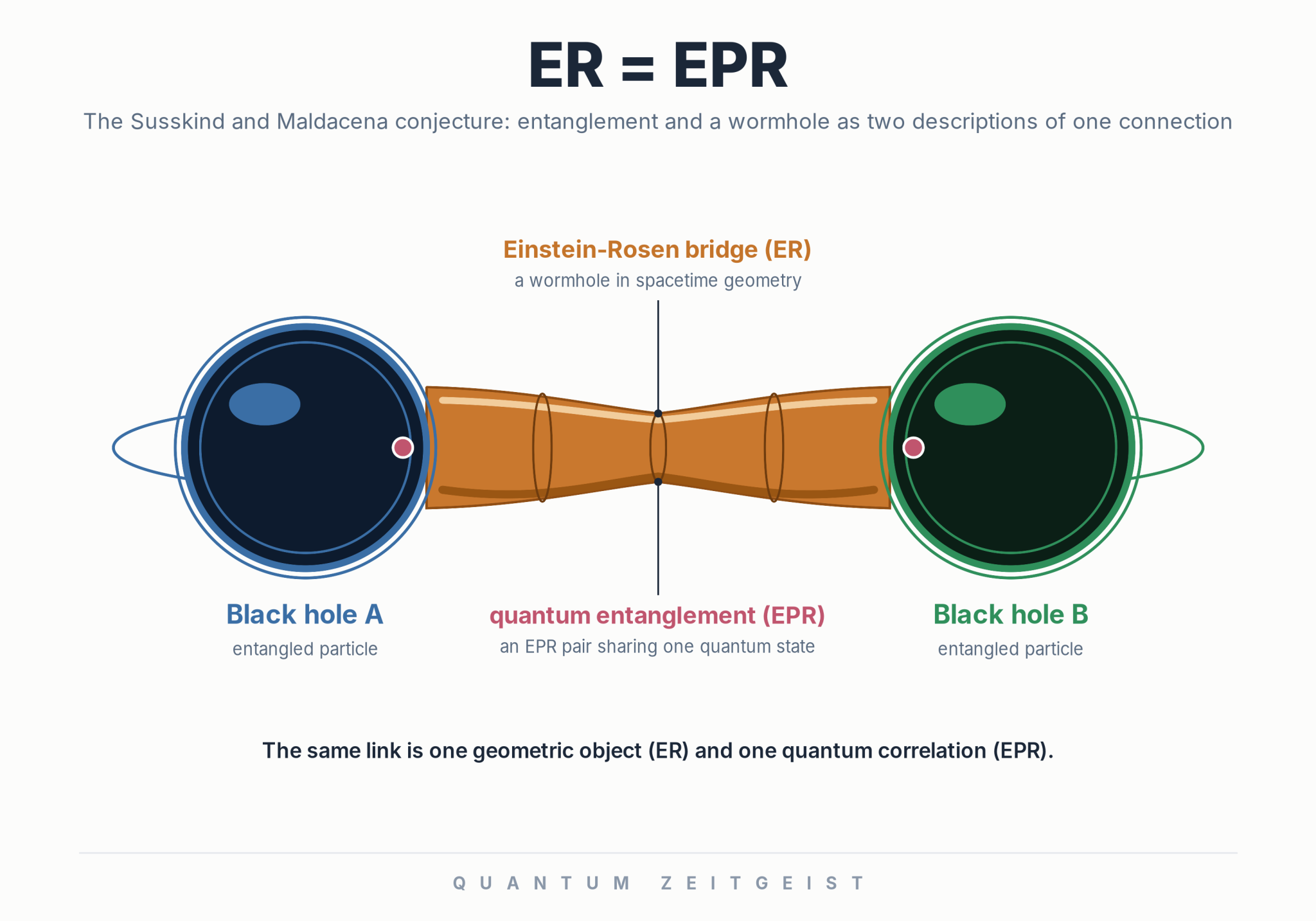
If correct, the idea suggests that the smooth fabric of space is built from entanglement between its parts. Susskind has described entanglement as what sews space together, a striking reframing of geometry in quantum terms. It offers a fresh angle on the firewall puzzle that troubled black hole physics in the early 2010s.
A conjecture, not a settled law
It is important to be clear that ER=EPR remains a conjecture and an active research direction rather than an established fact. The proposal has inspired a great deal of work, yet it has not been proven, and physicists continue to test and refine it. Treating it as a promising hypothesis, not a verdict, is the honest reading of where the field stands.
Quantum complexity and the shape of spacetime
More recently Susskind has argued that quantum computational complexity, a concept from computer science, may have a direct meaning in gravity. He and his collaborators proposed that the growing volume behind a black hole horizon corresponds to the rising complexity of the quantum state describing the black hole. This is the complexity equals volume idea, later sharpened into a related complexity equals action proposal.
These conjectures connect the difficulty of preparing a quantum state, measured by how many simple operations it takes, to concrete features of spacetime geometry. In this picture, the interior of a black hole keeps growing because its quantum complexity keeps climbing long after other quantities have settled. The work treats complexity as a physical resource that geometry can record.
What circuit complexity actually measures
In quantum computing, the complexity of a state is usually defined as the smallest number of elementary gates needed to prepare it starting from some simple reference state. A nearly random quantum state typically has very high complexity by this measure, since no short shortcut exists for building it, while a simple, highly structured state can often be prepared with only a handful of gates, a notion connected to the same kind of resource-counting that underlies debates about quantum supremacy.
Susskind’s proposal borrows this exact definition and applies it to the quantum state describing a black hole’s interior, arguing that the state becomes more complex, in precisely this gate-counting sense, for a very long time after the black hole forms. That growth in complexity, he argues, is what the growing volume behind the horizon is secretly tracking, tying a concept borrowed from computer science directly to the geometry of curved spacetime.
Why computing people should care
For anyone interested in quantum computing, this is a remarkable link between two fields. The same notion of circuit complexity that describes how hard a quantum computation is may also describe the inside of a black hole. These complexity-geometry ideas are research directions, not confirmed laws, but they show how central quantum information has become to fundamental physics.
Honors and recognition
Susskind’s contributions have been recognised across several distinct areas of physics rather than a single specialty, which is itself somewhat unusual for a theorist. In 1998 the American Physical Society awarded him the J. J. Sakurai Prize for Theoretical Particle Physics, citing his pioneering contributions to hadronic string models, lattice gauge theories, quantum chromodynamics, and dynamical symmetry breaking, a citation broad enough to cover several separate subfields at once.
He received the Oskar Klein Medal from Stockholm University in 2018, an honor named for the Swedish physicist who helped pioneer the idea of extra spatial dimensions decades before string theory made them fashionable again. In 2023 he shared the Dirac Medal of the International Centre for Theoretical Physics, one of the field’s most respected honors for foundational theoretical work, named for Paul Dirac, whose own equations first united quantum mechanics with special relativity.
Membership in the field’s most selective societies
Susskind is also a member of both the United States National Academy of Sciences and the American Academy of Arts and Sciences, two of the most selective scientific societies in the country, whose members are elected by existing members in recognition of sustained original contributions to their field. Election to either body is itself considered a significant career honor independent of any individual prize.
The breadth of that record reflects how Susskind’s career has actually unfolded. Rather than deepen a single result for decades the way some celebrated theorists do, he has repeatedly opened new subfields, from the strong-interaction string models of his early career through the holographic principle and matrix theory to his more recent complexity-geometry program, and the honors track that same pattern of restarting rather than settling into one specialty.
The Sakurai Prize citation rewards a close reading, because its list of hadronic string models, lattice gauge theories, quantum chromodynamics, and dynamical symmetry breaking maps almost exactly onto the sequence of problems Susskind worked through in the first half of his career. Each item on that list names a distinct line of research rather than a single celebrated result, which is part of why the award reads less like a prize for one discovery and more like a summary of a physicist who kept moving from one hard problem in the strong interaction to the next. The same restlessness that later carried him from string theory into black hole physics is already visible in that citation, written years before the holographic principle or the matrix model existed, and it is a reminder that the questions which made him famous to a general audience grew out of a much earlier and more technical apprenticeship in the physics of the strong force.
Taken together, the Sakurai Prize in 1998, the Oskar Klein Medal in 2018, and the Dirac Medal in 2023 trace the same arc as the rest of this profile, running from the strong-interaction string models of the 1960s through the holographic principle, the BFSS matrix model, and the later complexity-geometry program that ties quantum computation to the geometry of spacetime. Membership in the National Academy of Sciences and the American Academy of Arts and Sciences sits on top of that record as a broader mark of standing among his peers, independent of any single prize. What stands out across the whole list is its range, since the honors span particle physics, quantum gravity, and quantum information rather than clustering in a single specialty, and that range is the honest signature of a physicist who has repeatedly restarted in a new subfield, from the black hole war with Stephen Hawking to the ER=EPR conjecture and the complexity-geometry ideas that now sit at the center of how theorists think about information and gravity. That same breadth is also why his recognition reaches well beyond formal prizes to a broad public readership, with The Black Hole War, The Cosmic Landscape, and the Theoretical Minimum series carrying his name to an audience far larger than the academies that elected him.
The teacher and communicator
Beyond research, Susskind has become one of the most effective physics teachers of his generation. His lecture series The Theoretical Minimum, available online and in book form, walks readers through the real mathematics of classical mechanics, quantum mechanics, and relativity. The goal, in his words, is to give curious people exactly what they need to think about physics seriously, and nothing they do not.
A wider bookshelf than one debate
Susskind’s popular writing began earlier than The Black Hole War, with The Cosmic Landscape in 2005, which introduced general readers to the string theory landscape and the anthropic reasoning built on top of it, ideas that were still contentious inside physics departments even as he was explaining them to the public. The book set a template he would return to repeatedly: take a genuinely unresolved, sometimes controversial research question and walk a general reader through the actual stakes rather than a simplified version of them.
The Theoretical Minimum series eventually grew to four volumes, each pairing a book with a matching set of Stanford Continuing Studies lectures freely available online. Classical mechanics came first in 2013, written with George Hrabovsky, followed by quantum mechanics in 2014 with Art Friedman, special relativity and classical field theory in 2017 also with Friedman, and general relativity in 2023 with André Cabannes.
The project takes its name and its philosophy from the Soviet physicist Lev Landau, who was famous for setting a demanding entrance exam, his own “theoretical minimum,” for anyone wanting to join his research group. Susskind’s version relaxes the entrance requirements but keeps the ambition intact, aiming to give a committed amateur the actual working mathematics of physics rather than a purely qualitative summary of it.
His popular books reach a wide audience without diluting the science. The Black Hole War turned a technical dispute into a gripping narrative, and his other writing has explained string theory and cosmology to non-specialists. He has shown that careful exposition can coexist with frontier research.
This dual role gives his ideas unusual reach. When Susskind argues that information and complexity are central to physics, that message travels far beyond the seminar room. Many students who later worked on quantum information first met these themes through his lectures.
Why Leonard Susskind matters in quantum computing
Leonard Susskind matters to quantum computing because he helped move quantum information from a niche topic to the heart of fundamental physics. Through holography, ER=EPR, and his complexity-geometry program, he framed entanglement and quantum complexity as building blocks of spacetime rather than mere curiosities. That reframing changed which questions theorists consider central.
His ideas link directly to a living research frontier in quantum error correction and holography, a connection explored by physicists such as John Preskill. The notion that spacetime may behave like an error-correcting code grew directly out of the research program Susskind helped build. These are open problems, and progress is genuine but still partial.
Susskind also matters as a bridge between communities. He gave physicists a reason to learn the language of quantum computation, and he gave computer scientists a reason to care about black holes. Few researchers have done more to make quantum information feel like a fundamental part of how the universe works.