The engineer who rebuilt a fading chipmaker into a trillion-dollar contender, now wiring the classical machinery that quantum computers will lean on.
Who Lisa Su is
Lisa Su is the Taiwanese-American electrical engineer who chairs and runs AMD, one of the most important semiconductor companies in the world. Born in Tainan, Taiwan, on November 7, 1969, she immigrated to the United States as a young child and was drawn to engineering early, eventually studying at the Massachusetts Institute of Technology, where she earned bachelor’s, master’s, and doctoral degrees in electrical engineering.
From Taiwan to MIT
Su completed her PhD at MIT in 1994 with a dissertation on extreme-submicrometer silicon-on-insulator MOSFETs, a topic that sat at the frontier of how transistors could be made smaller and faster. That early focus on the physical limits of silicon would shape a career spent pushing chips toward higher performance and tighter integration. Her academic grounding gave her a deep technical fluency that later set her apart among technology chief executives.
What distinguishes Lisa Su is that she is an engineer first and an executive second. She is comfortable discussing transistor design, packaging, and memory bandwidth in the same breath as revenue and strategy. That combination has made her one of the most respected leaders in the global chip industry.
It is also important to be clear about what Lisa Su is and is not. She is a semiconductor engineer and a business leader, not a quantum physicist, and this profile treats her quantum relevance as infrastructural rather than scientific. With that framing in place, her significance to the future of computing becomes easier to state honestly.
The road to AMD’s top job
Before AMD, Su built a serious engineering reputation across several major companies. She worked at Texas Instruments early in her career, then spent years at IBM, where she contributed to silicon-on-insulator manufacturing technology and rose to vice president of the company’s Semiconductor Research and Development Center. She later served as chief technology officer and senior vice president at Freescale Semiconductor before joining AMD in 2012.
Engineering credibility built over decades
Su’s path was unusual because it ran through the laboratory rather than around it. Her IBM work on advanced silicon processes connected her directly to the manufacturing science behind modern computing. By the time she reached AMD, she understood both the device physics and the business pressures that govern a semiconductor company.
AMD named Lisa Su president and chief executive officer on October 8, 2014, replacing Rory Read. The company she inherited was financially fragile and had lost ground to Intel across most of its markets. Few observers expected the dramatic recovery that followed.
By the time she stepped into the chief executive role, Lisa Su had spent more than two decades moving between research benches and product organisations. That breadth meant she could judge a chip roadmap on its technical merits rather than relying solely on the assessments of others. It is a rare profile among large-company chief executives, and it became central to how she rebuilt AMD.
The AMD turnaround
The turnaround Su led at AMD is now studied as a model of corporate revival in technology. When she took over, AMD’s market value sat near three billion dollars and the company was widely seen as a fading competitor. Under her leadership, AMD’s market capitalization has since grown past nine hundred billion dollars, and in February 2022 the company overtook Intel in market value for the first time.
Zen and the return to competitiveness
The centerpiece of the recovery was the Zen processor architecture, which powered the Ryzen, Threadripper, and EPYC product lines. Zen-based chips, first released in 2017, gave AMD a competitive desktop and server processor for the first time in years and steadily won back market share. By the third generation of Zen, AMD held a clear performance position in important parts of the processor market.
Lisa Su paired the Zen comeback with a disciplined long-term roadmap that customers and investors could trust. She also pushed AMD deeper into data center silicon, where the highest-margin and most strategically important business now sits. That focus positioned the company for the artificial intelligence boom that followed.
The recovery was not the result of a single product but of repeated, predictable execution over many years. Su made a habit of setting public targets and then meeting them, which slowly restored AMD’s credibility with the largest cloud and enterprise buyers. By the early 2020s, AMD had moved from a survival story to a genuine technology leader in several of its core markets.
Investors rewarded that consistency, and AMD’s share price became one of the standout technology stories of the decade. The turnaround also reshaped the competitive balance of the processor market, ending years in which a single rival dominated. For students of corporate strategy, it stands as a clear case of how technical depth at the top of a company can translate into market results.
Building the AI compute engine
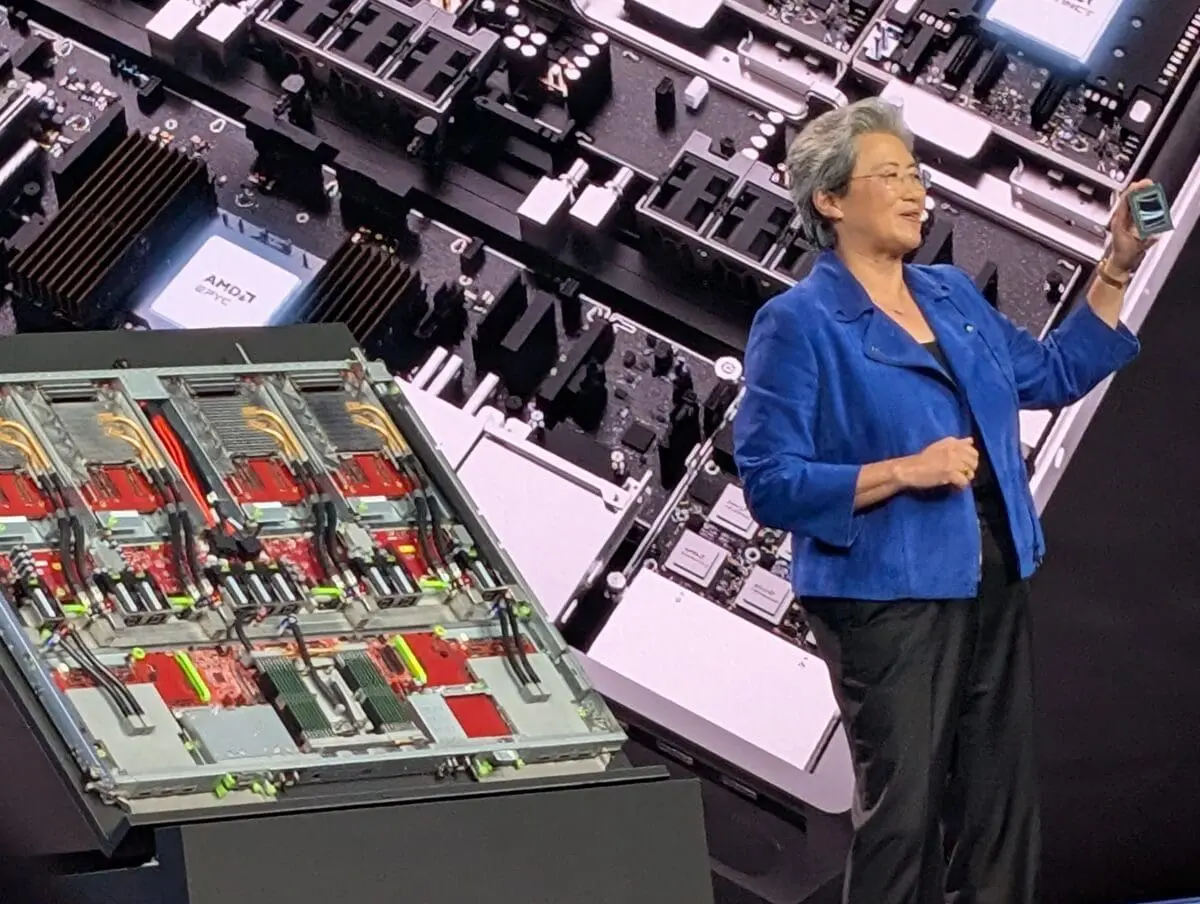
AMD under Su has become a serious force in artificial intelligence hardware. The company’s Instinct MI300 accelerators, launched in late 2023, target the data center training and inference workloads that have driven enormous demand for specialized chips. In 2024, Su reported that AMD’s MI300 GPUs crossed one billion dollars in quarterly revenue for the first time, and AMD delivered more than five billion dollars of AI accelerator revenue across the year.

CPUs and GPUs under one roof
A defining feature of AMD’s strategy is that it builds both high-performance CPUs and GPUs, along with adaptive chips acquired through Xilinx. In 2022, AMD completed its roughly forty-nine billion dollar acquisition of Xilinx, adding field-programmable gate arrays and adaptive computing to its portfolio. That breadth lets AMD assemble complete computing platforms rather than single components.
This portfolio matters far beyond conventional data centers. The same CPUs, GPUs, and adaptive chips that power AI clusters are also the building blocks that emerging computing models, including quantum systems, will depend on. Lisa Su has steadily widened AMD’s reach across every layer of high-performance compute.
The AI build-out also changed how Lisa Su talks about AMD’s future, with the company increasingly described as a complete computing platform supplier rather than a maker of discrete parts. That framing matters because the most demanding workloads, from large language models to scientific simulation, rarely run on a single chip type. The systems Su is assembling are designed to combine many kinds of compute into one coherent platform.
Where AMD meets quantum computing
Su is not a quantum physicist, and her direct scientific contributions are in classical semiconductor engineering rather than quantum theory. Her relevance to quantum computing is infrastructural and conceptual, and it is important to state that plainly. The honest framing is that AMD, under her leadership, supplies the classical computing that practical quantum systems are expected to require.
Quantum as an accelerator, not a replacement
Most researchers now expect quantum computing to operate in a hybrid model rather than as a standalone replacement for today’s machines. In that model, quantum processors act as specialized accelerators that handle particular problems, while classical CPUs and GPUs manage the surrounding work, the data movement, and the control logic. AMD’s public position aligns with this view, describing quantum computers as accelerators that work alongside high-performance classical infrastructure.
This is where Su’s industry overlaps naturally with quantum research, even though the two fields use very different physics. Quantum processors still need vast amounts of conventional computing to prepare problems, control the hardware, and interpret results. The companies that supply that classical layer, AMD prominent among them, therefore have a direct stake in how quantum systems are built and scaled.
In August 2025, AMD and IBM announced a collaboration on quantum-centric supercomputing that makes this connection concrete. The partnership aims to pair IBM quantum hardware with AMD CPUs, GPUs, and adaptive chips, including work on real-time quantum error correction, which is one of the hardest engineering problems in the field. Su framed the hybrid approach as a way to accelerate scientific discovery, a careful and accurate claim about infrastructure rather than a personal scientific breakthrough.
It is worth being precise about what this does and does not mean for Su’s legacy. She is not designing qubits or proving quantum algorithms, and nothing here suggests otherwise. Her contribution is the classical compute, error-correction acceleration, and systems engineering that a hybrid quantum machine needs to function, which is a real and demanding role without overstating it.
Honours and recognition
Su has collected some of the most prestigious recognitions in technology and engineering. In 2021, she became the first woman to receive the IEEE Robert Noyce Medal, the institute’s highest semiconductor honour, named for a co-inventor of the integrated circuit. The award placed her among the most decorated figures in the history of the chip industry.
Recognition from TIME
TIME magazine named Su its CEO of the Year in 2024, a distinction few semiconductor executives have received. She has also been recognized by Fortune as one of the world’s greatest leaders and has received several honorary doctorates, including from universities in Taiwan. These honours reflect both her engineering achievements and her record as a corporate leader.
Beyond awards, Su has taken on roles that shape the broader industry. She was elected chair of the board of the Semiconductor Industry Association in November 2025 and has been appointed to the President’s Council of Advisors on Science and Technology, serving under both the Biden and Trump administrations. Those positions extend her influence over national technology and manufacturing policy. They also place her at the centre of debates about supply chains, chip manufacturing, and the strategic importance of semiconductors to national security.
The breadth of recognition Su has received reflects a career that bridges deep technical work and large-scale leadership. Engineering bodies honour her for advances in semiconductor science, while business publications cite the scale of AMD’s recovery under her watch. Few figures in the industry are celebrated so consistently in both of those distinct worlds.
Lisa Su’s leadership style
Colleagues and analysts often describe Su’s leadership as patient, technical, and rooted in long-term execution. Rather than chasing every passing trend, she committed AMD to a multi-year roadmap and delivered against it generation after generation. That consistency rebuilt trust with the engineers, customers, and investors who had grown skeptical of the company.
One reason her approach has been effective is that she never stepped far from the technical detail. She is known for reviewing product specifics directly with engineering teams, which keeps the company’s strategy grounded in what the silicon can actually do. That habit reduces the gap between ambitious public roadmaps and the realities of manufacturing. It also signals to staff that the chief executive understands the work, which builds loyalty among the engineers who do it.
Su has also been a prominent voice for engineering as a career and for representation in technology leadership. As one of the most visible women running a major chip company, her trajectory carries weight well beyond AMD’s product lines. Her example has influenced how a generation of engineers thinks about ambition and persistence in a demanding industry.
Why Lisa Su matters in quantum computing
Su matters to quantum computing not as a quantum scientist but as the architect of the classical machinery that quantum systems will run beside. The field is converging on a hybrid future in which quantum processors handle narrow, hard problems and classical CPUs and GPUs handle everything around them, and AMD under Su is one of the largest suppliers of exactly that classical layer. Recognizing this distinction keeps the claim honest while still acknowledging her genuine importance.
The classical backbone of a quantum era
Her deeper significance comes from the manufacturing and chip-design world she commands, which is the same world quantum hardware must eventually scale into. Building reliable, manufacturable, high-performance silicon at volume is precisely the challenge that quantum engineering will face as it moves from laboratories toward practical machines. Su’s career is a reference point for how that kind of scaling gets done.
Taken together, her turnaround of AMD, her AI compute platform, and the AMD-IBM quantum-centric supercomputing partnership place Su at the practical edge of where quantum computing meets the real world. She is a towering figure in semiconductors whose work shapes the infrastructure quantum researchers will depend on, even though the quantum breakthroughs themselves will belong to others. That is the accurate measure of why Su matters here.
Frequently asked questions
Who is Lisa Su?
Is Lisa Su a quantum physicist?
What is Lisa Su known for at AMD?
What is AMD’s connection to quantum computing?
What degrees does Lisa Su hold?
What major awards has Lisa Su received?
Did AMD acquire Xilinx under Lisa Su?
Why does a chip executive matter to quantum computing?
What roles does Lisa Su hold beyond AMD?

See today’s quantum computing news on Quantum Zeitgeist for the latest breakthroughs in qubits, hardware, algorithms, and industry deals.