The British physicist who predicted antimatter, helped found quantum mechanics, and created the bra-ket notation that quantum computing still uses today.
A founder of quantum mechanics
Paul Dirac was one of the small group of physicists who built quantum mechanics in the 1920s, working alongside Werner Heisenberg, Erwin Schrödinger, Max Born and Niels Bohr. From his desk at Cambridge he gave the young theory a clean and general mathematical structure, one that absorbed the rival formulations of the day into a single framework. His 1930 book, The Principles of Quantum Mechanics, became the standard text on the subject and shaped how generations of physicists first learned it.
What set Dirac apart was the way he reasoned, starting from abstract mathematics and trusting it to lead him toward the physics. He often argued that a researcher should look for equations with real mathematical beauty, confident that nature tends to favour elegant structures, and that conviction guided almost everything he did. The results he reached this way were sometimes so far ahead of the experiments of his time that physicists spent the following decades catching up.
He held the Lucasian Professorship of Mathematics at Cambridge, the chair once occupied by Isaac Newton and later by Stephen Hawking, a measure of the regard in which he was held. Paul Dirac came to that position young and kept it for nearly four decades. Colleagues spoke of him with a mixture of awe and affection, and Bohr said that of all physicists, Dirac had the purest soul, a remark that captured both his honesty and his single-minded focus on the work.
From Bristol engineering to Cambridge
Paul Adrien Maurice Dirac was born on 8 August 1902 in Bristol, England, to a Swiss father who taught French and an English mother. The household was strict and often unhappy, and he later spoke of a childhood with little warmth, ruled by a father who insisted the children address him only in French. That austere upbringing seems to have shaped the famously reserved adult he became.
He first trained as an engineer, studying electrical engineering at the University of Bristol and graduating in 1921. Jobs were scarce in the post-war slump, and the young graduate could not find engineering work, so he stayed on in Bristol to study mathematics instead. The detour proved decisive, steering a practical engineer toward the abstract theory that would make his name.
In 1923 Dirac won a place at St John’s College, Cambridge, where Ralph Fowler supervised his research and introduced him to the unsettled state of atomic physics. When Heisenberg’s first paper on the new quantum mechanics reached Cambridge in 1925, Dirac saw what others had missed, recognising that the strange multiplication rule in it matched the structure of classical mechanics written in a particular way. Within months he had rebuilt the theory from that single insight.
He completed his doctorate in 1926 with a thesis simply titled Quantum Mechanics, believed to be the first ever submitted under that name. The work announced a talent that physics had not seen in a generation, and it set the direction for much of what followed. By the age of twenty-five Dirac was already counted among the leaders of the field.
The Dirac equation and antimatter
In 1928 Dirac wrote down the equation that now carries his name, describing how an electron behaves when quantum mechanics and Einstein’s special relativity are taken into account together. Earlier attempts to combine the two had failed in confusing ways, while his version worked and did something remarkable besides. It explained the electron’s spin and magnetic moment automatically, as though the theory had known about them all along.
The equation carried a strange implication, since its mathematics allowed states of negative energy that fit no known particle. Rather than discard the awkward solutions, Dirac interpreted them as physical, picturing the vacuum as filled with negative-energy electrons so that a gap in that sea would appear as a positively charged particle. In a 1931 paper he argued that this particle, the antiparticle of the electron, should be real.
The positron, the antimatter twin of the electron, was found experimentally by Carl Anderson in 1932, a direct confirmation of a prediction made first on paper. The discovery opened the whole field of antimatter physics and showed that the universe comes in matched pairs of particles and antiparticles. For this work Paul Dirac shared the 1933 Nobel Prize in Physics with Erwin Schrödinger, becoming at thirty-one one of the youngest theoreticians ever to receive it.
Quantum electrodynamics and the quantum field
A year before the famous equation, Dirac had already opened another frontier with a 1927 paper on the emission and absorption of radiation. In it he treated the electromagnetic field itself as a quantum object, quantising light in the same spirit that matter had been quantised. That step is now regarded as the birth of quantum electrodynamics, the theory of how light and matter interact.
Quantum electrodynamics went on to become the most precisely tested theory in all of science, and later physicists including Richard Feynman, Julian Schwinger and Sin-Itiro Tomonaga brought it to its modern form. Their work built directly on the foundation Dirac had laid, extending his idea of a quantised field into a complete and predictive theory. The framework they finished is now the template for every quantum field theory used in physics.
These ideas matter far beyond particle physics, because the language of quantum fields shapes how researchers describe a wide range of quantum systems. The notion that the world is made of fields whose excitations are particles traces back to the formal moves Dirac made in the late 1920s. He had shown how to count and manipulate the quanta of a field, a habit of thought that is now second nature across the discipline.
The notation behind modern quantum computing
Dirac also gave quantum physics much of its everyday language, beginning with his transformation theory of 1927, which unified Heisenberg’s matrices and Schrödinger’s waves into one consistent picture. To make the mathematics manageable he introduced the delta function, a sharply peaked object that physicists still call the Dirac delta. Mathematicians were uneasy with it at first, though it was later placed on rigorous ground and has been indispensable ever since.
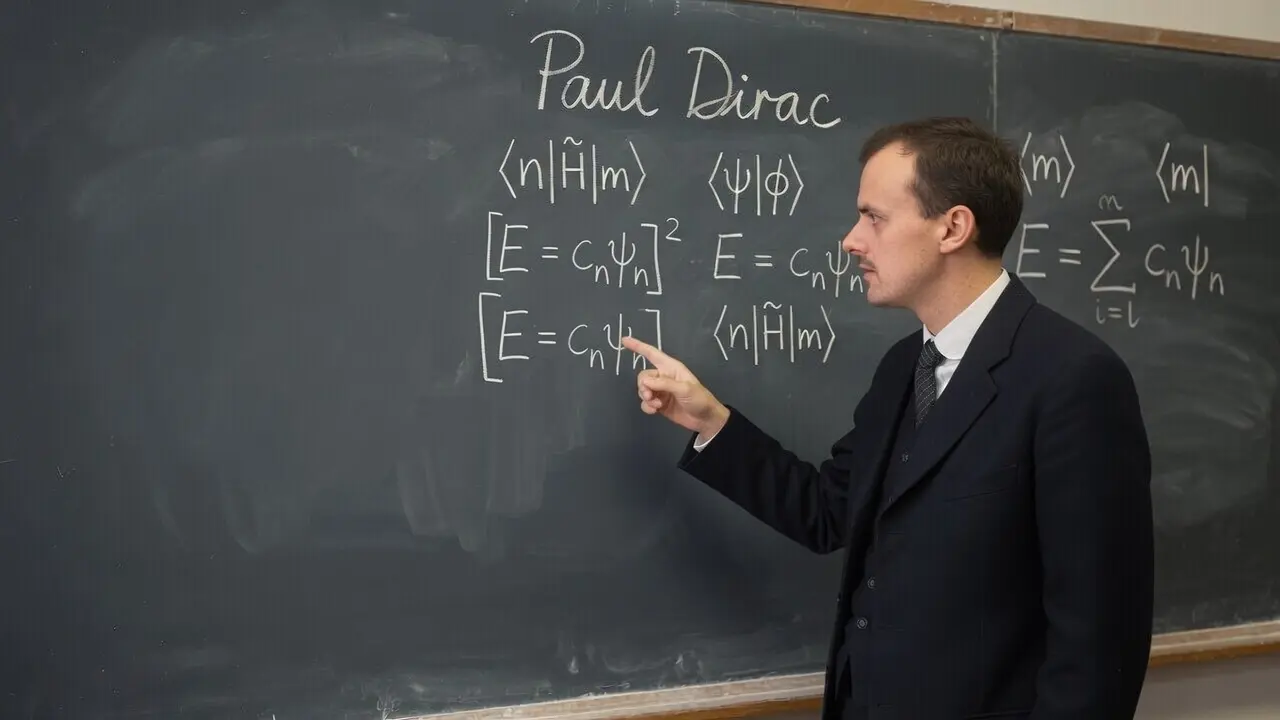
His most visible legacy is the bra-ket notation, a compact way of writing quantum states as kets and their duals as bras. He set it out fully in a 1939 paper, and it spread quickly because it made quantum calculations far easier to write and to read. Few pieces of mathematical shorthand have proved so durable or so widely adopted.
Anyone who studies quantum computing meets Dirac notation on the first day, since qubits, superpositions and measurements are all written with the bras and kets he devised. When an engineer describes the state of a register or the action of a quantum gate, the symbols on the whiteboard are Paul Dirac’s. His notation is the working script of every quantum laboratory and classroom in the world.
The book that taught quantum mechanics
If the Dirac equation made his reputation among researchers, it was a textbook that carried his influence to everyone else. The Principles of Quantum Mechanics, first published in 1930 and revised across four editions, presented the whole theory as a single elegant structure rather than a collection of recipes. Generations of physicists, including many who would later build quantum computing, first understood the subject through its pages.
The book was admired for its clarity and its almost severe economy, saying exactly what was needed and no more, much like its author. It introduced ideas, among them the bra-ket notation in its later editions, that students now absorb as though they had always existed. Einstein is said to have kept a copy close at hand and to have praised it as a uniquely logical presentation of the theory.
Part of the book’s lasting value is that it taught a way of thinking, not just a set of techniques. Readers learned to treat quantum states as abstract objects in a vector space and to act on them with operators, the very mindset a quantum programmer needs today. In that sense the textbook was an early bridge between pure theory and the practical quantum engineering that lay decades in the future.
Monopoles and the large numbers puzzle
The same 1931 paper that pointed to the positron also predicted another exotic object, the magnetic monopole, a particle carrying an isolated north or south magnetic pole. Dirac showed that if even one such monopole existed anywhere in the universe, it would explain why electric charge always comes in neat whole-number multiples. No monopole has yet been found, but the argument was so elegant that experimenters still hunt for one and theorists still take the idea seriously.
In his later years Dirac turned to cosmology with his large numbers hypothesis, noticing that certain huge dimensionless ratios in physics are surprisingly close in size. He suggested this could not be mere coincidence and proposed, controversially, that the strength of gravity might slowly change as the universe ages. The idea has not been confirmed, yet it shows the same instinct that served him so well, a refusal to dismiss a striking pattern as an accident.
Not every one of these later speculations paid off, and Dirac himself grew somewhat isolated from the mainstream in his final decades. Even so, the questions he raised were deep, and several of them remain open problems that physicists still return to. His willingness to follow a mathematical hint wherever it led was both his greatest strength and, at times, a limitation.
A singular mind
Dirac was famous for his precision and his silence, speaking rarely and only when he had something exact to say. Stories of his literal-minded replies became part of physics folklore, and colleagues jokingly defined a unit called the dirac, equal to one word per hour. Behind the reserve was a thinker of extraordinary originality who simply saw no reason to use words he did not mean.
In 1937 he married Margit Wigner, the sister of the physicist Eugene Wigner, and he is said to have introduced her to guests as Wigner’s sister rather than as his own wife, a story often told to capture his exactness. The marriage steadied a man who had known little warmth in childhood, and the couple raised a family together in Cambridge. Those who knew him well described a kind and loyal person beneath the famous shyness.
He disliked publicity intensely and reportedly considered turning down the Nobel Prize to avoid the attention, relenting only when Ernest Rutherford warned that a refusal would draw even more of it. Paul Dirac also declined a knighthood, in part because accepting would have meant being addressed by his first name by strangers. That blend of brilliance and reticence made him one of the most quietly revered figures in the history of science.
Why Paul Dirac matters in quantum computing
Dirac helped lay the mathematical foundation that all quantum technology stands on, and his bra-ket notation is the working language of the field. When engineers describe a qubit’s state or the action of a quantum gate, they write it in the symbols he devised, a direct line from 1920s Cambridge to the quantum processors being built today by companies such as IBM, Google and Infleqtion.
His example also shaped how physicists think about discovery itself. The faith that a beautiful equation can reveal a hidden truth, vindicated when antimatter turned out to be real, still guides the search for new physics and new ways of computing. Researchers chasing better qubits and error-corrected machines work in a tradition that Dirac did as much as anyone to establish.
Much of modern quantum field theory and particle physics grew directly from the formal structures he introduced, and those same structures now reach into quantum information science. The mathematics of states, operators and measurements that students learn for quantum computing is, in large part, the mathematics Dirac organised. His fingerprints are on both the hardware and the theory.
He spent his final years in the United States as a professor at Florida State University, far from the Cambridge where he had made his name, and he died in Tallahassee on 20 October 1984. He received the Order of Merit, one of Britain’s highest honours, and is commemorated with a plaque in Westminster Abbey near Isaac Newton. Paul Dirac remains one of the quiet giants on whose work the quantum era was built.
Frequently asked questions
Who was Paul Dirac?
What is the Dirac equation?
What did Paul Dirac predict?
What is bra-ket notation?
Did Paul Dirac win a Nobel Prize?
What is the Dirac delta function?
How does Paul Dirac influence quantum computing?
Where did Paul Dirac work?
Why did Paul Dirac value mathematical beauty?




See today’s quantum computing news on Quantum Zeitgeist for the latest breakthroughs in qubits, hardware, algorithms, and industry deals.