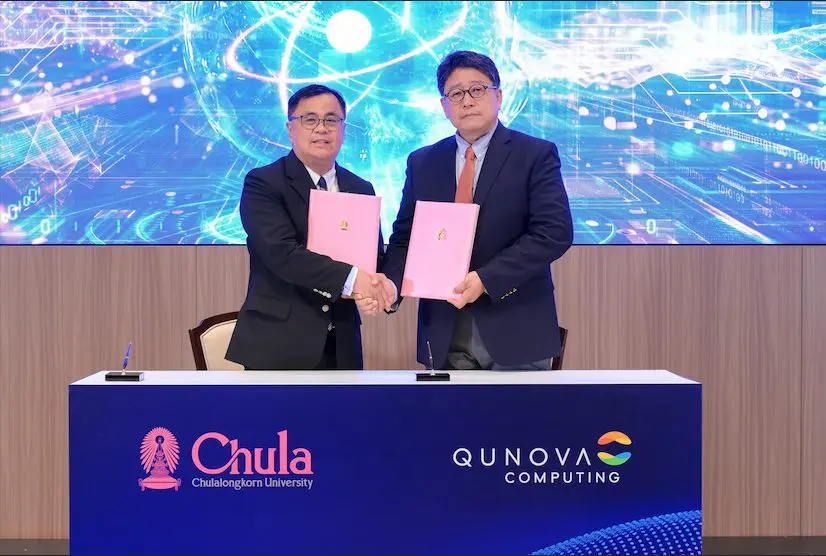
Chulalongkorn University has entered a three-year research collaboration with Qunova Computing, aiming to apply quantum technology to challenges in medicine, the physical sciences, and finance. The partnership, formalized through a Memorandum of Understanding, follows a workshop where researchers from Qunova and the Korea Advanced Institute of Science and Technology presented hybrid quantum-classical algorithms.
“Thailand should not merely be a user of technology that others have built,” said Professor Dr. Wilert Puriwat, President of Chulalongkorn University, emphasizing the nation’s ambition to actively participate in quantum technology development. Qunova’s Chief Product Officer, Dr. Jaewan Kim, noted the collaboration’s potential, stating.
Joint Research Initiatives Between Chulalongkorn and Qunova Computing
Chulalongkorn University and Qunova Computing will focus initial joint projects on real-world problems identified within Thai medicine, physical sciences, and finance, a departure from purely theoretical quantum research. During a preceding technical workshop, Chulalongkorn researchers presented specific challenges they currently face in these fields, prompting Qunova to tailor its expertise in hybrid quantum-classical algorithms to address them directly. Jaewan Kim, signals an intent to move beyond foundational research and deliver practical applications.
“Researchers in medicine, in the physical sciences and in finance each described problems they are already facing. That is where useful quantum work begins, and it is why we wanted this collaboration,” Kim stated. The collaboration extends beyond immediate research aims to include reciprocal exchanges of personnel and knowledge, with a three-year timeframe established by the signed Memorandum of Understanding.
Dean Eunseong Kim of KAIST, a founding institution of Qunova Computing, discussed opportunities for Thai students to pursue studies in the Republic of Korea, fostering a long-term pipeline of quantum expertise. This emphasis on personnel development underscores Chulalongkorn University’s ambition to become an active participant in quantum technology, rather than solely a consumer.
Professor Dr. Founded in 2021 as a spin-out from KAIST, the company has rapidly established itself as a player in the quantum software landscape, securing Series A funding of approximately 13.5 billion won from Korea Development Bank, Company K Partners, and GS Ventures. This financial backing, coupled with its selection for the JHPC-quantum Test User Program in Japan, demonstrates Qunova’s growing international recognition and its ability to integrate supercomputing resources with quantum algorithms.
The partnership with Chulalongkorn also reflects Thailand’s broader strategy of adopting a cloud-first approach to quantum computing, by using access to quantum hardware through cloud platforms rather than investing in building its own physical machines. Siam Quantum Square (SQ²), acting as the principal coordinator for Chulalongkorn, will facilitate this collaboration alongside existing partnerships with IBM Thailand, the Quantum Technology Foundation, and other institutions. “That is a demanding goal for a country of our size, and we can reach it only by working with the best partners we can find.”
What makes a collaboration like this real is people, a student who spends a year in Korea, a researcher who travels to Bangkok, or a problem from a Thai hospital that becomes a shared research question,” Puriwat explained, emphasizing the importance of human exchange in driving meaningful progress. The panel discussion following the signing, titled “Thailand–Korea Collaborations on Quantum Technology: from Academia to Use Cases,” further highlighted the commitment to translating academic research into tangible applications.
Thailand should not merely be a user of technology that others have built. We should understand it, take part in developing it, and help shape the direction it takes.
Professor Dr. Wilert Puriwat, President of Chulalongkorn University




See today’s quantum computing news on Quantum Zeitgeist for the latest breakthroughs in qubits, hardware, algorithms, and industry deals.