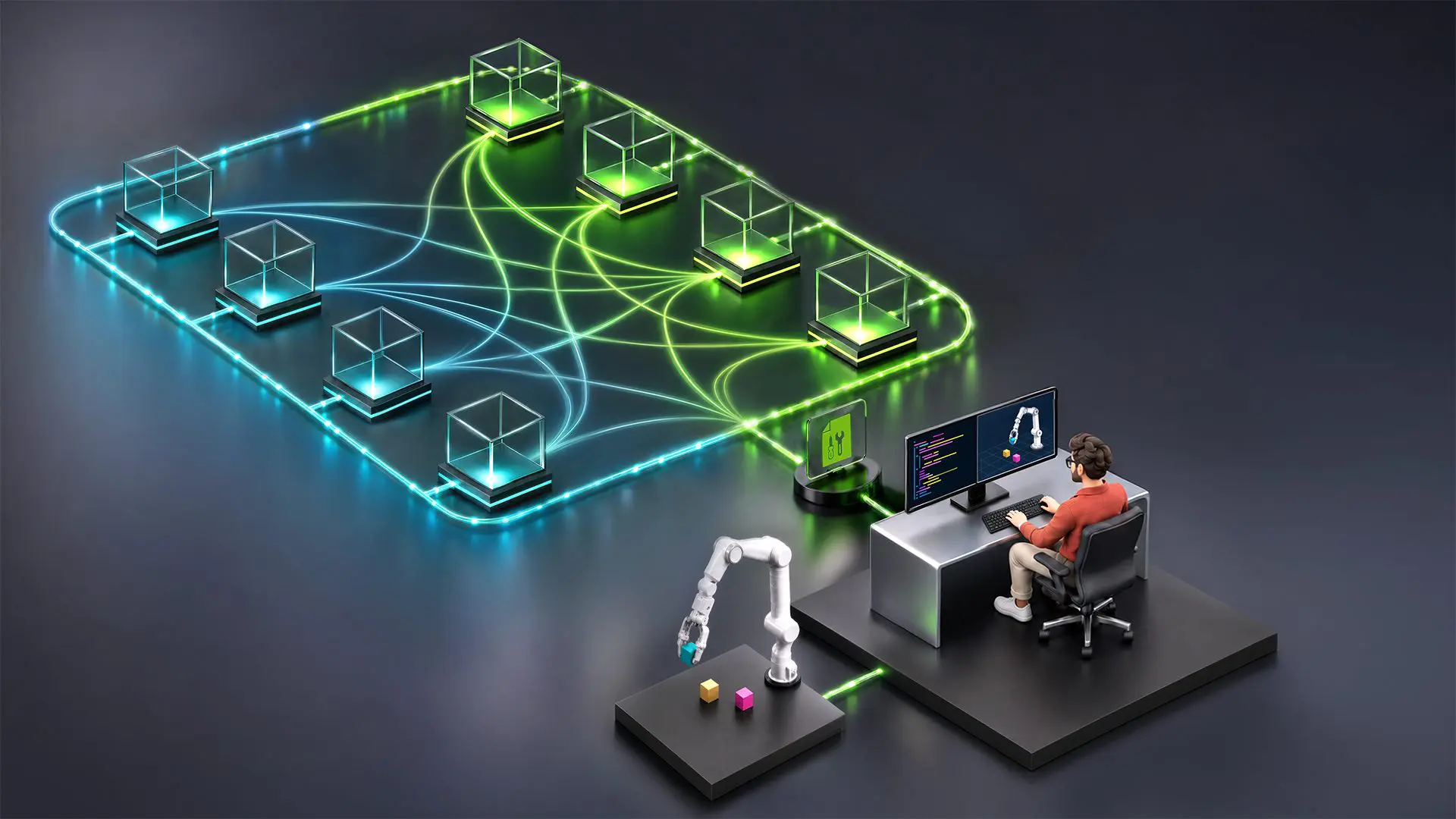
NVIDIA has equipped ROS 2 nodes with a new capability: zero-copy data transport, directly addressing performance bottlenecks that can arise even with GPU acceleration. The company recently contributed a CUDA buffer backend to ROS Lyrical, allowing GPU-resident payloads to move between nodes without CPU serialization or copying when conditions allow, NVIDIA says.
All nodes within NVIDIA Isaac ROS 5.0 have been updated to use the CUDA buffer backend and benefit from the more efficient data movement. This advancement moves memory sharing and data management behind a standard ROS 2 field, enabling developers to focus on node logic while retaining CPU fallback for compatibility.
NVIDIA Isaac ROS Acceleration with Zero-Copy Data Transfer
The ability to automatically audit and refactor existing CUDA-accelerated nodes represents a new approach to optimizing robotic systems, shifting the burden of complex code review from developers to an AI-powered workflow. This automated process is particularly valuable given that even with GPU acceleration, data transfer bottlenecks stemming from CPU memory copies can significantly limit performance gains in robotics applications.
Jaiveer Singh, an author of this article, explains the importance of this optimization for real-world robotic deployments, noting the need to “close the last-mile gap to bring robots into the real world.” The agent’s ability to verify the optimized data path and a CPU fallback ensures robustness and compatibility across diverse hardware configurations. NVIDIA demonstrated the effectiveness of this approach using a node that performs monocular metric-depth inference with NVIDIA TensorRT, according to the company.
This node, which converts incoming images to floating-point depth images, previously relied on CPU-backed ROS boundaries surrounding the GPU-native algorithm. By migrating to the CUDA buffer backend, the system eliminates unnecessary data transfers, streamlining the process and maximizing GPU utilization. During testing, the CUDA buffer APIs automatically detected the buffer backend type and performed conversions when needed, allowing the same code to function seamlessly with both CPU- and GPU-based messages.
The automated migration process begins with the AI agent tracing data movement within the ROS 2 node. It then identifies which fields would benefit most from GPU-backed storage, preserving standard ROS 2 interfaces throughout the process. This ensures that the optimized node remains compatible with existing ROS 2 infrastructure and can be easily integrated into larger robotic systems. As the agent plans the refactor, it prioritizes repeatability, turning what would typically be a one-off code modification into a streamlined, automated workflow.
The integration of this AI-assisted workflow within NVIDIA Isaac ROS 5.0 underscores the company’s commitment to providing a comprehensive software stack for robotics development. Coupled with the edge compute capabilities of NVIDIA Jetson AGX Thor, this platform enables the deployment of demanding ROS 2 perception, inference, and autonomy workloads directly on the robot.
rosidl::Buffer and CUDA Backend Enable GPU-Resident Messages
The introduction of rosidl::Buffer alongside a new CUDA buffer backend within ROS Lyrical allows for zero-copy transport of GPU-resident payloads between ROS 2 nodes, a capability previously hindered by CPU memory copies even with GPU acceleration. This advancement fundamentally alters data exchange, enabling direct communication without intermediate data duplication when runtime conditions are met, while maintaining compatibility with standard ROS 2 messaging protocols and node boundaries. The system uses rosidl::Buffer
Building from source after cloning the rosidl_buffer_backends repository is sufficient to activate the backend, as the core rosidl::Buffer functions are already integrated into ROS 2 Lyrical. The architecture is designed as a ROS 2 plugin, meaning building and sourcing the CUDA buffer backend packages within a workspace automatically makes it available to nodes at runtime. A typical data flow, prior to this update, involved CPU-based messages arriving at a TensorRT node with CPU-backed buffers. “backend.c_str); if (backend !=” is a check performed during this process, according to the documentation. Accelerating a ROS 2 node now requires optimizing both GPU computation and data movement, a task NVIDIA simplifies with rosidl::Buffer, the CUDA buffer backend, and an AI-guided migration skill within Isaac ROS 5, the firm reports. 0.
DA3 TensorRT Node as a Migration Case Study
The DA3 TensorRT node served as a focused test case for a migration strategy centered on minimizing data transfer overhead, even within an already GPU-accelerated pipeline. This particular node, designed to convert incoming images to floating-point depth images using NVIDIA TensorRT, presented an ideal scenario because its core computation was already offloaded to the GPU; the challenge lay in optimizing the data flow surrounding that computation, the company states. The initial setup involved CPU-backed ROS boundaries framing a GPU-native algorithm, creating a potential bottleneck despite the accelerated processing. Adapting the TensorRT wrapper to accept CUDA buffer handles for input and output data formed the core of the migration, while deliberately preserving the existing application programming interface. This approach prioritized minimal disruption to existing codebases, a key consideration for widespread adoption.
The resulting change to the ROS transport was remarkably contained: the addition of a single subscription option, a CUDA memory allocation, two stream-aware handle extractions, and a single publish operation. No new message definitions, separate CUDA topics, or branching CPU/CUDA publishers were required, streamlining the integration process. The team reports that the migration focused on the transport layer, leaving the computationally intensive TensorRT inference engine untouched. Building upon the ROS 2 Lyrical release, which introduced the rosidl::Buffer feature, the migrated node is designed for compatibility with Lyrical and subsequent versions utilizing supported Remote Modularization Wrapper (RMW) implementations, specifically rmw_fastrtps_cpp and rmw_zenoh_cpp.
Verification of the CUDA buffer backend’s effectiveness relies on inspecting GPU activity and memory transfers using NVIDIA Nsight Systems. A successful migration, the team asserts, should not exhibit payload-sized host-to-device or device-to-host transfers at the ROS boundary. Comparable latency measurements before and after the change provide quantitative evidence of performance gains. The migrated DA3 node, they claim, preserves the RGB-to-depth result while using CUDA-backed ROS 2 message storage. In a CPU control setup, the node automatically detects the buffer backend type and performs CPU-to-CUDA conversion when necessary, ensuring compatibility with existing CPU-based messages. Conversely, with CUDA buffer-based messages, the CUDA buffer-aware subscriber can directly access the CUDA handle without additional copies. This automated migration workflow extends beyond the DA3 node, applicable to other CUDA-accelerated ROS 2 nodes featuring variable-length primitive message fields. The underlying principle, according to the documentation, is to treat optimization as an end-to-end systems task.
The ability to deploy this agent-driven ROS 2 workflow on NVIDIA Jetson AGX Thor enables more efficient and responsive performance in complex environments. The team emphasizes that the migration strategy is about optimizing the entire data pipeline for maximum efficiency.
AI Agent Skill Automates rosidl::Buffer Integration
All nodes in NVIDIA Isaac ROS 5.0 have been updated to use the CUDA buffer backend and benefit from the more efficient data movement enabled by rosidl::Buffer, immediately benefiting from the streamlined data movement it provides, and existing nodes can adopt the system with minimal code alterations. An AI coding agent now automates the process of integrating this CUDA buffer backend into existing CUDA-accelerated nodes, shifting the burden of optimization from manual code review to an AI-assisted workflow. This agent doesn’t simply rewrite code or apply templates; it directs a series of precise steps, beginning with recording the initial revision, target ROS environment, and any local changes, then confirming compatibility and adding necessary dependencies. The agent’s analysis extends to tracing each message field from receipt to publication, accounting for CUDA calls, strides, streams, and optional outputs, before generating a per-field migration plan.
This plan details removed copies, required adjustments, and paths that should remain unchanged, ensuring a minimal, interface-preserving patch is implemented. Verification isn’t limited to semantic correctness; the agent independently assesses backend negotiation, separate-process transport, buffer lifetime, and actual memory-copy behavior, ensuring the refactored node functions as expected. “Record the starting revision, target ROS environment, and existing local changes,” details the documentation outlining the agent’s initial steps. The rosidl::Buffer feature, introduced in ROS 2 Lyrical, is the foundation, while the CUDA buffer backend streamlines CUDA acceleration. The resulting accelerated workload can then be deployed on NVIDIA Jetson AGX Thor, further demonstrating the potential of this integrated approach. Even when enabled, some operations may still require device-to-host copies and synchronization, but the migration strategy minimizes these occurrences, focusing on optimizing the most critical data paths. To get started, NVIDIA recommends downloading Isaac ROS 5.0, reviewing the relevant documentation, installing the agent skill, and running the guided workflow on an existing CUDA-accelerated ROS 2 node, then profiling the resulting graph on Jetson AGX Thor.
Updating ROS 2 Nodes for CUDA Buffer Compatibility
The ability to exchange data directly between GPU memory and ROS 2 nodes, without CPU intervention, is now streamlined through an AI-assisted workflow. This isn’t a future promise, but a current implementation designed to bypass performance bottlenecks caused by traditional CPU memory copies even when GPU acceleration is employed. The system uses the rosidl::Buffer abstraction, initially introduced in ROS 2 Lyrical, to facilitate this direct memory access. This agent doesn’t rewrite code automatically, but rather analyzes data flow, identifies host-device boundaries, and coordinates necessary modifications to source code, dependencies, launch files, and testing procedures. Confirmation of message field type compatibility and the addition of CUDA buffer backend packages as dependencies are also automated steps within the workflow.
The core principle behind this optimization is to allow nodes to publish and subscribe to messages with data residing directly in GPU memory, bypassing the overhead of transferring data to and from the CPU. When publisher and subscriber meet the necessary runtime requirements, a shared host, CUDA device, and a supported RMW implementation like rmw_fastrtps_cpp, the payload moves without serialization or host copies. If these conditions aren’t met, ROS 2 automatically reverts to a CPU-based path, maintaining compatibility with existing nodes. “With the provided CUDA buffer APIs, from_input_buffer automatically handles the CPU fallback internally,” notes accompanying documentation, simplifying integration for developers. A simple command sequence, colcon build –packages-up-to cuda_buffer_backend followed by source install/setup. bash, makes the backend available to nodes at runtime.
This approach allows for a modular and flexible system, where developers can selectively enable GPU-direct communication for specific nodes without requiring a complete overhaul of their ROS 2 applications, the company’s account states. The system also includes a verification step, generating custom source and sink nodes to test the migrated node under both CPU and GPU configurations without code alterations. The workflow has been demonstrated on NVIDIA Jetson AGX Thor, showcasing the potential for accelerated performance in robotic applications, the company claims. The company emphasizes that optimization should be treated as an end-to-end systems task, not merely a computational one. This holistic approach extends beyond accelerating individual computations to encompass the entire data pipeline, from data acquisition to processing and control. The CUDA buffer backend, alongside the agent-driven migration workflow, represents a step toward more efficient and responsive robotic systems.
The ability to minimize data movement and maximize GPU utilization is crucial for real-time applications, such as autonomous navigation, object recognition, and manipulation. The system’s design prioritizes compatibility and flexibility, allowing developers to adopt the technology incrementally and integrate it seamlessly into existing ROS 2 projects. The skill also contains a verification step that helps produce custom source and sink nodes for testing and validation, ensuring the integrity of the migrated data flow.
Source: https://developer.nvidia.com/blog/accelerating-a-ros-2-node-with-an-ai-agent-and-nvidia-isaac-ros/



See today’s quantum computing news on Quantum Zeitgeist for the latest breakthroughs in qubits, hardware, algorithms, and industry deals.