Researchers at Nanjing University have experimentally demonstrated a measurement-device-independent quantum cryptographic conferencing (MDI QCC) network, an important step toward building practical multi-user quantum communication systems. The group of Prof. Xiao-Song Ma achieved conference key rates of up to 7.54 bits per second with losses of 14.1 dB, utilizing a refined protocol and demonstrating multi-photon interference.
Measurement-Device-Independent QCC Protocol Enables Multi-User Security
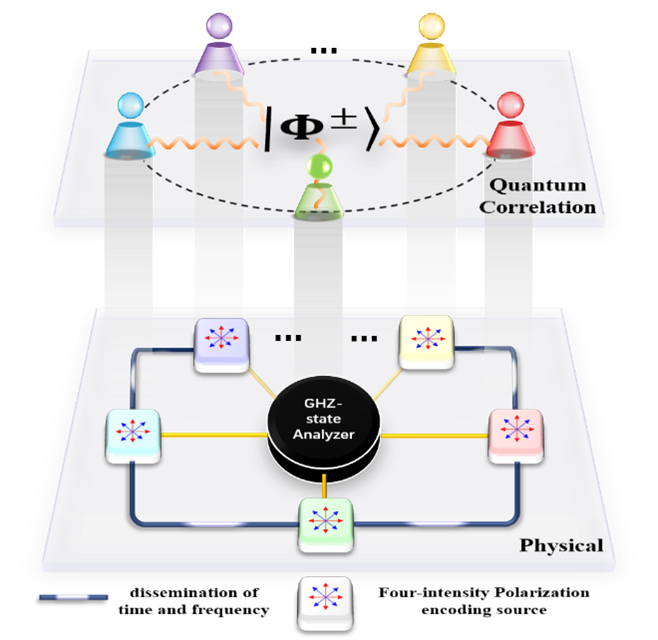
MDI-QCC protocols utilize three-photon GHZ states post-selected by a GHZ-state analyzer, a departure from the two-photon Bell states common in standard MDI QKD protocols and a key element in expanding network capacity. This approach allows multiple users to share a single secure key, establishing multipartite quantum correlation essential for enhanced security, as the team at Nanjing University demonstrated experimentally. The demonstrated protocol offers immunity to attacks targeting detection systems, improving practicality and security over entanglement-based methods that rely on direct multi-photon entanglement distribution.
The polarization-encoding MDI QCC protocol, initially proposed in 2015 with publication in Phys. 114, 090501, provided the theoretical groundwork for this experimental verification, though practical implementation remained a challenge until now. According to the researchers, this work confirms the protocol’s feasibility and establishes a benchmark for future MDI-QCC networks aiming for higher key rates and extended communication distances.
This advancement coincides with complementary work from the Southern University of Science and Technology, published in Phys. 133, 210803, further accelerating the development of practical multi-user quantum networks. The laboratory, established in 1984 and currently staffed by approximately 86 people, continues to investigate quantum phenomena in solid-state systems, with a focus on creating quantum devices for both computing and sensing applications; Yu Yang’s group previously reported long-range ZZ interaction via resonator-induced phase in superconducting qubits. The team reports this signifies a move beyond two-user quantum key distribution towards a more scalable quantum internet.
Four-Intensity Protocol Upgrades Key Rate and Distance
The team upgraded an original three-intensity protocol, significantly enhancing secure key rates and extending communication distance under realistic conditions of limited transmitted pulses. This improvement hinged on theoretical investigation and experimental verification of multi-photon interference during GHZ-state projection measurement using weak coherent states. Establishing a three-user communication network, the researchers achieved conference key rates of approximately 7.54 bits per second at 14.1 dB loss, alongside 1.17 bps at 17.8 dB and 0.097 bps at 21.5 dB, demonstrating scalability beyond two-user quantum key distribution.
The team reports, referencing publication 114, 090501. The laboratory, actively engaged in quantum computing applications, continues to refine these protocols for broader implementation.
Nanjing University Demonstrates 7.54 bps Conference Key Rates
Yifeng Du, a doctoral candidate at Nanjing University, spearheaded experimental work extending quantum key distribution beyond two parties. Funding for this research came from multiple sources, including the National Key Research and Development Program of China and the National Natural Science Foundation of China. Support also came from the Leading-Edge Technology Program of Jiangsu Natural Science Foundation, the Fundamental Research Funds for the Central Universities, and internal programs at Nanjing University and the University of Science and Technology of China.
Academician Shining Zhu from Nanjing University offered guidance throughout the project, contributing to the refinement of the protocol. Professor Xiao-song Ma at Nanjing University served as the corresponding author, overseeing the project and its publication.



See today’s quantum computing news on Quantum Zeitgeist for the latest breakthroughs in qubits, hardware, algorithms, and industry deals.