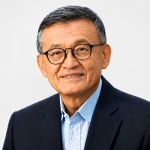
Adam Wei Tsen, Associate Professor in Chemistry and faculty in Quantum Computing, has been appointed an Endowed Chair in Nanotechnology at Waterloo, a position he will hold for an initial term of five years with potential for renewal. Tsen’s research focuses on two-dimensional quantum materials, engineered into heterostructures exhibiting properties like superconductivity and unique magnetism, then fabricated into devices that can surpass traditional systems.
He leads a team integrating expertise from chemistry, physics, and engineering, stating, “It helps to have people with different backgrounds precisely because our work is at the intersection between different fields.” This interdisciplinary approach, supported by Waterloo’s nanotechnology infrastructure, aims to bridge materials science with quantum device development.
Tsen Appointed Endowed Chair in Nanotechnology
This long-term investment acknowledges the significance of Tsen’s work at the intersection of materials science and device engineering, a field demanding both fundamental understanding and practical application. Critical to this research is access to specialized facilities; Tsen emphasizes the necessity of nanofabrication tools for creating electrical contacts and complex heterostructures.
“A lot of our work requires the ability to make devices on extremely small materials—on the micron scale,” he says. Without that infrastructure, we wouldn’t be able to do the things that we do at all.” This infrastructure, he notes, is uniquely available within Canada, providing a distinct advantage for his team’s investigations into nanoscale phenomena.
Expertise in devices and circuits complements a deep understanding of solid-state materials, creating a synergistic environment for tackling complex challenges. “Someone from a purely chemistry or physics background might not have a lot of exposure to devices and circuits. Someone from an engineering background might not know much about solid-state materials. These different types of expertise complement each other,” Tsen explains. He envisions his work bridging the gap between materials science, nanotechnology, quantum computing, and device engineering, fostering collaboration across traditionally separate communities.
He aims to extend techniques developed for two-dimensional systems to other materials, including bulk crystals and thin films, broadening the potential impact of his research. This expansion of scope underscores the ambition of the newly endowed chair to advance nanotechnology through a uniquely integrated approach.
The nanotechnology infrastructure here is quite unique in Canada.
Adam Wei Tsen, Associate Professor in Chemistry and faculty at the Institute for Quantum Computing

See today’s quantum computing news on Quantum Zeitgeist for the latest breakthroughs in qubits, hardware, algorithms, and industry deals.