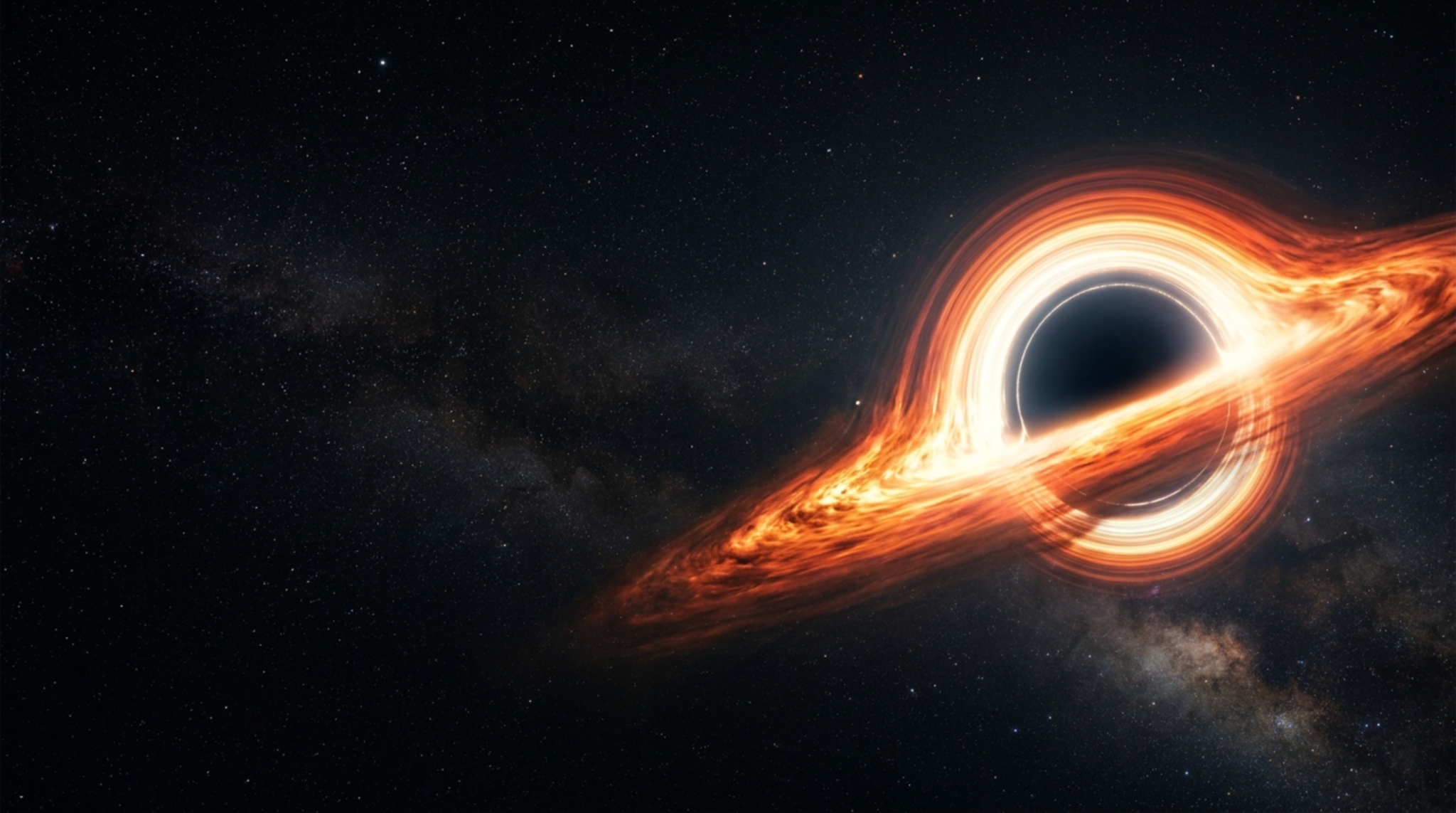
Both Hawking thermality and interior quantum scrambling have been successfully simulated within a unified framework on superconducting quantum hardware. A chiral spin chain implemented on this platform at the University of Leeds revealed an inverse relationship between peak arrival time and surface gravity, establishing a calibrated estimator for Hawking temperature. Key black hole characteristics are now unifiedly simulated using superconducting quantum hardware.
The simulation combines observations of Hawking radiation with internal chaotic behaviour known as scrambling within one experiment. Previously, simulations typically studied either emission or chaos separately; this approach enables fuller exploration of connections between gravity and quantum mechanics. The University of Leeds has achieved an advance by simulating key characteristics of black holes, Hawking thermality and internal quantum scrambling, within a single experiment on superconducting hardware.
Their setup utilises a simplified mathematical representation of a black hole’s edge; this ‘chiral spin chain’ consists of interconnected quantum bits behaving like tiny magnets with a specific directional twist. Researchers observed Hawking thermality alongside investigation into how information becomes scrambled within the simulated black hole’s interior, akin to repeatedly shuffling cards until their original order is lost. This unified approach allows for deeper exploration of connections between gravity and quantum mechanics than previous simulations which focused on either emission or chaos in isolation; detailed technical aspects regarding circuit implementation and model parameters follow.
Simulating Black Hole Horizons with Programmable Superconducting Qubits
A technique centred around a ‘chiral spin chain’, a simplified mathematical representation of the edge of a black hole built from interconnected quantum bits behaving like tiny magnets with a specific directional twist, enabled precise control over simulated spacetime curvature. Rather than build one enormous simulation encompassing all aspects of a black hole, researchers created custom circuits derived from this core model and optimised them to probe different phenomena without increasing computational demands beyond current hardware capabilities. Specifically, they developed mean-field and coordinate equivalent versions alongside an interacting circuit allowing focus on either light propagation, thermal emission or internal scrambling independently but within the same foundational framework.
Superconducting quantum hardware constructed this chiral spin chain simulating a black hole; it enables focused investigation into both semiclassical physics at the event horizon and internal quantum scrambling. Researchers optimised each version, including mean-field and coordinate equivalents plus an interacting circuit, for its respective measurement objective within a unified framework. This approach allows examination of specific phenomena such as light propagation or thermal emission without exceeding current limitations.
Simulating Hawking radiation and quantum scrambling concurrently reveals internal black hole dynamics
The researchers and colleagues have achieved over sixfold improvement in simulating black hole interiors by simultaneously modelling both Hawking radiation and quantum scrambling using observable-specific circuits. The advance overcomes hardware depth restrictions that previously limited investigations to isolated aspects of black hole physics, enabling more thorough exploration of connections between gravity and quantum mechanics. Researchers implemented a chiral spin chain constructed from interconnected quantum bits on superconducting hardware allowing precise control over spacetime curvature simulation.
Measurements of dispersion relations verified predicted light-cone evolution within the black hole exterior and interior; these tests confirmed how spacetime curves around a black hole affect the path of light according to general relativity. To assess Hawking thermality, researchers introduced a localised disturbance inside the simulated horizon then monitored as it spread outwards, observing an inverse relationship between peak arrival time and surface gravity expected for thermal radiation.
Furthermore, by adjusting interaction strengths within their simulation, they distinguished predictable wave behaviour in simpler systems from chaotic ‘Lyapunov-like’ spreading characteristic of complex quantum scrambling processes. These experiments employed custom circuits derived from this underlying model reducing computational demands while preserving key physical properties relevant to each measurement type.
Hawking radiation and information scrambling modelled using chiral spin chains
The ability to simulate black holes offers a unique testing ground for fundamental theories attempting to reconcile general relativity with quantum mechanics; however, faithfully recreating these extreme environments remains computationally challenging. The scientists acknowledge that their simplified mathematical analogue of a black hole’s edge necessarily omits important aspects of true gravitational effects arising from spacetime curvature itself. Nevertheless, the focused approach allows isolation of key quantum effects without being overwhelmed by computational demands.
This programmable platform will unlock deeper understanding of these complex phenomena, paving the way for new theoretical advances. Their successful simulation provides a unified framework to study both Hawking thermality and internal quantum scrambling simultaneously, previous work typically investigated these separately. This advance overcomes limitations imposed by current superconducting hardware allowing more fully exploration of connections between gravity and quantum mechanics; it builds upon earlier simulations utilising a chiral spin chain constructed from interconnected quantum bits.
The researchers successfully simulated aspects of black hole physics using superconducting quantum hardware and a chiral spin-chain model. They measured an inverse relationship between peak arrival time and surface gravity when monitoring disturbances introduced inside the simulated horizon, consistent with expectations for thermal radiation like that predicted by Hawking’s theory. The team created a unified platform to study both Hawking thermality and internal quantum scrambling simultaneously, which may aid further theoretical development in this field.
👉 More information
🗞 Simulating Black Hole Thermality and Interior Scrambling on a Superconducting Quantum Processor
✍️ Ryan Smith, Ewan Forbes, Iason Sofos Andrew Hallam and Jiannis Pachos
🧠 ArXiv: https://arxiv.org/abs/2608.19318
See today’s quantum computing news on Quantum Zeitgeist for the latest breakthroughs in qubits, hardware, algorithms, and industry deals.