

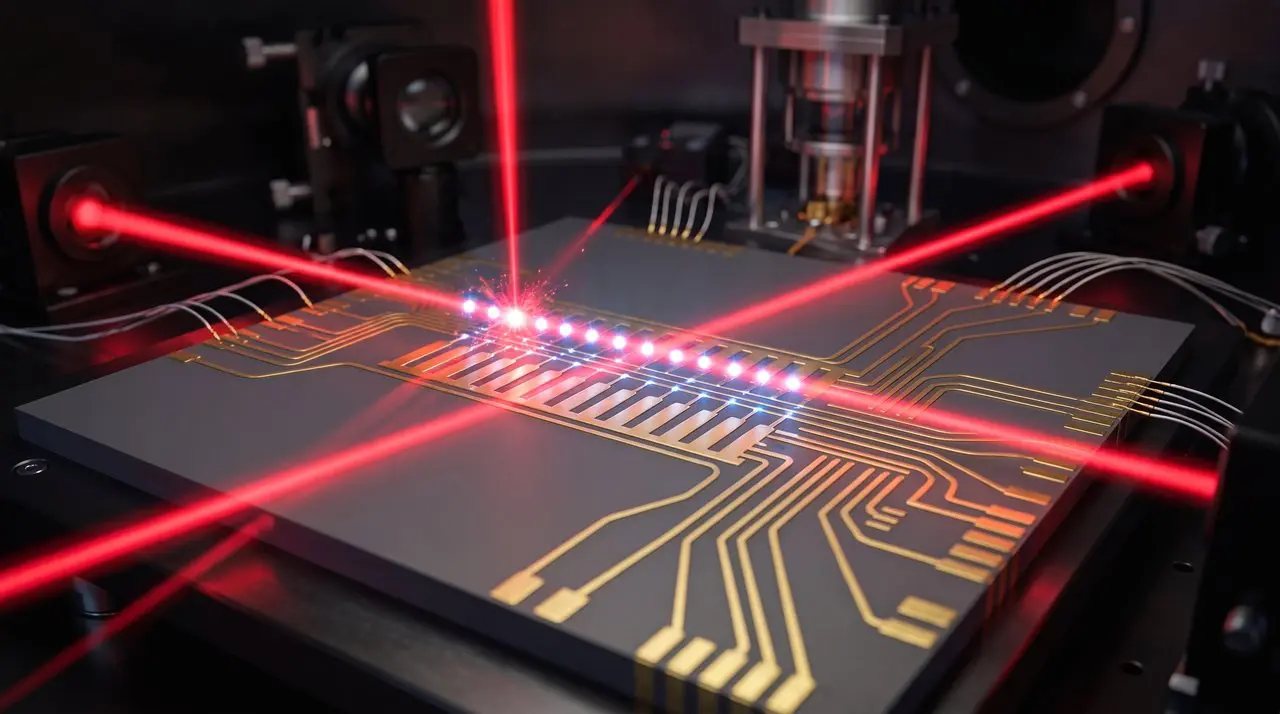
Analytical equations now detail how external disturbances impact Majorana qubits for the first time, moving beyond previous approximations. Sauri Bhattacharyya and Bernard van Heck from Dipartimento di Fisica, Sapienza Universit`a di Roma developed equations describing a Majorana qubit’s steady state, parity leakage rate, and decoherence rate within a topological superconductor experiencing quasiparticle poisoning, a process where unwanted particles disrupt coherence. The analysis shows that imperfections in materials influence majorana qubit stability; these qubits represent a potential pathway toward constructing more resilient quantum computers.
The team’s analysis reveals initial protection against computational errors diminishes when key characteristics within the qubit change due to external disturbances affecting its coherence. This quantitative understanding will aid future development by enabling interpretation of data from experimental prototypes. Their work details how external disturbances impact Majorana qubits, unusual states of matter potentially useful for storing quantum information because they are naturally protected from certain types of noise.
The team derived analytical expressions describing a qubit’s behaviour within a topological superconductor experiencing quasiparticle poisoning, disruptions caused by unwanted particles impacting coherence. The analysis reveals that initial error protection decreases as characteristics change in the qubit itself; this is similar to tracking how a spinning top gradually slows down through friction and energy loss over time. These findings provide quantitative insight into interpreting data from experimental prototypes and will support further development towards building more resilient quantum computers, although questions remain regarding precisely how these disturbances affect long-term stability.
Increased Energy Splitting Mitigates Decoherence via Quasiparticle Poisoning in Topological Qubits
A key indicator of qubit coherence, initial exponential suppression of dephasing rates, is removed when energy splitting increases within qubits. Previously available derivations were limited as they could not be applied across arbitrary charging energies; this analysis details how extrinsic quasiparticle poisoning impacts Majorana qubits hosted in finite-size topological superconductors with four Majorana zero modes. Increasing the energy difference between qubit states diminishes parity leakage rates, errors stemming from extraneous particles, and offers a new understanding of decoherence mechanisms affecting these promising quantum bits.
Unwanted electrons leak into superconducting circuits via external connections, but increasing energy splitting counteracts this decoherence process. The calculations detail how finite-size effects influence topological superconductors hosting four Majorana zero modes; insight is provided into the decrease in parity leakage rates as the difference between qubit states grows.
Analytical models predict resilience thresholds for topological qubit coherence
Stable quantum bits require minimising decoherence because these fragile states are easily disrupted by external influences that destroy encoded information. Current modelling often concentrates solely upon ‘extrinsic’ quasiparticle poisoning, unwanted particles entering from outside the system, potentially overlooking other sources of disruption present within actual physical qubits, highlighting a tension between analytical clarity and capturing all relevant complexities inherent to real-world device fabrication and operation. This acknowledgement offers important insights when building better qubits, providing benchmarks against which to assess experimental data from prototype Majorana qubits.
Maintaining fragile quantum information longer is particularly useful as scientists explore how energy splitting impacts dephasing rates. The Majorana tetron represents a promising type of quantum bit; it relies on exotic particles with unique properties for strong information storage.
Disturbances degrade quantum information within topological superconductors, superconducting circuits hosting unusual states known as Majorana zero modes that potentially offer inherent durability to noise. Deriving analytical expressions for key qubit properties like steady state behaviour and decoherence rates moved the research beyond previous approximations reliant on simplified models, revealing increasing the energy difference between qubit states can counteract disruption caused by quasiparticle poisoning.
The researchers demonstrated that increasing the energy separation of qubit states helps reduce decoherence in a Majorana tetron qubit. This finding matters because minimising decoherence is essential for maintaining stable quantum information processing. Their analysis, based on the Bloch-Redfield equation applied to a topological superconductor with four Majorana zero modes, provides equations describing qubit stability at varying charging energies. The authors suggest these results will aid interpretation of experimental data gathered from current prototype devices.
👉 More information
🗞 Dynamics of Majorana tetron qubits under quasiparticle poisoning
✍️ Sauri Bhattacharyya and Bernard van Heck
🧠 ArXiv: https://arxiv.org/abs/2608.18042


See today’s quantum computing news on Quantum Zeitgeist for the latest breakthroughs in qubits, hardware, algorithms, and industry deals.



