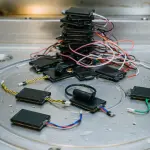
Qubic will deliver nine cryogenic amplifiers, along with components and software, to a Canadian government agency under a new CA$1.5 million (US$1.1 million) contract. The agreement tasks Qubic with providing low-noise amplifiers for testing as potential components in quantum computing systems, with all deliverables expected by spring 2027.
“The real-world applications for this technology are both tangible and strategically important on many levels,” said Jerome Bourassa, CEO and Co-founder at Qubic, as the company scales manufacturing to meet demand from quantum computing and defence sectors. The project, funded through the Innovation Solutions Canada program, will allow the government agency to evaluate the equipment and provide feedback to accelerate Qubic’s hardware development.
$1.5 Million ISC Contract Fuels Cryogenic Amplifier Delivery
Qubic will deliver additional components and software alongside the nine cryogenic amplifiers detailed in a new CA$1.5 million (US$1.1 million) contract with a Canadian government agency, following a $3.5 million seed funding round completed in June and a recent agreement with Quantum Machines. The contract, awarded through the Innovation Solutions Canada (ISC) Testing Stream, tasks Qubic with providing amplifiers for evaluation as low-noise receivers specifically for quantum computing applications, the company says.
All project milestones, including full product delivery, are scheduled for completion by spring 2027, establishing a clear timeline for the government’s assessment of the technology. Kinetic Inductance Traveling Wave Parametric Amplifiers, or KI-TWPAs, developed by Qubic, offer ultra-low-noise amplification across a broad microwave bandwidth, enhancing weak signals while minimizing distortion, a critical feature for sensitive quantum measurements.
Traditional amplifiers used in cryogenic environments consume approximately half of the cooling power available from dilution refrigerators, but Qubic projects its devices will dissipate less than 0.1 mW of heat. This reduction in heat dissipation has significant implications for both applied quantum sensing and the scalability of quantum computing systems, addressing a key challenge in maintaining stable cryogenic conditions. The amplifiers are designed for reading out superconducting qubits, but their functionality extends to other qubit modalities, broadening their potential applications within the quantum computing landscape, according to Qubic.
Unlike conventional amplifier designs reliant on fragile Josephson junctions, Qubic’s KI-TWPAs derive nonlinear inductance directly from the transmission line material itself. This design choice results in a more robust amplifier capable of operating near the quantum limit, while also enabling multiplexed qubit readout, a technique for simultaneously measuring multiple qubits.
The government agency procuring the amplifiers will conduct thorough testing and evaluation, providing Qubic with valuable feedback to accelerate its quantum hardware development and commercialization efforts. This customer input is expected to refine the amplifier’s performance and address any challenges encountered during real-world implementation. Qubic is currently finalizing the commercialization process and expanding manufacturing capacity to meet anticipated demand from both the quantum computing and defence sectors.
To date, the company has secured nearly $10 million CAD in combined equity investment and non-dilutive grant funding, supporting its research and development activities. Qubic’s technology aims to improve measurement sensitivity and reduce noise to near-zero levels, enhancing the accuracy of critical data in quantum systems.
As a spin-off of both the Institut Quantique and the Institute for Quantum Computing, the company focuses on developing signal processing hardware tailored for a quantum future. Bourassa added, “Quantum computing requires hardware innovations such as our amplifier, which unlocks new physical capabilities, in order to reach utility-scale in the medium term.” Our technology will enable future advancements related to several other applications and is already attracting interest from organizations across multiple sectors. Qubic’s dual-use technology is intended to push the boundaries of information clarity and operational excellence across a range of applications.
The market is beginning to accept what has been our thesis from the outset. Quantum computing requires hardware innovations such as our amplifier, which unlocks new physical capabilities, in order to reach utility-scale in the medium term.



See today’s quantum computing news on Quantum Zeitgeist for the latest breakthroughs in qubits, hardware, algorithms, and industry deals.