Quantinuum announced a 99.9995% logical fidelity on its Helios computer this week, exceeding Google Quantum AI’s previous record and indicating continued progress in the development of fault-tolerant qubits. This achievement uses a ‘color code’ error correction method and AI-driven decoders, and arrives with a separate Quantinuum breakthrough showing a twelve-fold reduction in the resource states needed for quantum computation, suggesting a path to scale beyond current limitations. However, University of Copenhagen and IBM researchers simultaneously revealed a fundamental weakness in a widely used error correction decoding technique, BP OSD, demonstrating that symmetries within the code can prevent accurate error identification.
The tension between advances in building qubits and discovering new ways they can fail is mirrored across the week’s developments. IBM systems powered six of the nine winning teams in Japan’s NEDO Quantum Challenge, demonstrating practical applications from drug discovery to content creation. NVIDIA’s successful simulation of a 104-qubit fault-tolerant computer on JUPITER relies on techniques to drastically reduce the physical qubit count needed, acknowledging the current difficulty of building and controlling large numbers of reliable qubits.
These parallel efforts to both improve hardware and reduce the demands on it suggest a growing recognition that a single solution will not deliver practical quantum computing. The field is now actively pursuing multiple, potentially complementary, strategies for achieving fault tolerance, and the next year will reveal which of these approaches can deliver demonstrable, sustained progress.
1. Quantinuum Achieves 12x Reduction in Quantum Resource States
Researchers and Quantinuum have designed a new quantum computer architecture reducing resources needed for error correction and computation. The design employs ‘concatenated cultivation’ to build strong resource states, injecting logic gates via teleportation using pre-shared entangled particles. This approach enables quantum algorithms to run with fewer resource states, offering spacetime reduction compared to existing methods, currently tested with H codes and Hamming codes. The architecture reduces resource state consumption for quantum algorithms, demonstrating execution with twelve or fewer states when approximately one hundred were previously required per layer. However, the team acknowledges benchmarks are limited to specific code concatenations, and it is unclear if this reduction in required resources will allow practical large-scale quantum computation.
2. University of Copenhagen and IBM Detail Quantum Error Correction Decoder Weakness

Researchers at the University of Copenhagen and IBM have identified a symmetry-induced failure mode in Belief Propagation combined with Ordered Statistics Decoding (BP OSD), a common technique for correcting errors in quantum computers. BP OSD struggles with errors smaller than half a key parameter, ‘d/2’, because of symmetries preventing accurate calculations, but adjustments to how the decoder updates information can overcome these issues. The team exhaustively tested five Bivariate Bicycle codes, pinpointing exact failure points down to an error weight of 5, and discovered numerical instabilities during simulations. This analysis improves understanding of how quantum codes fail, and offers a pathway toward more durable error correction, though accurately assessing performance at extremely low error rates remains challenging.
3. Quantinuum Achieves 10x Error Reduction with Helios Quantum Computer

Quantinuum announced a new world record of 99.9995% logical fidelity on its Helios computer, surpassing Google Quantum AI’s previous result. This achievement stemmed from an implementation of a ‘color code’ error correction method, combined with tailored AI decoders and all-to-all qubit connectivity. Quantinuum’s architecture demonstrated increasingly effective error suppression as the code scales, potentially requiring fewer qubits than other approaches. The company is focused on integrating hardware and software for fault-tolerant quantum computing, with a stated goal of a universal fault-tolerant computer. They reported an exponential fall in logical errors as the ‘code distance’ increases, with each tested increase reducing remaining logical errors by a factor of 12. This latest record follows a similar breakthrough one month prior, using the Helix code on the same Helios hardware.
4. Award-winning Japanese research projects utilize IBM systems for quantum computing advances.

IBM quantum computers were used by six of the nine prize-winning teams in Japan’s NEDO Quantum Challenge. The competition focused on applying quantum computing to real-world problems, with winning projects ranging from disaster prevention to creative content generation. Two teams, Q4Health and EntangleTune, have launched companies based on their IBM-powered research, addressing challenges from drug-resistant bacteria to creative content generation. Teams collectively used over 5,900 minutes of compute time on IBM’s quantum systems, exceeding allocated resources by five percent. Q4Health encoded a problem searching for bacteria combinations to combat drug-resistant infections with diagonal Pauli operators. IBM provided algorithmic advice and co-research opportunities, collaborating with teams from Mitsubishi Chemical, Keio University and Arizona State University.
5. Google Quantum AI Launches AI Contest to Shrink Quantum Circuits

Google Quantum AI has launched a competition on Kaggle to use artificial intelligence for compressing quantum circuits, aiming to reduce the demands on qubit counts and gate fidelity. The contest challenges participants to minimize circuit size using “kickmix” circuits, a structured design enabling efficient classical verification, across benchmarks including fusion energy and molecular simulation. This approach allows AI agents to automate the search for more efficient circuits, a process previously limited by verification difficulties, and builds on successes with the Gemini 4 Argon AI model. By focusing on benchmarks like the iron-molybdenum cofactor, the competition seeks to improve the efficiency of quantum simulations and accelerate the development of practical quantum algorithms, with circuits tested at 60 billion gates per second.
6. NVIDIA’s Ising Decoding Accelerates Quantum Error Correction
NVIDIA researchers and collaborators developed Ising Decoding, a pre-decoder that speeds up quantum error correction. The system filters easily corrected errors before sending the remaining issues to a standard decoder, reducing the time for a single error correction cycle. Benchmarks on Amazon Web Services show that, at a code distance of 31, Ising Decoding reduces decoding latency by 2.4 to 2.9 times compared to minimum-weight perfect matching, while also improving logical error rates. The computational cost of traditional decoding methods increases with code size, potentially limiting scalability; the team’s code and AWS sample are publicly available for further testing and adaptation.
7. Qiskit v2.6 Extends Quantum Software Beyond Python with C API
Qiskit has released version 2.6 of its SDK, introducing a C Application Programming Interface to expand capabilities beyond Python. This update features a customizable pass-manager framework and QPY serialization, enabling quantum circuit manipulation and transfer between languages without Python intermediary. The new QPY v18 format improves data handling for circuits with large or numerous classical registers. By providing direct access to core functionalities via C, Qiskit aims to integrate with high-performance computing environments and support complex quantum systems important for quantum-centric supercomputing and future fault-tolerant workloads. This work reflects a strategy of building Qiskit as a performant software stack for the entire quantum computing continuum, and changes are designed to be additive; existing C code should compile against version 2.6 without modification. Version 2.6 is the last Qiskit version that will support Python 3.10.
8. IBM Quantum Simplifies Gate Calibration with SVD Stacking Technique

IBM Quantum and collaborating institutions have developed SVD stacking, a technique to simplify the design of high-fidelity quantum gates. This method reduces the complexity of calibrating gates by identifying and focusing on a low-dimensional subset of the full parameter space used in optimization, allowing for more efficient on-device adjustments. The team successfully calibrated two Xπ/2 gates, one resilient to amplitude and detuning errors, and another against coherent errors, demonstrating targeted error mitigation. By streamlining calibration, this work addresses a challenge in scaling quantum computing and enables more precise control over qubits, potentially accelerating the development of fault-tolerant systems.
9. Quantinuum and Delft Demonstrate Scalable Boson Simulations with 56 Qubits

Researchers at Quantinuum, collaborating with the Delft Institute of Applied Mathematics and QuTech, have successfully simulated boson-matter interactions using a 56-qubit trapped-ion device. This work demonstrates that binary quadrature encoding, a method using the quantum Fourier transform, efficiently represents continuous properties with a balance of qubit count and computational steps. Previous simulations of this type required thousands of qubits, but this new approach achieved results with fewer resources. Initial experiments revealed noise sensitivity impacting accuracy at low boson numbers, prompting further research into error correction strategies to improve scalability and reliability. The detailed comparison of encoding methods provides a benchmark for evaluating future improvements in quantum error correction.
10. NVIDIA Simulates 104-Qubit Fault-Tolerant Quantum Computer on JUPITER
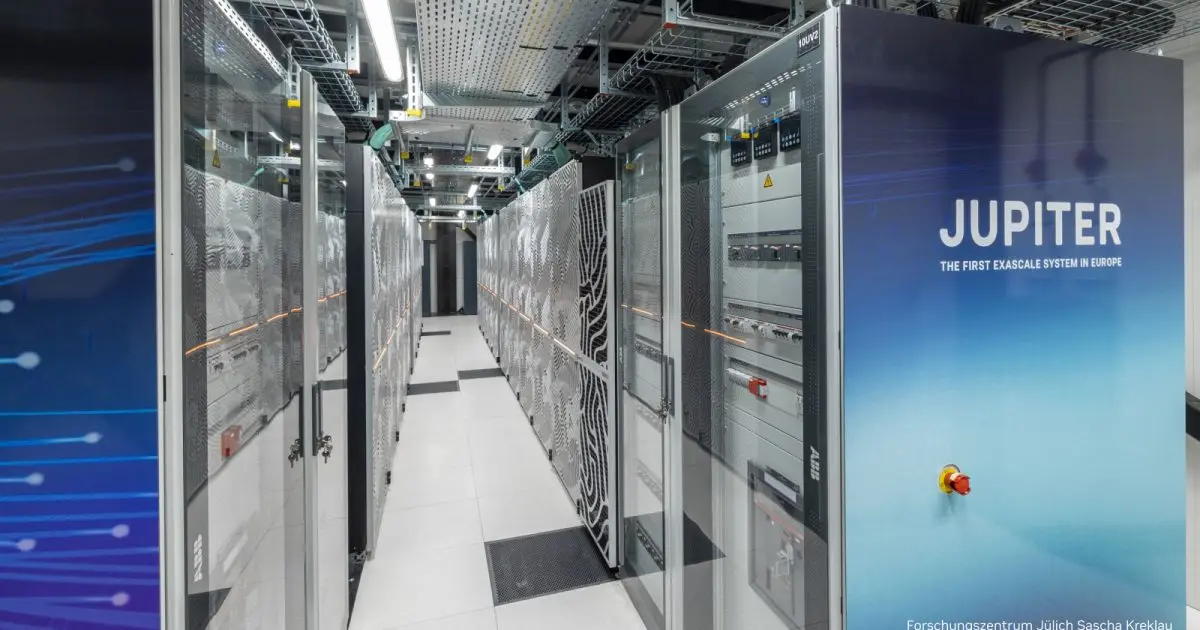
NVIDIA researchers have successfully simulated a 104-qubit fault-tolerant quantum computer using the JUPITER supercomputer. This simulation validated a method requiring 90% fewer physical qubits than previous approaches, potentially speeding up the development of practical quantum computers. Researchers refined their simulation techniques using NVIDIA’s GB200 NVL72 system before deploying them on JUPITER’s 8,192 GPUs, reducing a weeks-long task to just days. Including realistic hardware noise in the simulation, a key advancement over previous 50-qubit tests, allows for more accurate performance predictions, lowering the cost and time needed to build quantum computers for applications like drug discovery and financial modeling.




See today’s quantum computing news on Quantum Zeitgeist for the latest breakthroughs in qubits, hardware, algorithms, and industry deals.