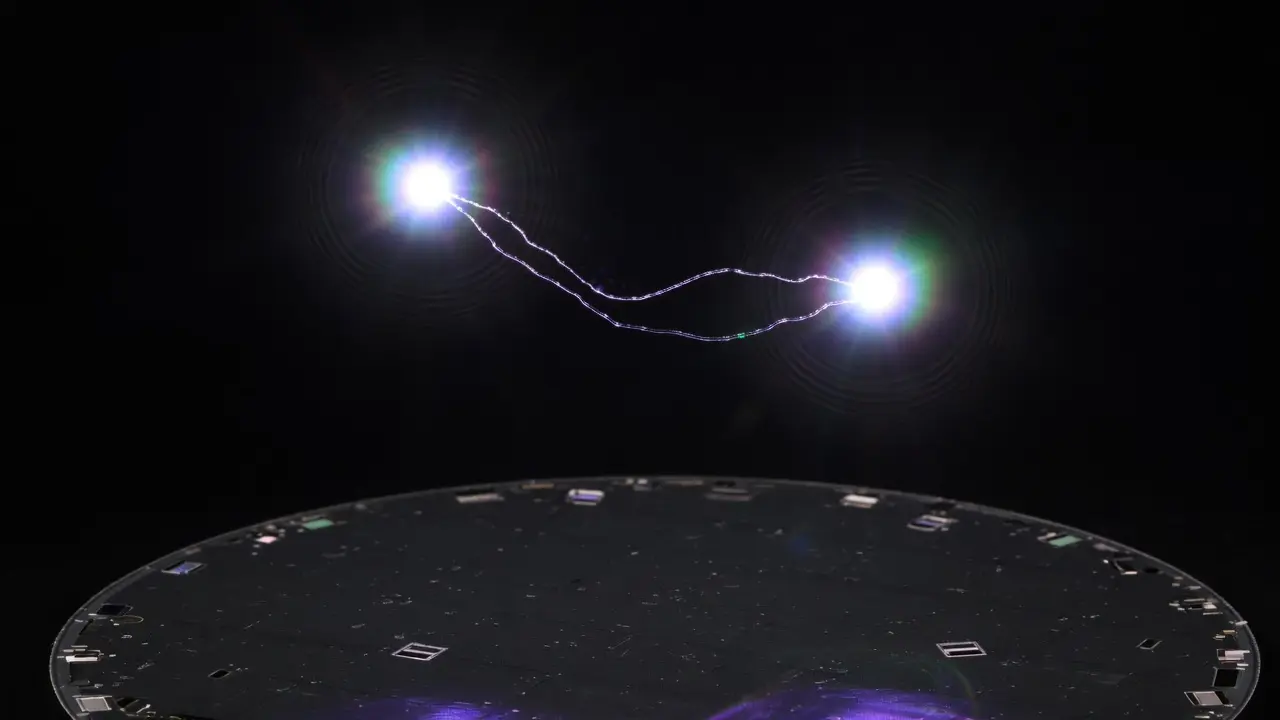
Until now, building modular optical fault-tolerant quantum computers has required separating resource preparation from online processing on a Gaussian processor. An interface between verified Bell-resource factories and these processors is demonstrated using GKP qubits; simulations show support for CNOT, SWAP, and Hadamard gates with tracked permutations. At 15.6 dB and two levels of concatenation, the system achieves one-sided ninety-five percent upper bounds below ten to the power of minus five for errors under specific conditions.
A new way of building modular quantum computers using light separates how essential resources are created from how they’re used in calculations; this is akin to prefabricating components before assembly. Simulations demonstrate that key operations, including CNOT, SWAP, and Hadamard gates, can be successfully performed with low errors at signal strengths of 15.6 dB after two stages of refinement. This approach uses physical qubits encoded on the properties of light waves; imagine dimming or brightening a torch to represent information, but with far greater precision.
An offline “factory” producing verified entangled pairs, known as Bell resources, built from recursively layered error correction (similar to wrapping something fragile multiple times) has been combined with an online processor performing calculations via measurement-based quantum computation. Simulations at signal strengths of 15.6 dB after two stages of refinement demonstrate low errors, achieving upper bounds below ten to the power of minus five for certain conditions. The team now seeks to understand how this interface scales with increasing complexity and resource demands.
Gaussian optics achieve scalable quantum computation with low
Error rates dropped sharply from unquantifiable levels to below 10-5 at a signal strength of 15.6 decibels after two stages of refinement using this new architecture. This design separates resource creation from its use in calculations, a key feature improving scalability within modular optical quantum computation utilising GKP qubits on a common Gaussian processor.
Defined interactions between prepared states enable scalable error management in optical quantum
The modular approach tackles the bottleneck of generating high-quality entangled states, offering a promising path toward scalable optical quantum computers by separating resource creation from processing. A division now exists between creating Bell resources and performing calculations with them, analogous to prefabricating components in conventional engineering. While simulations demonstrate low error rates under specific conditions using recursively layered error correction with GKP qubits (physical qubits encoded on light waves), these results heavily rely on pre-verified resources.
NTT researchers demonstrated how defining interactions between pre-prepared components and ongoing calculations can manage errors in complex systems, a key step towards scalability. The team successfully built an interface allowing separate stages within the modular optical system utilising GKP qubits, achieving finite-level logical error ordering at acceptable noise levels. This architecture supports essential operations like CNOT gates and Hadamard constructions while maintaining efficient processing speeds, paving the way for scalable systems by addressing resource generation bottlenecks. Building a fully functional optical quantum computer remains immense undertaking, but this represents vital progress nonetheless.
This research introduced an interface separating the creation of encoded resources from their use in computation on a Gaussian optical processor using GKP qubits. By dividing these processes, the design addresses challenges to scalability in modular quantum computing and achieved low errors, below one in one hundred thousand, at signal strengths of 15.6 decibels with two stages of refinement.
Simulations confirmed that increasing error correction complexity resulted in improved performance under specified noise conditions; specifically, finite-level logical Bell-error ordering was demonstrated. The authors suggest further work will focus on expanding parallel resource preparation through increased concatenation levels.
👉 More information
🗞 Modular optical fault-tolerant quantum computation via an interface between verified resources and online logical operations
✍️ Kosuke Fukui, Takaya Matsuura, Yohji Chin, Shohei Kiryu, Takaya Hoshi, Kan Takase and Warit Asavanant (Affiliation: OptQC)
🧠 ArXiv: https://arxiv.org/abs/2610.32838

See today’s quantum computing news on Quantum Zeitgeist for the latest breakthroughs in qubits, hardware, algorithms, and industry deals.