
Quantum Computing Myths and Reality
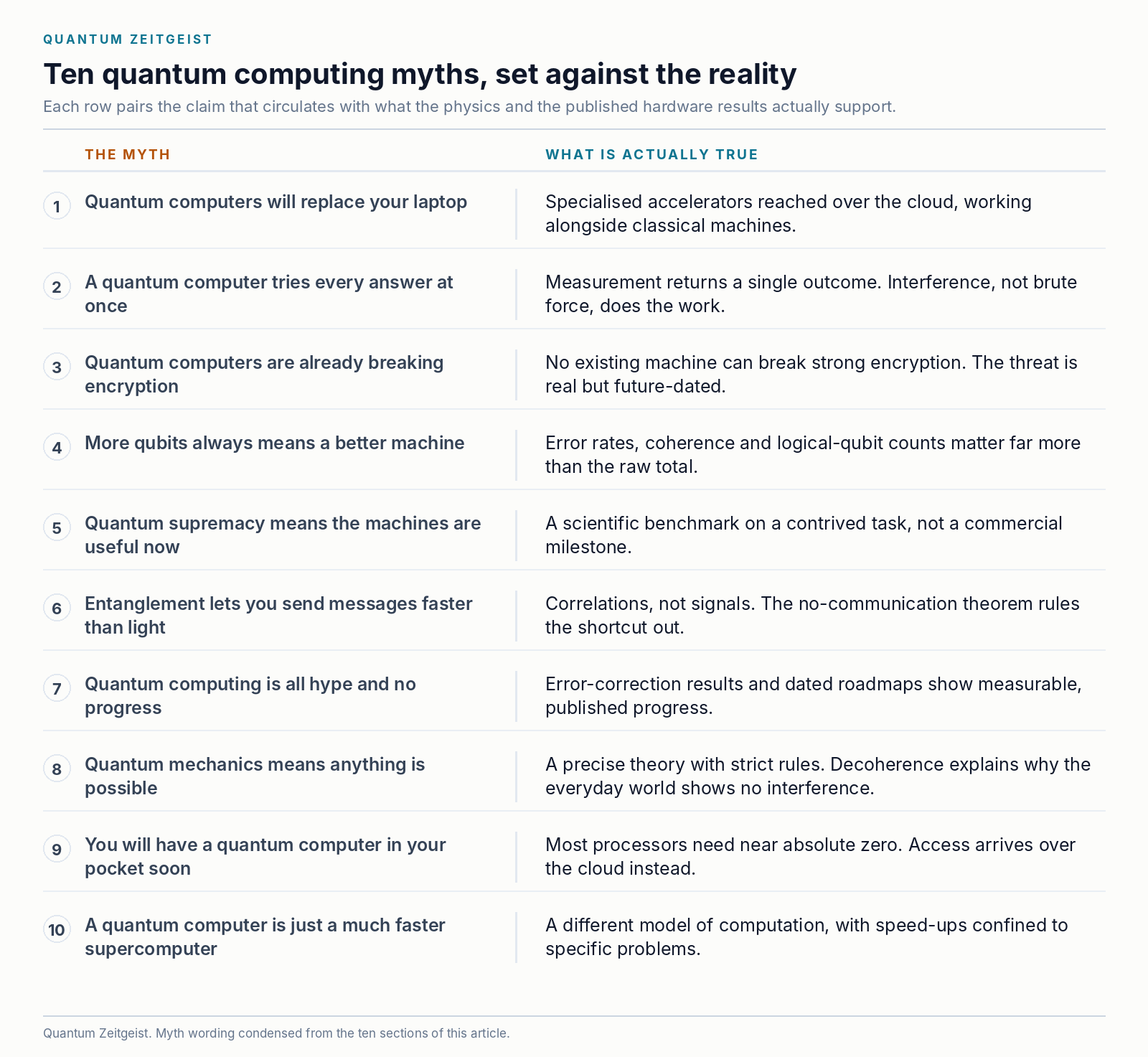
Few technologies are surrounded by as much confusion as this one. Here are ten of the most common quantum computing myths, set against what the science and the engineering actually show.
A quantum computer will not replace your laptop. It is a specialised accelerator for a narrow class of problems. For everything you do today, a classical machine is faster and cheaper.
It does not try every answer at once. Superposition is not parallel search. Interference has to cancel the wrong answers, and designing that cancellation is the whole difficulty of a quantum algorithm.
Encryption is not falling this year. The best current estimate for breaking RSA-2048 is under a million noisy qubits, and no machine has more than about twelve hundred. The risk that matters is data stolen today and decrypted later.
More qubits does not mean a better machine. Error rate, connectivity and coherence time decide what a chip can run. A noisy thousand-qubit device can be less useful than a clean fifty-qubit one.
Quantum supremacy was never a claim of usefulness. It means a machine did something a classical computer finds hard, on a task chosen to be hard. None has yet solved a problem anyone needed solved.
Entanglement cannot send a message. The two sets of results match when you compare them, and comparing them needs an ordinary channel. No-signalling is a theorem, not an engineering limit.
Quantum computing myths travel faster than the research that should correct them, because the subject is genuinely strange and the headlines reward drama over nuance. A field that deals in superposition and entanglement is easy to dress up as magic, and easy to dismiss as a con, and both reactions miss what is really happening. The truth sits in a less excitable middle, where the machines are real and improving, the timelines are uncertain, and the limits are as important as the promise. Sorting the myths from the reality is the first step toward understanding the technology at all.
These quantum computing myths matter because people act on them. Executives green-light or kill projects on the strength of a half-remembered headline, investors chase or flee a sector on a single quotable remark, and newcomers either expect a miracle next year or write the whole field off as hype. A clearer picture protects against all of those errors, and it costs nothing but a little attention. What follows is a tour of the ten claims we hear most often, each stated plainly and then measured against the evidence.
None of this requires advanced physics, only a willingness to separate what a quantum computer is from what people wish or fear it to be. The reality is more interesting than the myths in any case, because the actual capabilities and limits of these machines are stranger and more specific than the cartoon version. With that, here is where the popular story tends to go wrong.
- Quantum computers will replace your laptop
- A quantum computer tries every answer at once
- Quantum computers are already breaking encryption
- More qubits always means a better machine
- Quantum supremacy means the machines are useful now
- Entanglement lets you send messages faster than light
- Quantum computing is all hype and no progress
- Quantum mechanics means anything is possible
- You will have a quantum computer in your pocket soon
- A quantum computer is just a much faster supercomputer
Quantum computers will replace your laptop
A quantum computer is just a faster, better version of an ordinary computer. One day everyone will own one in place of a classical PC or phone.
Quantum machines are specialised tools, not general replacements. They offer advantage only on particular problems and will work alongside classical computers, which remain better for almost everything you do daily.
This is the most persistent of all quantum computing myths, and it misreads the technology at the most basic level. A quantum computer is not a faster classical computer but a different kind of machine, suited to a narrow set of problems where quantum effects can be exploited. For browsing, email, spreadsheets and video, a classical processor is not just adequate but vastly better, and that will not change.
The realistic future is hybrid rather than a handover. Quantum processors will sit in data centres as specialised accelerators, reached over the cloud and used for the slices of a problem they handle well, while classical and AI systems do the rest. You can see the shape of that model in the way vendors such as IBM describe their roadmaps, with a quantum chip as one component among many rather than a replacement for the whole.
A quantum computer tries every answer at once
A qubit can be in superposition, so a quantum computer checks all possible answers at the same time. It then instantly picks the right one out of the pile.
Superposition is not brute-force parallelism. A measurement returns just one outcome, so the art is designing interference that makes the correct answers reinforce and the wrong ones cancel before you read the result.
The image of a machine that tests every solution in parallel is seductive and wrong. A quantum computer can hold many possibilities in superposition, but when you measure it, you get a single answer, and the rest of the information vanishes. Simply having all the possibilities present does not hand you the one you want.
What makes quantum algorithms powerful is subtler and more demanding. They use interference, arranging the computation so that the amplitudes of wrong answers cancel out while the right answers add together, which is why designing a good qubit algorithm is hard and why only some problems benefit. The computer scientist Scott Aaronson has spent years correcting quantum computing myths on his blog Shtetl-Optimized. The standing line at the top of it tells readers that quantum computers will not solve hard problems instantly by trying all the solutions at once. Reading out a single value from a superposition is the constraint the whole field designs around. Turning that into a usable speedup is the real work.
Interference cancels the wrong answers
This is the most widespread misunderstanding in the subject and it is worth taking apart carefully, because it sounds like an explanation and prevents one. The picture is that a quantum computer holds every possible answer simultaneously and therefore checks all of them in the time a classical machine checks one.
The first half is roughly right and the conclusion does not follow. A register of qubits can be in a superposition covering every possible value, and reading it returns exactly one of those values, chosen with a probability set by how much amplitude the algorithm has piled onto it. If trying everything at once were the mechanism, the answer would be useless, because you would receive a random one of the possibilities and have no way to know whether it was the right one.
What actually happens is interference. A quantum algorithm arranges the phases so that paths leading to wrong answers cancel one another and paths leading to right answers add up, in the way overlapping waves reinforce at some points and flatten at others. The skill in designing one is engineering that cancellation, which is why there are so few quantum algorithms rather than one for every problem.
The practical consequence of understanding this properly is that it predicts where quantum computers will help. They are useful when a problem has structure that interference can exploit, and unhelpful for unstructured search beyond a modest square-root improvement. Anyone who believes the parallel-universe story expects a general speedup on everything, which is the single most common error in coverage of the field.
Quantum computers are already breaking encryption
Quantum computers can already crack the encryption that protects banking, messaging and state secrets. The security of the internet has effectively fallen.
No existing machine can break strong encryption. Doing so would need a large, fault-tolerant computer that does not yet exist, though the threat is real enough that migration to new standards has already begun.
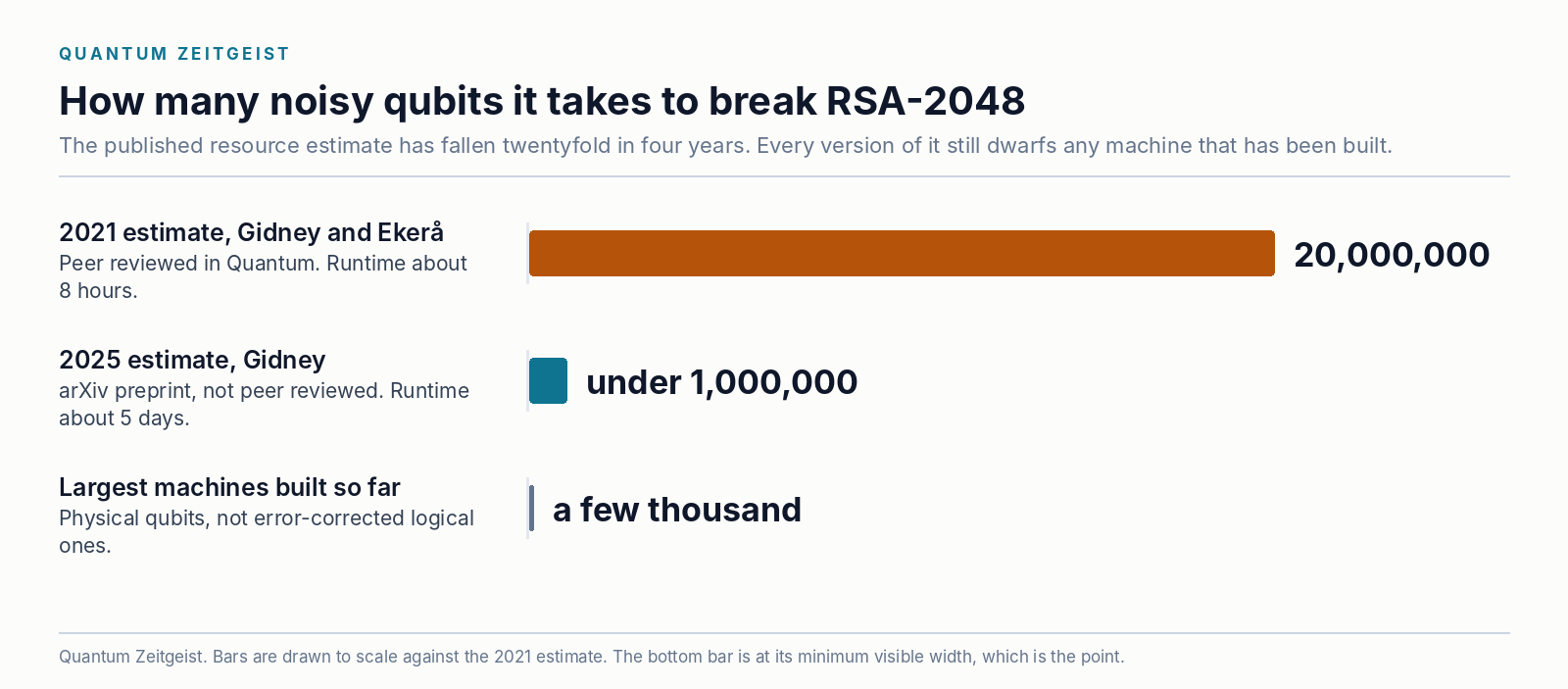
This myth swings between panic and complacency, and neither is warranted. Breaking the public-key cryptography that secures the internet would require a quantum computer running deep, error-corrected circuits, and today’s devices are many orders of magnitude short of that. The published estimates have moved fast, from 20 million noisy qubits in a 2021 calculation to under a million in a 2025 revision that has not yet been peer reviewed.
Both numbers assume a particular machine. The qubits sit on a square grid and talk only to their neighbours, the gate error rate is one in a thousand, and an error-correction cycle takes a millionth of a second. Change those assumptions and the answer moves by an order of magnitude, which is why a qubit figure should always be read with them attached.
The saving was bought with time. The 2021 estimate finished in about eight hours and the 2025 one takes about five days. Even the lower figure is roughly nine hundred times the qubit count of the largest gate-based processors, which run about twelve hundred qubits. More atoms than that have been held in one place, 6,100 of them in a Caltech tweezer array (Nature 647, 60, 2025), but holding qubits still is not the same as running circuits on them. The algorithms have been known since the 1990s. The hardware to run them at useful problem sizes has not arrived.
The danger is real but future-dated, which changes what you should do rather than whether you should worry. Adversaries can harvest encrypted data now and decrypt it once the hardware arrives, so anything that must stay secret for a decade is already at risk, and that is why NIST finalised its post-quantum algorithms in 2024 as FIPS 203, 204 and 205. Our guide to the post-quantum cryptography companies covers the defences that already run on ordinary hardware.
Public-key cryptography is the vulnerable half
Coverage of this subject tends to compress a careful position into an alarming one, and the compression loses two important qualifications. The first is that only part of the encryption stack is threatened. Public-key cryptography, which agrees a shared secret and proves identity, is the vulnerable half, while the ciphers that scramble the data itself are barely touched, and doubling the key length settles any residual doubt.
The second qualification is scale. Breaking the encryption in use today would need a machine with error rates and qubit counts far beyond anything demonstrated, and published estimates have fallen substantially while remaining orders of magnitude away from current hardware. Anyone naming a specific year is stating a personal forecast rather than a known fact.
What makes the topic genuinely urgent is neither of those, and it is the recording problem. Encrypted traffic captured today can be stored until a capable machine exists, so anything that must stay secret into the 2040s is already exposed to a machine that does not yet exist. That argument does not require predicting a date, which is what makes it the one worth repeating.
The replacement is also further along than the alarm suggests. Standards were finished in 2024, browsers and messaging apps have already switched their handshakes, and the migration is a software project rather than a wait for new physics. The accurate summary is that a real problem has a known remedy and an unhurried public conversation.
More qubits always means a better machine
The quality of a quantum computer is measured by its qubit count. Whichever company announces the most qubits therefore has the most powerful machine.
Qubit count is the least informative number a vendor can quote. Error rates, coherence times and the number of reliable logical qubits matter far more than the raw total.
Counting qubits is easy, which is exactly why it makes such a poor measure. A processor with a thousand noisy qubits can be less capable than one with a hundred clean ones, because every operation on a low-quality qubit introduces error, and those errors accumulate until the computation is meaningless. The headline number tells you almost nothing about what a machine can actually do.
The figures that matter capture quality rather than quantity. Gate fidelity, coherence time, composite benchmarks such as quantum volume, and above all the count of error-corrected logical qubits are the real indicators. Ask what those logical qubits actually did, because most announcements describe qubits that were prepared and checked rather than corrected while a calculation ran. Turning many physical qubits into a few reliable logical ones is the central task of quantum error correction.
The number that settles it is the logical error rate per correction cycle, and whether that rate falls when the surface code is made larger. A bigger code only helps if the physical qubits are already good enough. Below that bar, adding qubits makes the encoded qubit worse rather than better.
Quantum supremacy means the machines are useful now
When a company claims quantum supremacy, it means quantum computers have overtaken classical ones for good. The machines are now ready to solve real-world problems.
Supremacy is a scientific benchmark, not a business milestone. It shows a machine beating classical methods on a contrived task, which is not the same as solving a problem anyone would pay for.
The phrase quantum supremacy is dramatic, and that drama causes the confusion. It marks the point where a quantum computer performs some task beyond the reach of the best classical computer, but the task is usually chosen precisely because it suits the quantum machine, not because it is useful. Demonstrating supremacy is a genuine scientific milestone, yet it says nothing about commercial value.
These claims also tend to shrink under scrutiny, which is healthy rather than damning. A result that beats a classical estimate is only as strong as the classical comparison behind it, and those comparisons keep improving, so a headline that looks decisive one year can be matched the next. Reading supremacy as a benchmark, not a promise of applications, is the mark of an informed observer.
Entanglement lets you send messages faster than light
Entangled particles affect each other instantly across any distance. You can therefore use entanglement to transmit information faster than light.
Entanglement produces correlations, not signals. The outcomes are random until compared over an ordinary channel, so no usable information travels faster than light, a result fixed by the no-communication theorem.
This one is irresistible to science fiction, and it is firmly false. When two particles are entangled, the two sets of results match when you compare them, no matter how far apart they were measured. That sounds like a faster-than-light telegraph. But each measurement on its own yields a random result, and you cannot control what you get, so there is no way to encode a message in it.
To make sense of the correlation, the two parties must compare their results over a normal, slower-than-light channel. That requirement is not a technical limitation but a theorem, often called the no-communication theorem, and it is why entanglement and quantum teleportation never break relativity. The effect is real and useful for cryptography and computing, just not for sending signals across the galaxy.
Quantum computing is all hype and no progress
Quantum computing is a perpetual decade away. It is a marketing bubble that never delivers anything beyond press releases and funding rounds.
The scepticism is healthy but overstated. Error-correction milestones and dated public roadmaps show measurable, published progress, even if useful advantage has not yet arrived.
Dismissing the whole field as a scam is as mistaken as believing every breakthrough headline. Real, checkable progress is happening, most importantly in error correction, where in December 2024 Google reported in Nature that adding qubits to its Willow chip made an encoded qubit better rather than worse, crossing the long-sought below-threshold point.
Each time they made the code two distance steps larger, the encoded qubit’s error rate fell by a factor of 2.14. The largest version held its state better than the best single physical qubit on the chip, though it was decoded after the fact rather than by a decoder running in the loop. That is a physics result, not a slogan, and several groups are now pushing the same frontier.
The commercial side has matured too, even if it runs ahead of the science. A growing roster of quantum companies now trade publicly, which measures investor appetite rather than capability. Some hardware makers publish dated roadmaps and have so far met them, and you can trace the arc through the history of quantum computing. Progress being slower than the hype is not the same as no progress at all.

Quantum mechanics means anything is possible
Quantum physics shows that observation creates reality and that anything can happen. This is why it supposedly explains consciousness, the paranormal and the power of positive thinking.
Quantum mechanics is a precise mathematical theory with strict rules. Measurement is a physical interaction, not a conscious act, and decoherence explains why the everyday world shows no quantum interference. Why any single outcome happens is still argued over, and none of the serious answers involve a conscious mind.
Quantum mechanics attracts mysticism because words like observer and uncertainty get stretched far beyond their technical meaning. In physics, an observation is any interaction that extracts information, performed by a detector or a stray photon, with no mind required, and the theory predicts outcomes with extraordinary numerical accuracy. The strangeness is real, but it is disciplined strangeness, governed by equations rather than wishes.
The reason the large world looks solid and definite is decoherence, the rapid leakage of quantum information into the environment that destroys fragile superpositions. Far from licensing anything-goes thinking, quantum mechanics is one of the most constrained and best-tested theories in science. Schrödinger’s cat is a teaching device about superposition and measurement, not evidence that belief shapes matter.
You will have a quantum computer in your pocket soon
Quantum computers will shrink just as classical ones did. A quantum chip will appear in your phone or home PC within a few years.
Most quantum machines need extreme isolation, often near absolute zero, and elaborate control systems. Access will come through the cloud, not through a device in your pocket, for the foreseeable future.
The history of classical computing, from room-sized mainframes to smartphones, makes people assume quantum hardware will follow the same shrinking path. But many leading quantum processors must be cooled to within a fraction of a degree of absolute zero, shielded from vibration and stray fields, and wired to racks of control electronics. Those are not constraints that fold neatly into a consumer gadget.
The sensible model is access without ownership, just as few people run their own data centre. Real qubit hardware is already available over the cloud from several vendors, so a developer can run a program on a real machine without owning one. For almost everyone, that is how quantum computing will be used, through a connection rather than a chip in your hand.
A quantum computer is just a much faster supercomputer
Quantum computers are simply the next generation of supercomputers. They deliver a blanket speed-up across all heavy computing tasks.
They use a fundamentally different model of computation and speed up only specific problem classes, such as factoring, simulation and search. For most heavy workloads, classical supercomputers remain faster.
Calling a quantum computer a faster supercomputer hides the most important fact about it. It does not run classical programs more quickly but computes in a different way, and its advantages are confined to particular structures. Factoring large numbers and simulating quantum systems are the clear cases, where the separation is proven. Search gets a square-root improvement whose cost may swallow it whole, and for optimisation no speedup has been proven on any practical problem at all. Outside those areas, a classical supercomputer is usually the better tool, sometimes by a wide margin.
Even the famous speed-ups are specific rather than universal. Chemistry and materials simulation is the application most often cited as a natural fit, and many everyday workloads gain nothing at all.
Quantum machine learning deserves its own warning. In 2018 Ewin Tang, then an undergraduate, wrote a classical algorithm (arXiv:1807.04271) that matched a proposed quantum speedup for recommendation systems, and a run of similar results followed. The pattern was the same each time. The quantum algorithm had been granted a kind of data access the classical baseline was denied. Level the access and the exponential gap goes. For the fuller picture, our guide to quantum computing sets out where the real advantages lie. A widely cited assessment in Communications of the ACM of where quantum advantage is realistically achievable makes the same point in detail, arguing that even quadratic speed-ups are unlikely to pay off in practice. There is no general speed-up, only a set of specific ones.
How to tell quantum fact from fiction
Most quantum computing myths share a common root, which is treating a specific, constrained technology as either magic or fraud. The antidote is a handful of habits that anyone can apply without a physics background. Once you know what to look for, the misleading claims tend to give themselves away.
A real claim names the task and the classical baseline
When you meet a quantum claim, the first question is which specific problem the machine is solving and how that compares to the best classical method. A real result names the task and the baseline, while a hyped one speaks in sweeping generalities about revolutionising everything. The presence or absence of a concrete, measured comparison is usually all you need to judge it.
Error rate and coherence time beat qubit count
The second habit is ignoring qubit count in favour of quality measures such as error rate, coherence time and logical-qubit count. A vendor that leads with raw qubits and little else is signalling where its story is weakest. Standards bodies and independent benchmarks, rather than press releases, are the better guide to who is genuinely ahead.
Separate the science from the share price
The third habit is keeping scientific progress and market sentiment apart, because the two often diverge for years. In January 2025 the Nvidia chief executive Jensen Huang said useful quantum computers were probably fifteen to thirty years away, and the listed quantum stocks fell hard the same day. No experiment had changed. That was a shift in expectation, not in capability. Following the published results and roadmaps, while treating valuations as mood rather than measurement, keeps you grounded. Nothing here is investment advice.
The reality is stranger than the myth
Stripping away the quantum computing myths does not make the subject less interesting. It makes it more so. The genuine article is a machine that exploits superposition and entanglement to gain a real but narrow edge. It needs heroic engineering just to hold a calculation together, and it is advancing on a published schedule toward fault tolerance. That story is harder to compress into a headline than either the miracle or the hoax, which is precisely why the myths persist.
Understanding the reality is also the practical advantage. The organisations and individuals who see the technology clearly will spot the genuine opportunities, avoid the expensive mistakes, and prepare for the threats that are already real, such as the cryptographic one. The quantum computing myths make for better headlines. The reality is what you can plan around, and it rewards the people who take the trouble to learn it. Anyone weighing the field on its merits should start from the complete guide and the history of quantum computing, not from the quantum computing myths that surround it.
Legal disclaimer
Quantum Zeitgeist does not provide personal investment or financial advice, and does not act as a personal financial, legal, or institutional investment adviser. We do not individually advocate the purchase or sale of any security or investment, or the use of any particular financial strategy, and all investment strategies carry the risk of loss for some or even all of your capital.
Before pursuing any financial strategy discussed here, or relying on information within this website, you should always consult a licensed financial adviser. Any analysis we provide is for informational purposes only, does not take your circumstances into account, and should not be treated as an individualised recommendation, since the securities mentioned may not be suitable for all investors.
Frequently asked questions
What are the most common quantum computing myths?
The most common quantum computing myths are that quantum machines will replace ordinary computers, that they try every answer at once, that they can already break encryption, and that more qubits always means a better machine. Each mistakes a specific, constrained technology for a general or magical one. The reality is narrower and more demanding than the popular version.
Can quantum computers break encryption today?
No current quantum computer can break strong encryption, because doing so would need a large, fault-tolerant machine that does not yet exist. The threat is still taken seriously because data harvested now could be decrypted later, which is why the first three post-quantum cryptography standards were finalised in 2024. Organisations can and should begin migrating today on ordinary hardware.
Does a quantum computer really try all answers at once?
Not in the way the myth suggests, since a measurement collapses the machine to a single outcome. Quantum algorithms instead use interference so that wrong answers cancel and correct ones reinforce before the result is read. That design problem, not brute-force parallelism, is the real source of any speed-up.
Can entanglement be used to communicate faster than light?
No. Entanglement produces correlations between measurements, but each result is random and cannot be controlled, so no information is transmitted by the link itself. Making sense of the correlation requires comparing results over an ordinary channel, which is limited by the speed of light, a fact captured by the no-communication theorem.
Is more qubits always better in quantum computing?
No, qubit count is the least informative measure of a quantum computer. Error rates, coherence times and the number of reliable logical qubits matter far more, because noisy qubits accumulate errors that ruin a computation. A smaller, cleaner machine often outperforms a larger, noisier one.
Does quantum supremacy mean quantum computers are useful?
Not directly, because quantum supremacy is a scientific benchmark rather than a business milestone. It shows a machine beating classical methods on a task chosen to suit it, which is not the same as solving a problem of economic value. Such claims also tend to weaken as classical methods improve.
Will I own a quantum computer at home?
For the foreseeable future, almost certainly not, because most quantum machines require extreme cooling, isolation and elaborate control electronics. Access comes through the cloud, where real hardware from several vendors is already available to anyone. The model is renting capability rather than owning a device.
Is quantum computing just hype?
No, although the hype is real and worth resisting. Error-correction milestones, dated and largely met roadmaps, and a wave of public company listings show measurable progress. Useful commercial advantage has not yet arrived, but that is different from no progress at all.
Does quantum physics prove that anything is possible?
No, quantum mechanics is a precise mathematical theory with strict rules and extraordinarily accurate predictions. An observation is any physical interaction that extracts information, not a conscious act, and decoherence explains why the large-scale world looks classical. It does not support claims about consciousness or the paranormal.
Is a quantum computer just a faster supercomputer?
No, a quantum computer uses a fundamentally different model of computation rather than simply running faster. Its advantages apply only to specific problem classes. Factoring and simulating quantum systems are the clear cases. Search gets a square-root improvement that may never be worth the cost of running it, and classical supercomputers remain better for most workloads. There is no general, across-the-board speed-up.



See today’s quantum computing news on Quantum Zeitgeist for the latest breakthroughs in qubits, hardware, algorithms, and industry deals.