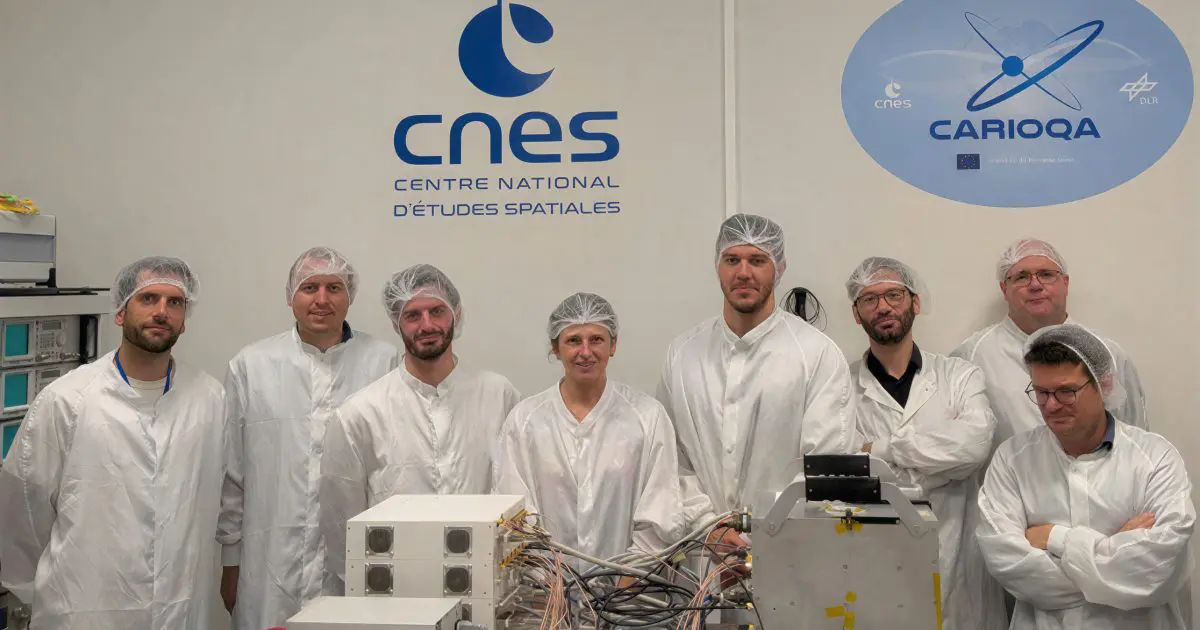
Exail, a global leader in ocean technologies, is now providing a space-grade laser source to the French space agency, CNES. The laser will be used for Europe’s CARIOQA, Europe’s Quantum Space Gravimetry Pathfinder mission. Exail empowers photonics engineers “with high-performance, innovative and reliable optical solutions,” and this delivery marks an expansion into space-based quantum communications.
Exail’s Space-Grade Laser for CARIOQA Quantum Mission
This mission, formally Europe’s Quantum Space Gravimetry Pathfinder mission, is defined as “CARIOQA: Definition of a quantum pathfinder mission,” signaling a focused effort to advance quantum technology in orbit. Commissioning and validation of the laser source occurred at CNES in Toulouse, with no anomalies reported during testing. The laser will generate frequency-stabilized beams for trapping, cooling, and analyzing a cloud of atoms within the CARIOQA instrument.
These atoms function as a test mass in an atom-interferometry accelerometer, designed to measure gravity-related acceleration with extreme precision. The system’s compact design represents a substantial reduction in size compared to previous generations, according to CNES. This compactness was a key factor in the mission’s feasibility, allowing for integration of advanced quantum and space technologies into a robust system.
The European Union is funding the CARIOQA mission, highlighting a commitment to fostering innovation in quantum sensing from space. Through this project, Exail is contributing to the development of technologies necessary for future applications beyond Earth’s atmosphere, solidifying its position at the intersection of quantum systems, space-qualified photonics, and precision sensing.
Delivering this laser source is a decisive step in de-risking cold-atom laser technology for space. Our objective was to transfer the metrological stability of our laser systems for terrestrial quantum gravimetry into an architecture that meets the severe size, weight, and power (SWaP) constraints of space.
Laser Source Application: Atom Interferometry & Gravity Measurement
Exail’s expansion into space-based quantum technology builds on a foundation of delivering naval and land defense solutions, from navigation and robotics solutions to stand-off mine countermeasures systems, ensuring reliability and safety in the toughest environments. The laser’s function within CARIOQA centers on atom interferometry, a technique demanding frequency-stabilized beams to manipulate atoms as a highly sensitive gravity measurement tool.


See today’s quantum computing news on Quantum Zeitgeist for the latest breakthroughs in qubits, hardware, algorithms, and industry deals.