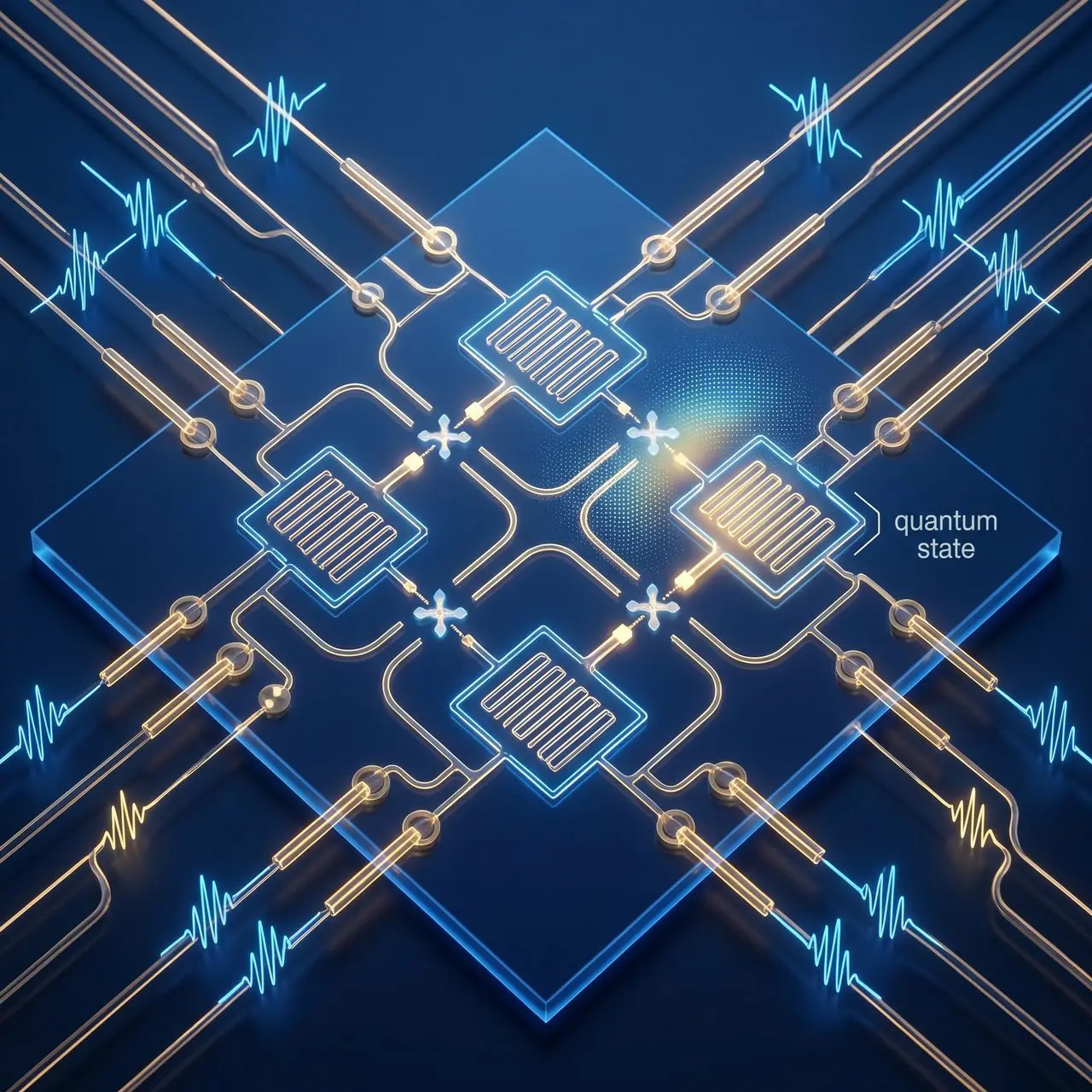
A single quasiparticle tunneling across a superconducting qubit’s Josephson junction can simultaneously absorb a qubit excitation and photons from the microwave drive, according to a new theory developed by Mykola Kishmar of Columbia University, Pavel D. Kurilovich and Thomas Connolly of Yale University, and Andrey Klots, Igor L. Aleiner, and Vladislav D. Kurilovich of Google Quantum AI. Even at cryogenic temperatures, which are two orders of magnitude smaller than the superconducting energy gap, an appreciable fraction of Cooper pairs remain broken, contributing to these quasiparticle excitations. The work establishes a fundamental limitation on the fidelity of microwave qubit operations, even in qubits designed to be insensitive to them, because the microwave drive can reanimate quasiparticle tunneling and induce decoherence.
This persistent presence of broken Cooper pairs manifests as quasiparticle (QP) excitations, and theoretical work reveals their surprisingly complex role in limiting qubit fidelity. One mechanism centers on existing QPs tunneling across a qubit’s Josephson junction. This simultaneous absorption allows tunneling that would otherwise be forbidden, effectively reanimating the QP channel even in qubits engineered to suppress QP effects. The authors write that for a strong drive, this effect can completely negate the benefit in coherence gained from gap engineering, potentially undoing carefully implemented error mitigation strategies.
Beyond the impact of existing QPs, the research unveils a potentially more concerning feedback loop: the team’s model shows that qubit transitions themselves can create new QPs. Specifically, the non-linear absorption of multiple drive quanta during a qubit operation can directly convert those photons into a pair of QPs at the Josephson junction. Researchers explain that photons have sufficient energy to break a Cooper pair at the Josephson junction, illustrating how the drive itself contributes to the problem.
The theoretical framework developed by Pavel D. Kurilovich of Yale University, and colleagues at Columbia University and Google Quantum AI, relates the rate of QP-induced decoherence to the power and frequency of the microwave drive, and elucidates its dependence on flux bias. This work establishes that even with advanced gap engineering techniques, the presence and potential creation of QPs fundamentally limits the performance of microwave qubit operations. The density of these nonequilibrium QPs, normalized by the Cooper pair density, is a key parameter in understanding the extent of decoherence.
Researchers at Google Quantum AI, in collaboration with scientists at Columbia University and Yale University, have detailed two distinct mechanisms by which these QPs degrade qubit performance. This complex interaction, detailed in figures within the paper, opens a pathway for tunneling that would otherwise be blocked. Multiple drive quanta can be converted into a pair of new QPs during a qubit transition. The theory establishes a fundamental limitation on the fidelity of microwave qubit operations stemming from QPs.
Gap Engineering Strategy for Reducing QP Tunneling
Researchers at Google Quantum AI, Columbia University, and Yale University have developed a theory detailing how remaining quasiparticles (QPs) continue to degrade qubit performance, even in systems specifically engineered to suppress their effects. A recently developed strategy, termed gap engineering, aims to counteract QP tunneling by implementing qubits with a difference in gap values across the Josephson junction. This gap difference, δΔ, acts as a potential barrier for QPs and can effectively block the QP channel of energy relaxation if δΔ/ℏ exceeds the qubit frequency for “cold” QPs.
While demonstrating dramatic suppression of radiation impacts on qubit arrays, this approach doesn’t eliminate QPs entirely, nor does it prevent processes that generate new ones. The central question driving work at Google Quantum AI, Columbia University, and Yale University is whether QPs can still damage the performance of gap-engineered qubits, and the answer, it appears, is yes.
Qubit operations, such as readout or gates, rely on irradiating the qubit with microwaves, and these microwaves can reanimate QP tunneling, bringing back decoherence. Researchers have developed a theory outlining two distinct mechanisms at play. The first involves an existing QP tunneling across the qubit’s Josephson junction while simultaneously absorbing a qubit excitation and one, or several, photons from the drive. This process demonstrates a non-linear effect where qubit operations themselves contribute to the QP density.
Despite increasingly sophisticated cryogenic cooling, maintaining qubit coherence remains a significant challenge in superconducting quantum computing. This persistent presence of QPs, each contributing two excitations, fundamentally limits the fidelity of microwave qubit operations. Researchers at Google Quantum AI are developing a theory detailing how these QPs do not represent merely static defects, but actively interact with the very signals used to control qubits. Beyond simply responding to the drive, the theoretical framework reveals a surprising feedback loop: qubit operations themselves can reanimate QP tunneling and bring back qubit decoherence.
This pair-breaking process, occurring at the Josephson junction, introduces further qubit transitions. The authors establish a model considering the Hamiltonian of a driven flux-tunable transmon and accounts for both single-photon and multi-photon interactions with QPs. The density of these nonequilibrium QPs, normalized by the Cooper pair density, is a parameter in understanding decoherence. While strategies like gap engineering can suppress QP tunneling, they do not eliminate the underlying issue.
Work by Kishmar and colleagues establishes that these QPs actively participate in decoherence mechanisms, even in qubits engineered to be insensitive to them. The research, appearing in a recent publication, delves into two distinct pathways by which QPs degrade qubit performance when driven by microwaves. A central finding concerns the surprising interaction between existing QPs and the drive signal. This absorption pathway effectively reanimates tunneling that would otherwise be blocked, particularly in qubits employing gap engineering, a technique designed to suppress QP tunneling by creating a potential barrier.
Beyond this, the theoretical framework reveals a non-linear process where qubit operations themselves create new QPs. This research underscores the need for continued exploration of QP mitigation techniques that address the root cause of their generation, not just their impact on qubit coherence.

See today’s quantum computing news on Quantum Zeitgeist for the latest breakthroughs in qubits, hardware, algorithms, and industry deals.