Infleqtion has secured three projects within the U.S. Department of Energy’s new Genesis Mission, a national initiative integrating AI, supercomputing, quantum systems, and advanced scientific instruments. These collaborations with Argonne, Brookhaven, and Lawrence Livermore National Laboratories, along with the University of Colorado Boulder, will focus on applications ranging from nuclear research to energy efficiency. The Genesis Mission aims to accelerate breakthroughs in energy, science, and national security by uniting government, industry, and academia. “AI data centers are pulling more power than the grid was ever built to handle, and the industry is recognizing that these types of issues are beyond the capabilities of classical computing alone,” notes Infleqtion CEO Matthew Kinsella, highlighting the impetus for exploring quantum solutions. These awards signal increasing investment in quantum technology as a strategic national asset.
AI-Optimized Quantum Circuit Design for Nuclear Applications
Infleqtion’s recent success in securing three projects within the U.S. Department of Energy’s Genesis Mission underscores a growing focus on leveraging quantum computing for complex scientific challenges, particularly the optimization of quantum circuit design for nuclear applications. A collaboration between Infleqtion and Argonne National Laboratory specifically targets this challenge, aiming to improve computational methods for realistic nuclear problems. This partnership reflects a broader trend of integrating artificial intelligence with quantum systems to overcome limitations inherent in classical computing; this acknowledgement of classical computing’s energy constraints is driving investment into alternative solutions like quantum computing, particularly for computationally intensive tasks. The Phase I Research and Funding Announcement awards from the Genesis Mission are designed to identify promising pathways toward transformative scientific capabilities and establish a foundation for future investment.
Infleqtion’s work with Argonne will focus on designing and demonstrating research workflows that integrate AI with scientific investigation, evaluating whether these approaches can accelerate discovery and improve predictive capabilities. This project aims to move beyond theoretical quantum algorithms toward practical applications in nuclear science, potentially unlocking new insights into materials science and energy production.
AI data centers are pulling more power than the grid was ever built to handle, and the industry is recognizing that these types of issues are beyond the capabilities of classical computing alone.
Matthew Kinsella, CEO at Infleqtion
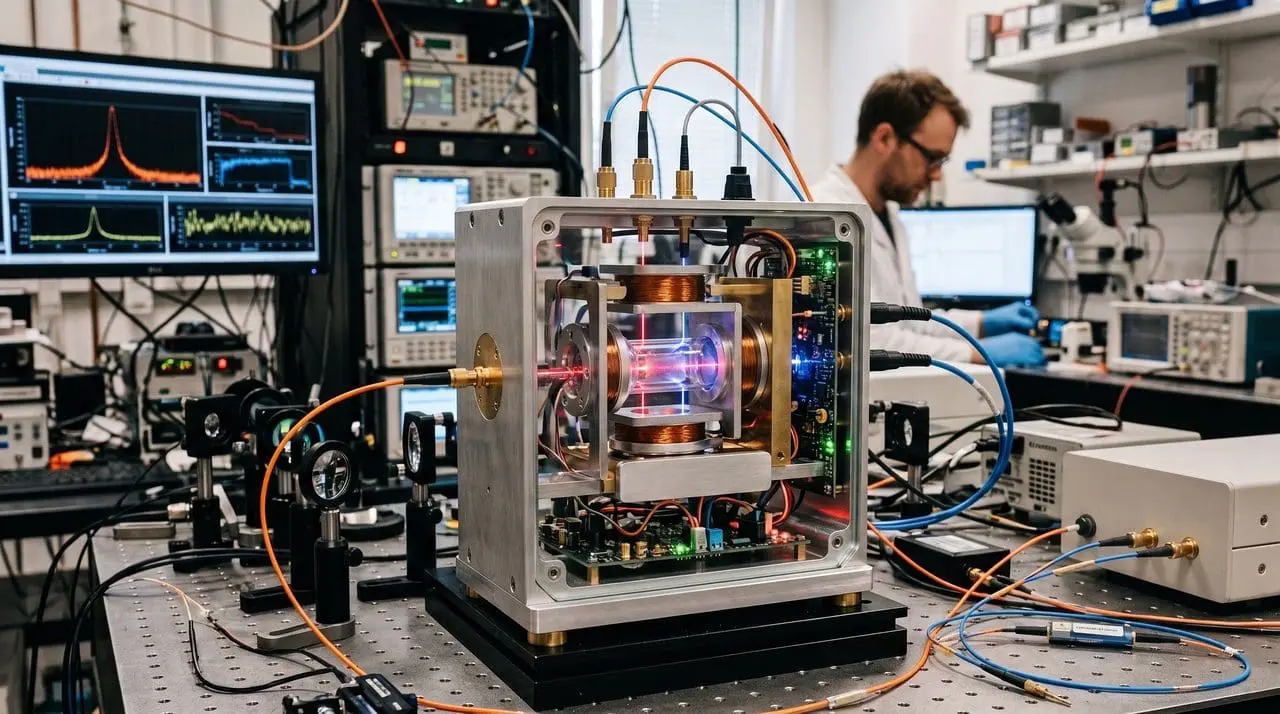
Unlike conventional sensors reliant on classical physics, atomic quantum sensors leverage the precise properties of atoms to measure subtle changes in gravity, magnetic fields, and time with greater accuracy. The Genesis Mission’s investment in this area acknowledges the potential for quantum sensors to revolutionize fields like materials science, environmental monitoring, and national security. Infleqtion’s approach goes beyond simply building a more sensitive sensor; it aims to create a system that can autonomously adapt and optimize its performance using Agentic AI. This means the sensor won’t just collect data, but will actively learn from its environment and adjust its settings to maximize signal quality and minimize noise. This collaboration will focus on designing and testing these deployable sensors, evaluating whether the AI-driven approach can accelerate data acquisition, improve the accuracy of measurements, or unlock new scientific insights previously inaccessible with conventional methods. Infleqtion’s work in this area underscores a broader shift toward practical applications of quantum technology, moving beyond theoretical demonstrations toward real-world solutions.




See today’s quantum computing news on Quantum Zeitgeist for the latest breakthroughs in qubits, hardware, algorithms, and industry deals.