

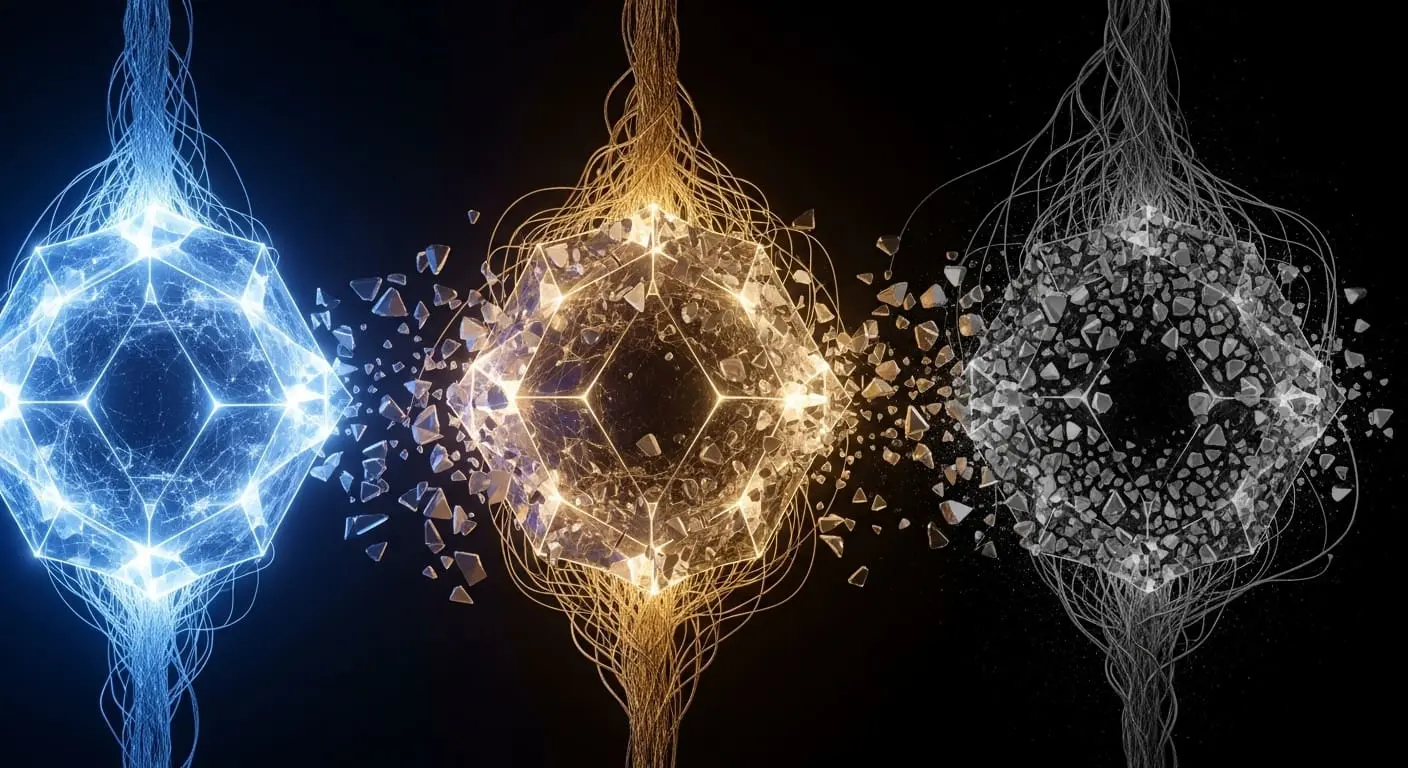
A new multi-qubit mean-field Lindblad master equation framework predicts how qubit interactions, concentration, spatial arrangement, and environmental factors influence relaxation and decoherence times. Dhiman Nandi and Sanghamitra Neogi at University of Colorado Boulder demonstrate that the framework uniquely connects microscopic interactions and noise sources to measurable decoherence, offering analytical solutions and extending to complex dynamics like concentration dependence and noise-induced dephasing. Applying this model to Er3+-doped CeO2 identifies Förster resonance energy transfer as the key mechanism driving decoherence, resolving discrepancies with previous findings and providing a modular set of tools for optimising solid-state qubit performance.
Förster resonance energy transfer dominates decoherence in erbium-doped cerium dioxide qubits
A framework demonstrably improves relaxation time (T_1) and decoherence time (T_2) prediction, achieving a two-fold increase in compared to previous models when applied to Er3+-doped CeO2. This improvement stems from a more holistic approach to modelling decoherence, moving beyond single-qubit considerations and incorporating the collective behaviour of multi-qubit systems. Previous models often treated qubits in isolation or focused solely on environmental decoherence, neglecting the significant contribution of inter-qubit interactions. The ability to accurately predict and is crucial for assessing the viability of any qubit platform, as these parameters directly dictate the length of time quantum information can be reliably stored and processed. This breakthrough overcomes the limitations of earlier approaches, which were unable to connect microscopic interactions to measurable decoherence, opening avenues for targeted qubit optimisation. Successfully identifying Förster resonance energy transfer as the dominant mechanism for excitation transfer, the multi-qubit mean-field Lindblad master equation (MQMF-LME) framework resolves discrepancies with prior research favouring short-range interactions. The model accurately simulates complex dynamics, including concentration dependence and the impact of environmental noise on qubit performance, offering a pathway to designing solid-state qubit systems with enhanced coherence.
Energy transfer between qubits increases with system density, reducing both relaxation time (T1) and decoherence time (T_2). This is because a higher qubit concentration leads to a greater probability of unwanted energy transfer, effectively shortening the lifetime of the excited state and introducing errors into quantum computations. The MQMF-LME framework accounts for this concentration dependence by explicitly modelling the interactions between qubits as a function of their spatial separation and density. Simulations revealed that fluctuations in qubit energy splitting introduce a non-exponential loss of coherence, impacting T2 without altering ; this pure dephasing effect contributes to decoherence caused by qubit interactions. This distinction between energy relaxation (T1) and pure dephasing (T_2) is important because it highlights the different mechanisms that contribute to decoherence. represents the loss of energy from the qubit, while represents the loss of phase coherence, which is essential for performing quantum operations. The observation that fluctuations in energy splitting can affect T2 without affecting suggests that these fluctuations are primarily responsible for dephasing, rather than energy relaxation. When applied to Er3+-doped CeO2, the framework accurately reproduces the experimental decline in relaxation time with increasing dopant concentration by modelling long-range Förster resonance, a result not achieved with short-range Dexter-type exchange. Förster resonance, a dipole-dipole coupling mechanism, allows for efficient energy transfer over relatively long distances, making it particularly relevant in systems with low qubit concentrations. While detailed consideration of fabrication imperfections, which sharply impact real-world qubit performance, remains absent, the model confirms previous experimental observations and provides a modular approach to designing solid-state qubit systems.
Researchers and the Max Planck Institute are striving to build quantum computers strong enough to tackle complex problems, such as drug discovery, materials science, and financial modelling, but maintaining the delicate quantum state of qubits remains a formidable challenge. Quantum information is inherently fragile and susceptible to environmental noise, leading to decoherence and errors in computation. The team’s new framework offers a way to predict how qubits lose information, successfully linking microscopic interactions to measurable decoherence, a key hurdle in quantum computing development. Understanding the origins of decoherence is essential for developing strategies to mitigate its effects and improve the performance of quantum computers. Despite being currently tailored to a specific material, Er3+-doped CeO2, and a particular energy transfer process, Förster resonance, this does not diminish its value as a foundational step. Er3+-doped CeO2 is a promising material for solid-state qubits due to its relatively long coherence times and compatibility with existing fabrication techniques, but the underlying principles of the MQMF-LME framework are applicable to a wide range of qubit platforms.
Establishing a direct link between a qubit’s environment and the loss of its quantum information, the new framework represents an important step towards building stable quantum computers. The Lindblad master equation, a cornerstone of open quantum systems theory, provides a mathematical framework for describing the evolution of quantum systems in the presence of decoherence. By extending this equation to incorporate multi-qubit interactions and a mean-field approximation, the researchers have developed a powerful tool for predicting qubit behaviour. Modelling qubits as interacting with an ‘effective bath’ of surrounding qubits, the approach moved beyond simply observing decoherence to predicting its rate based on concentration and spatial arrangement. This ‘bath’ represents the collective effect of all the other qubits in the system, effectively smoothing out the individual interactions and simplifying the calculations. This accurately simulates how energy transfers via Förster resonance, a process where energy is exchanged without physical contact, impacts coherence times. The ability to accurately model Förster resonance is particularly important in Er3+-doped CeO2, where this process is known to be a dominant source of decoherence.
The research successfully developed a multi-qubit framework that predicts how interactions between qubits and their environment cause the loss of quantum information. This is important because understanding decoherence is crucial for improving the performance of quantum computers. The framework links qubit concentration, spatial distribution, and environmental noise to measurable relaxation and decoherence times, demonstrated using Er3+-doped CeO2 and Förster resonance energy transfer. Researchers suggest the underlying principles are broadly applicable to various qubit platforms, offering a foundational step towards more stable quantum technologies.
👉 More information
🗞 A Mean-Field Lindblad Master Equation Framework for Interaction-Driven Decoherence in Solid-State Qubit Ensembles
✍️ Dhiman Nandi and Sanghamitra Neogi
🧠 ArXiv: https://arxiv.org/abs/2606.25261
See today’s quantum computing news on Quantum Zeitgeist for the latest breakthroughs in qubits, hardware, algorithms, and industry deals.



