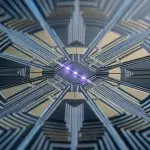
Detailed mapping of magnetic phase diagrams previously required conventional bulk probes limited to two-point correlation functions. However, at Delft University of Technology, researchers achieved programmable control over a Heisenberg spin ladder using a germanium quantum dot array. By varying rung and leg coupling under a fixed magnetic field, they mapped rung-singlet, canted antiferromagnetic, and fully polarized phases for the first time. An artificial magnetic system engineered with germanium quantum dots, tiny structures capable of mimicking complex materials at tiny scales.
This programmable platform provides unprecedented control over simulated magnetism; enabling detailed observation of behaviours previously inaccessible with traditional methods. Measuring how individual spins interact, including connections beyond standard two-point checks, allowed the team to map distinct magnetic states: rung-singlet, canted antiferromagnetic, and fully polarized, revealing key insights into these systems’ underlying structure. At Delft University of Technology, researchers created a programmable magnetic system using germanium quantum dots which mimic materials but are controllable at an tiny scale.
This artificial “Heisenberg spin ladder”, where each step is a miniature magnet interacting with its neighbours, allows unprecedented control over simulated magnetism, moving beyond limitations of traditional methods. Like listening for subtle harmonies within a choir rather than individual voices, the team measured how multiple spins connect via ‘four-point correlations’, revealing details inaccessible to standard techniques and mapping out distinct magnetic states including rung-singlet, canted antiferromagnetic, and fully polarized phases.
Incorporating effects similar to an electron experiencing a slight ‘drag due to its own spin, known as spin-orbit interaction, the researchers accurately modelled observed behaviours; but this platform may unlock insights into more complex quantum phenomena like unconventional superconductivity.
Electrostatic gate manipulation enables programmable spin couplings in germanium quantum dots
Site-resolved tunable exchange interactions underpinned this work, where researchers precisely controlled how strongly each tiny germanium quantum dot “spin” interacted with its neighbours. This granular control, adjusting connections individually rather than globally, allowed construction of an artificial magnetic system mimicking complex materials but offering unprecedented programmability; imagine a staircase where each step represents a tiny magnet and the team could independently strengthen or weaken the connection between adjacent steps. Careful calibration of electrostatic gates surrounding each quantum dot was required to manipulate electron flow and therefore spin coupling strength.
An eight-site germanium quantum dot array fabricated as the basis for simulating magnetic materials. The approach offered greater programmability compared to traditional bulk samples which lack continuous tuning capabilities, measuring only two-point correlations instead. Applying a fixed magnetic field while varying coupling strengths enabled exploration into different phases mirroring antiferromagnetic spin ladders, a common theoretical model in magnetism research. This setup allowed investigation into how changes in interaction strength affect overall system behaviour, paving the way for more complex investigations.
Four-point correlation mapping reveals complex magnetic phases in a quantum dot Heisenberg
Scientists and collaborating institutions achieved four-point correlation measurements within a germanium quantum dot array simulating a Heisenberg spin ladder; this surpasses limitations imposed by traditional methods reliant on interactions between just two spins. Precisely controlling rung and leg coupling under fixed magnetic fields characterised distinct phases, including rung-singlet, canted antiferromagnetic and fully polarised states, using protocols incorporating effects from spin-orbit interactions where electron spin interacts with its motion within the material. The programmable platform enables exploration into unconventional superconductivity within doped systems, offering unprecedented control over simulated magnetism at an tiny scale.
The germanium quantum dot array accurately simulates a Heisenberg spin ladder using tunable interactions through variation of both rung and leg coupling while applying a fixed magnetic field; consequently, predicted phases of rung-singlet, canted antiferromagnetic, and fully polarised states were successfully identified. These protocols allowed precise reproduction of observed transitions between phases despite inherent crossover behaviours in finite systems. Furthermore, measurements extended beyond traditional two-point correlations to include four-point correlations, revealing subtle signatures of phase structure previously inaccessible with conventional bulk probes and demonstrating enhanced sensitivity to collective quantum behaviour.
This demonstration offers tantalising prospects for understanding exotic quantum phenomena but realising genuinely unconventional superconductivity remains an open challenge despite this advance. While distinct magnetic phases mapped with impressive precision, the current work only establishes groundwork for future investigations into pairing behaviour within doped systems. Nevertheless, a valuable set of tools created for exploring quantum materials: a programmable spin ladder built from germanium quantum dots allowing precise control over magnetic interactions and providing an unprecedented platform to investigate complex behaviours within these systems. By precisely controlling the interactions between artificial “spins” arranged in this ladder configuration, and varying both rung and leg coupling under fixed magnetic fields, theoretical predictions regarding phase transitions validated; representing a major advance beyond traditional methods for studying magnetism and enabling detailed exploration of collective behaviours previously hidden from observation.
The researchers successfully demonstrated a programmable Heisenberg spin ladder constructed from a half-filled germanium quantum dot array with tunable exchange interactions. This achievement provides a controllable system for investigating fundamental aspects of quantum magnetism at a small scale, allowing identification of predicted phases including rung-singlet, canted antiferromagnetic, and fully polarised states. Measurements utilising four-point correlations, beyond standard techniques, revealed details about the underlying structure of these phases. The authors suggest this platform will be used to investigate pairing behaviour in doped systems as a next step in their research.
👉 More information
🗞 Observation of magnetic quantum phase crossovers in a semiconductor spin ladder
✍️ Elizaveta Morozova, Xin Zhang, Utso Bhattacharya, Pablo Cova Fariña, Daniel Jirovec, Alexander Nico-Katz, Stefan D. Oosterhout, Sougato Bose, Giordano Scappucci, Menno Veldhorst, Eugene Demler and Lieven M. K. Vandersypen
🧠 ArXiv: https://arxiv.org/abs/2608.17789

See today’s quantum computing news on Quantum Zeitgeist for the latest breakthroughs in qubits, hardware, algorithms, and industry deals.