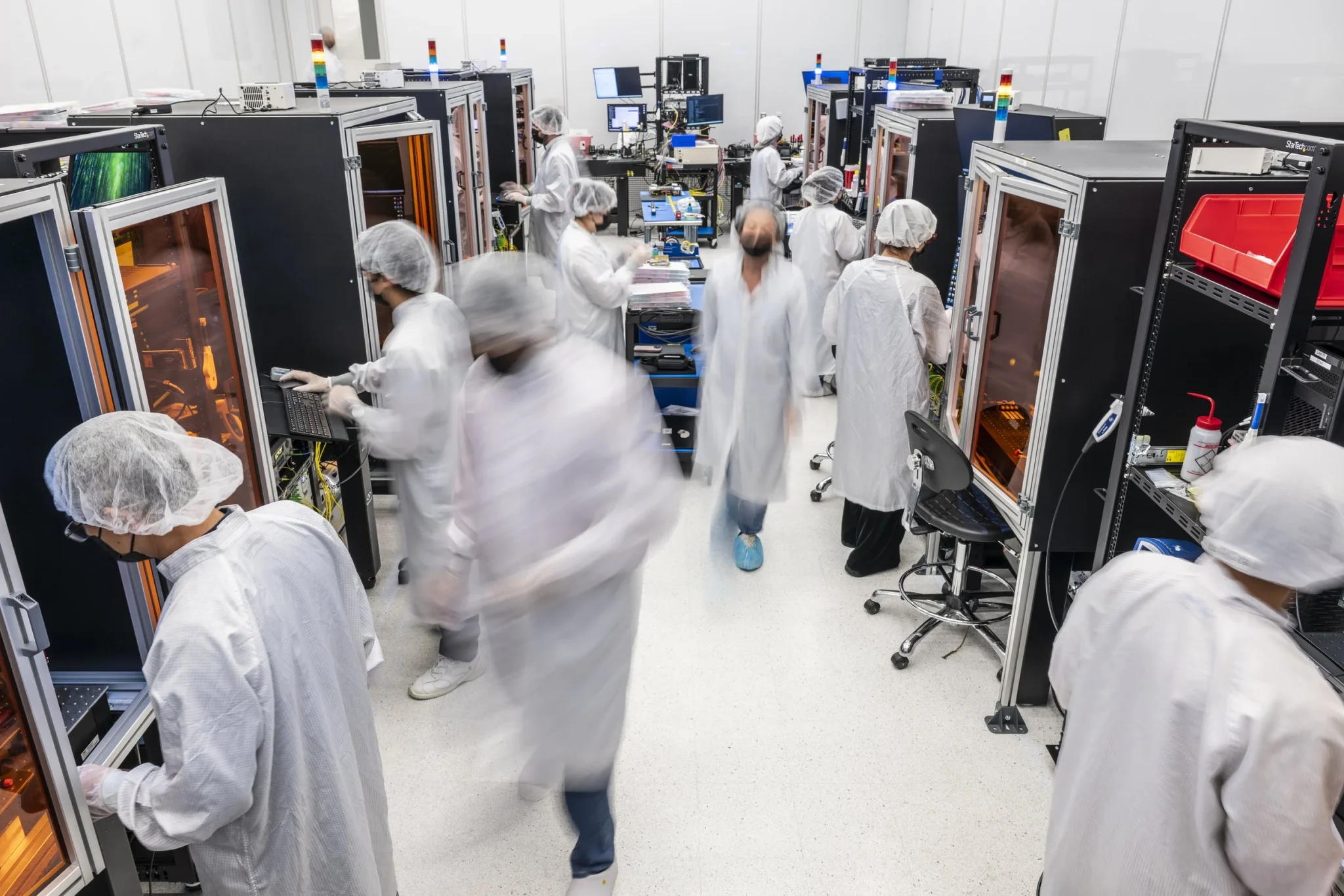
PsiQuantum will accelerate research and development of critical components with a $100 million award from the U.S. Department of Commerce. The funding, enabled by the CHIPS and Science Act, will focus on manufacturing advancements like high-performance optical switches, high-temperature single-photon detectors, and advanced packaging approaches. This investment follows a letter of intent signed in May 2026, demonstrating rapid progress and government confidence in PsiQuantum’s plans. “America’s national security and economic prosperity depend on secure supply chains for advanced technologies,” said Victor Peng, Chief Executive Officer of PsiQuantum.
PsiQuantum’s Silicon Photonics Platform & Domestic Supply Chain Growth
PsiQuantum will expand domestic manufacturing of barium titanate, a critical material for advanced optical switches, with newly secured funding from the U.S. Department of Commerce. The funding will also accelerate research and development focused on high-temperature single-photon detectors and advanced packaging techniques, essential for building practical, scalable quantum systems. These components represent a departure from solely focusing on the quantum processor itself, signaling a broader investment in the entire quantum computing infrastructure.
PsiQuantum’s approach uses existing semiconductor manufacturing processes to rapidly scale its silicon photonics platform and integrate it with established cryogenic infrastructure. “PsiQuantum’s silicon photonics platform will create opportunities across advanced computing infrastructure even as we build and deploy fault-tolerant quantum computers,” said Rob Soderbery, Executive Vice President at PsiQuantum.
In 2025, PsiQuantum invested approximately $200 million with hundreds of American suppliers and vendors across 38 states, demonstrating a pre-existing commitment to domestic sourcing, the company says. This new award is expected to build on those investments, further solidifying the company’s reliance on U.S.-based manufacturing and expertise.
The company’s partnership with GlobalFoundries, initiated in 2019, will continue to be central to scaling quantum photonic chipset production within the country. “GlobalFoundries is excited to continue partnering with PsiQuantum to accelerate photonic quantum computing,” said Tim Breen, Chief Executive Officer of GlobalFoundries. government research institutions, including the Air Force Research Lab, where work has been underway since 2022 to advance semiconductor chip manufacturing and silicon photonics expertise.
The company’s expanded $125 million agreement with the Defense Advanced Research Projects Agency (DARPA), announced in July 2026, places PsiQuantum in a key position for the U.S. government’s evaluation of commercial pathways to utility-scale quantum computing. “Our new award from the Department of Commerce will help take our momentum to the next level,” Soderbery added.
PsiQuantum’s commitment to domestic supply chains extends beyond materials and manufacturing; the company also utilizes a Molecular Beam Epitaxy tool in Santa Clara, California, to develop 300mm wafers of barium titanate. “Thanks to the leadership of the U.S. government, our company will be able to manufacture even more of our components in America.” The company’s long-term goal, established since its founding in 2016, remains the construction and deployment of the world’s first useful quantum computers, a vision now further enabled by this strategic investment in U.S, according to PsiQuantum. manufacturing capacity.
PsiQuantum’s silicon photonics platform will create consequential opportunities across advanced computing infrastructure even as we build and deploy fault-tolerant quantum computers.
Rob Soderbery, Executive Vice President at PsiQuantum




See today’s quantum computing news on Quantum Zeitgeist for the latest breakthroughs in qubits, hardware, algorithms, and industry deals.