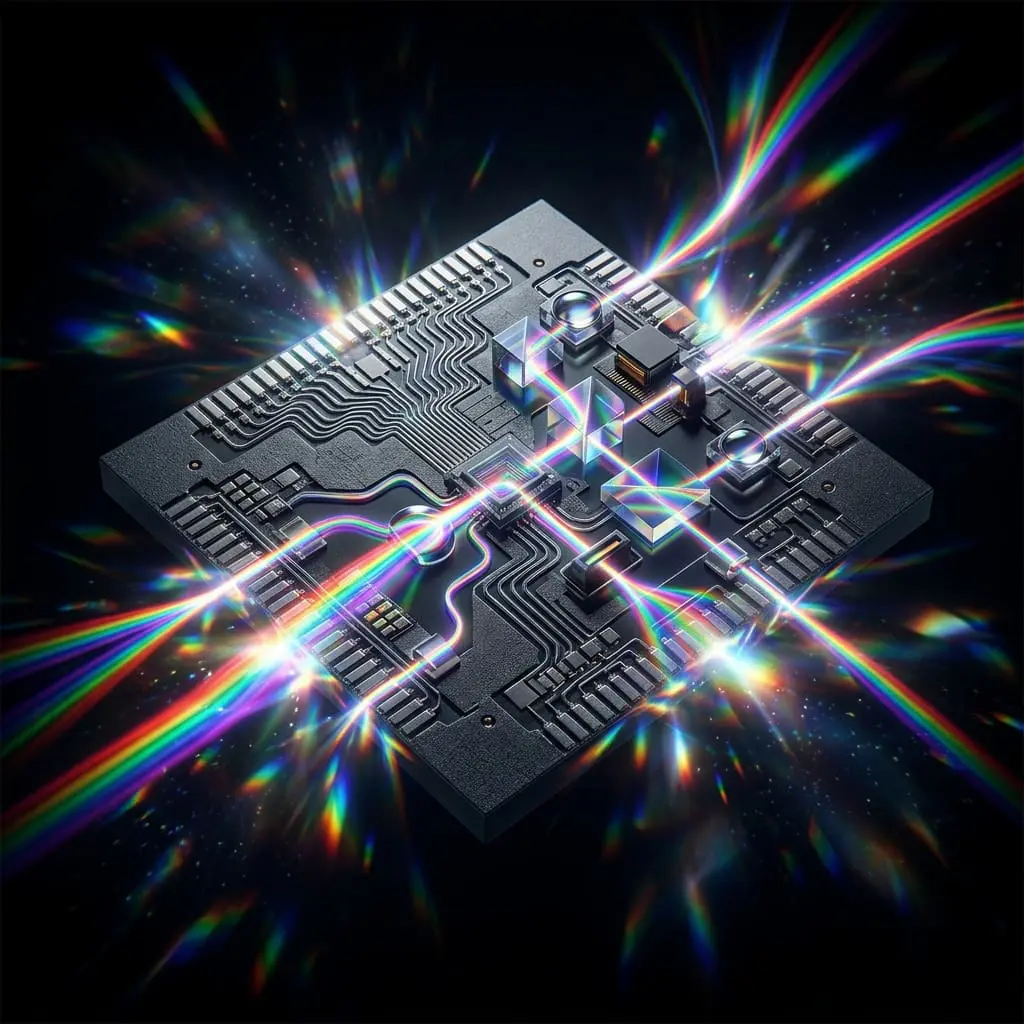
Alberto Paniate and colleagues at Quantum metrology and nanotechnologies, in collaboration with Cornell University, have theoretically investigated the fundamental mechanisms governing photon-pair generation within quantum metasurfaces. A deeper understanding of generation efficiency and emission directionality is key for optimising these compact and integrable platforms for complex quantum state engineering. Their framework interprets current experimental findings and establishes clear design guidelines for future metasurface development, revealing how pump configurations and measurement geometries impact photon-pair characteristics. Furthermore, the study highlights substrate thickness and multilayer configurations as key, previously underutilised, parameters for enhancing generation efficiency and controlling emission directionality, offering a new pathway towards improved photon-pair sources.
Pump geometry and substrate engineering optimise photon-pair emission from quantum metasurfaces
Metasurface designs and experimental configurations are often optimised through trial-and-error procedures because the underlying physics is not yet fully understood. This work theoretically investigates the main mechanisms that control photon-pair generation and detection by studying how different pump configurations and measurement geometries affect the generation efficiency, emission directionality, and collection efficiency of the emitted photon pairs. This framework allows interpretation of existing experimental results and provides general guidelines for the design of metasurfaces and the choice of experimental configurations in future experiments.
Substrate thickness and multilayer configurations represent additional degrees of freedom for quantum metasurface design and can be engineered to enhance the generation efficiency and control the emission directionality, providing a new route for the optimisation of photon-pair sources based on metasurfaces. Traditionally, spontaneous parametric down-conversion (SPDC) has been performed in bulk non-centrosymmetric crystals, where the millimeter-scale interaction length between the pump field and the nonlinear medium enables efficient generation of entangled photon pairs, commonly referred to as signal and idler photons. In recent years, micrometer- and nanometer-thick nonlinear films have attracted considerable interest as compact and integrable SPDC sources with relaxed longitudinal phase-matching condition.
The intrinsically low conversion efficiency of ultra-thin nonlinear media has motivated the development of structured nonlinear systems, in which the resonances supported provide strong field enhancement and thereby sharply increase the photon-pair generation efficiency. Nonlinear metasurfaces offer many design degrees of freedom beyond efficiency enhancement, enabling multifunctional quantum-light sources with properties difficult to achieve in bulk crystals, such as engineered spatial emission, tunable and arbitrary polarization Bell-state generation, and cluster-state generation. Although their efficiencies remain generally lower than those of conventional bulk sources, compactness and integrability represent their main advantage for quantum light generation.
Progress in fully exploiting this multifunctionality is strongly limited by the lack of a thorough theoretical framework describing the mechanisms governing quantum emission from nonlinear metasurfaces, with key properties like generation efficiency and emission directionality often difficult to predict and determined through trial-and-error approaches. This study theoretically investigates, within a quasi-normal-mode (QNM) framework, how pump directions and detection geometries affect the photon-pair generation efficiency and the collection of the emitted photons. Comparing the theoretical predictions with existing experimental results obtained from a lithium-niobate (LN) metasurface fabricated on a glass substrate provides a physical interpretation of the observed behaviour.
Motivated by substrate-induced effects emerging from this analysis, the generation efficiency and the emission directionality were investigated first within a semi-infinite substrate approximation, which isolates the intrinsic response of the metasurface by neglecting finite-thickness effects, and then for substrates with finite thickness and multiple layers. Addressing these effects, which remain largely unexplored in SPDC metasurfaces, opens new routes to enhance photon-pair generation and tailor the emission properties of quantum metasurfaces, similarly to recent substrate-interference strategies used to enhance second-harmonic generation in two-dimensional materials. A realistic example illustrates the proposed theoretical framework.
The investigated metasurface consists of an infinite periodic array, with periodicity of 900nm, of truncated pyramids. Several resonances support the metasurface, labelled with numbers 1. Owing to their intrinsically leaky nature, these resonances are commonly referred to as quasi-normal modes (QNMs). The red dots indicate the different QNMs together with their corresponding quality factors, defined as Q = ω/(2 γ), where ω and γ are respectively the real and imaginary parts of the complex eigenfrequency ω = ω −i γ. Resonance frequency determines ω, while γ describes the radiative leakage rate of the mode. The QNMs are shown together with their electric near-field distributions inside a single unit-cell of the metasurface | E|. The black arrows and crossed circles indicate the local polarization of the electric field.
Among the different modes, QNM1, whose resonance wavelength is closest to the degenerate SPDC wavelength (2 λp = 1576nm), exhibits the largest near-field amplitude inside the non-linear material and its electric field is predominantly oriented along the optical axis of LN, corresponding to the z-direction, for which the nonlinear tensor component χ zzz is the largest. For these reasons, the following focuses on QNM1 as the dominant and most physically relevant channel, allowing isolation of the main mechanisms governing the substrate-dependent SPDC response. The angular dependence of the corresponding complex electric far-field, | E(θ, φ)|, is shown below the near-field profile of QNM1. The mode exhibits equal collimated far-field intensity in the air and substrate half-spaces and is mainly polarized along the z-axis, consistently with the dominant polarization of the near-field inside the LN resonators.
Therefore, the analysis restricts the discussion to the z-polarized component emitted by QNM1. Performing the QNM analysis at zero Floquet wave-vector describes the dominant normal emission channel, arising from the coherent in-phase contribution of the periodic array of unit-cells. Their angular and spectral properties are analysed in Supplementary Material section, using QNMs analysis with non-zero Floquet wave-vector. The contribution of the QNM pair QNM1 −QNM1 to the SPDC photon-pair detection rate is given by | This|2 = ξ(ωs) Ez(θi) Ez(θs) 2, where This is the complex two-photon amplitude, namely the probability amplitude associated with the joint detection of the idler and signal photons.
The signal and idler angular frequencies are ωs and ωi = ωp −ωs, respectively, where ωp is the pump angular frequency. The two photons are detected in the far-field along the directions of polar angles θi and θs, respectively, with polarization along the z-axis. In the normal-emission case considered here, the relevant far-field amplitudes are evaluated along the normal emission channels: θ = 0◦on the substrate side and θ = 180◦on the air side. A plane-wave excitation is incident on the metasurface supported by a semi-infinite glass substrate.
The theoretically calculated number of detected photon pairs is integrated over the full spectral distribution and the resulting count rates are then compared for the four different excitation and detection geometries. Metasurfaces are becoming a favoured platform for photon-pair generation via spontaneous parametric down-conversion, owing to their compact size, integrability, and inherent multifunctionality which allows for the engineering of complex quantum states. However, their potential remains limited because the physical mechanisms governing key properties of the generated photon pairs, such as generation efficiency and emission directionality, are not yet fully understood.
Consequently, metasurface designs and experimental setups are often optimised through trial-and-error procedures. A theoretical investigation explores the main mechanisms controlling photon-pair generation and detection by examining how different pump configurations and measurement geometries affect the generation efficiency, emission directionality, and collection efficiency of emitted photon pairs. This framework aids interpretation of existing experimental results and provides guidance for the design of metasurfaces and selection of experimental configurations in future work. Substrate thickness and multilayer configurations represent additional degrees of freedom for quantum metasurface design and can be engineered to enhance generation efficiency and control emission directionality, offering a new route to optimise photon-pair sources based on metasurfaces.
Optimising metasurface designs through theoretical prediction of entangled photon emission
Quantum technologies promise revolutionary advances in computation and communication, yet building practical devices demands efficient sources of entangled photons. Metasurfaces, artificial materials engineered at the nanoscale, offer a compelling route to creating these sources due to their small size and potential for integration into complex circuits. However, progress has been hampered by a reliance on trial-and-error design, optimising devices experimentally without fully understanding the underlying physics governing photon generation.
Detailed theoretical work has clarified how subtle changes to metasurface design can dramatically improve the efficiency of creating entangled photons, detailing the impact of laser alignment and material layering on photon generation and moving beyond random testing of designs. This work provides important guidance for researchers building quantum devices, even with the acknowledged complexities in fully predicting photon behaviour within these structures. Understanding how pump laser configurations and detection angles impact efficiency and directionality moves the field beyond simply testing designs at random.
Insights into substrate thickness and multilayer designs offer new avenues for optimising photon sources, potentially boosting performance and paving the way for more practical quantum technologies. This theoretical work establishes a thorough framework for understanding photon-pair generation within quantum metasurfaces, moving beyond empirical optimisation of device designs and demonstrating how pump configurations and measurement geometries influence both the efficiency of creating these photon pairs and the direction in which they are emitted, providing important design guidelines for future experiments. By revealing the impact of substrate thickness and multilayer configurations, previously underutilised parameters capable of enhancing generation efficiency and controlling emission directionality were identified.
The research demonstrated that the efficiency and direction of photon-pair generation from metasurfaces are strongly influenced by pump laser alignment, material layering, and substrate thickness. This understanding is important because it moves the field away from trial-and-error design towards a more predictable and optimised approach for building sources of entangled photons. The theoretical framework developed clarifies the physical mechanisms governing photon generation, offering general guidelines for future metasurface designs and experimental setups. Researchers can now utilise these insights to enhance generation efficiency and control emission directionality, representing a step towards more refined quantum devices.
👉 More information
🗞 Mechanisms governing photon-pair generation and emission directionality in quantum metasurfaces
✍️ Alberto Paniate, Ivano Ruo-Berchera and Francesco Monticone
🧠 ArXiv: https://arxiv.org/abs/2606.26303



See today’s quantum computing news on Quantum Zeitgeist for the latest breakthroughs in qubits, hardware, algorithms, and industry deals.