Quantum-classical orchestration is the software and control layer that fuses classical computing, the CPUs, GPUs and supercomputers we already run, with quantum processing units inside a single workflow. It matters because a quantum computer on its own does almost nothing useful, since the classical machine prepares the problem, suppresses errors, decodes the results and decides what to send back. This guide is a plain-English explainer of how quantum-classical orchestration actually works, why every real workload is hybrid rather than pure quantum, and what the software stack looks like from the control electronics up to the cloud. A scannable list of the companies building this layer sits near the end, but the heart of the article is the concept itself.
1. The QPU is never alone. Every practical quantum workload is a hybrid one, with classical compute handling preparation, error suppression, decoding and post-processing around a short burst of quantum execution.
2. The loop is the unit of work. Quantum-classical orchestration is built around a repeating loop in which a classical computer sends a circuit, reads the result and decides what to run next, rather than a single one-shot computation.
3. Variational algorithms are the canonical pattern. VQE and QAOA put a classical optimizer in charge and use the quantum processor as a fast evaluator, which is why they are the textbook example of orchestration in action.
4. The stack is layered. Control hardware sits at the bottom, then runtime and middleware, then compilers and synthesis, then cloud access, with networked entanglement at the edge, and different companies own different rungs.
5. Latency decides the architecture. Loose coupling tolerates seconds of network delay, while tight coupling for real-time error correction needs a loop measured in microseconds, and that gap shapes every design choice.
6. Error correction is an orchestration problem. Real-time decoding, the classical compute that runs inside the quantum loop, is the hardest and most strategic piece of the whole stack.
What quantum-classical orchestration is
A quantum processor is a strange and narrow device. It can hold a fragile superposition for anywhere from microseconds to seconds depending on the platform and run a short circuit, but it cannot load a dataset, store results, suppress its own noise or decide what to compute next. All of that work belongs to classical machines, and the quality of the final answer depends far more on how well the two are coordinated than on raw qubit count. Quantum-classical orchestration is the discipline of running that coordination well, and it is where most of the near-term commercial value in the field now sits.
The reason hybrid is the only realistic model, rather than a temporary crutch, is that the two kinds of machine are good at opposite things. A classical computer is reliable, has abundant memory and runs ordinary logic cheaply, while a quantum processor offers a potential speedup, ranging from quadratic to, for a few structured problems, exponential, on specific tasks and little else. Pairing them lets each do what it does best, with the qubit acting as a co-processor or accelerator that the classical host calls when a particular subproblem suits it. This is the same relationship a CPU has with a GPU, where the GPU is powerful but useless without a host program feeding it work.
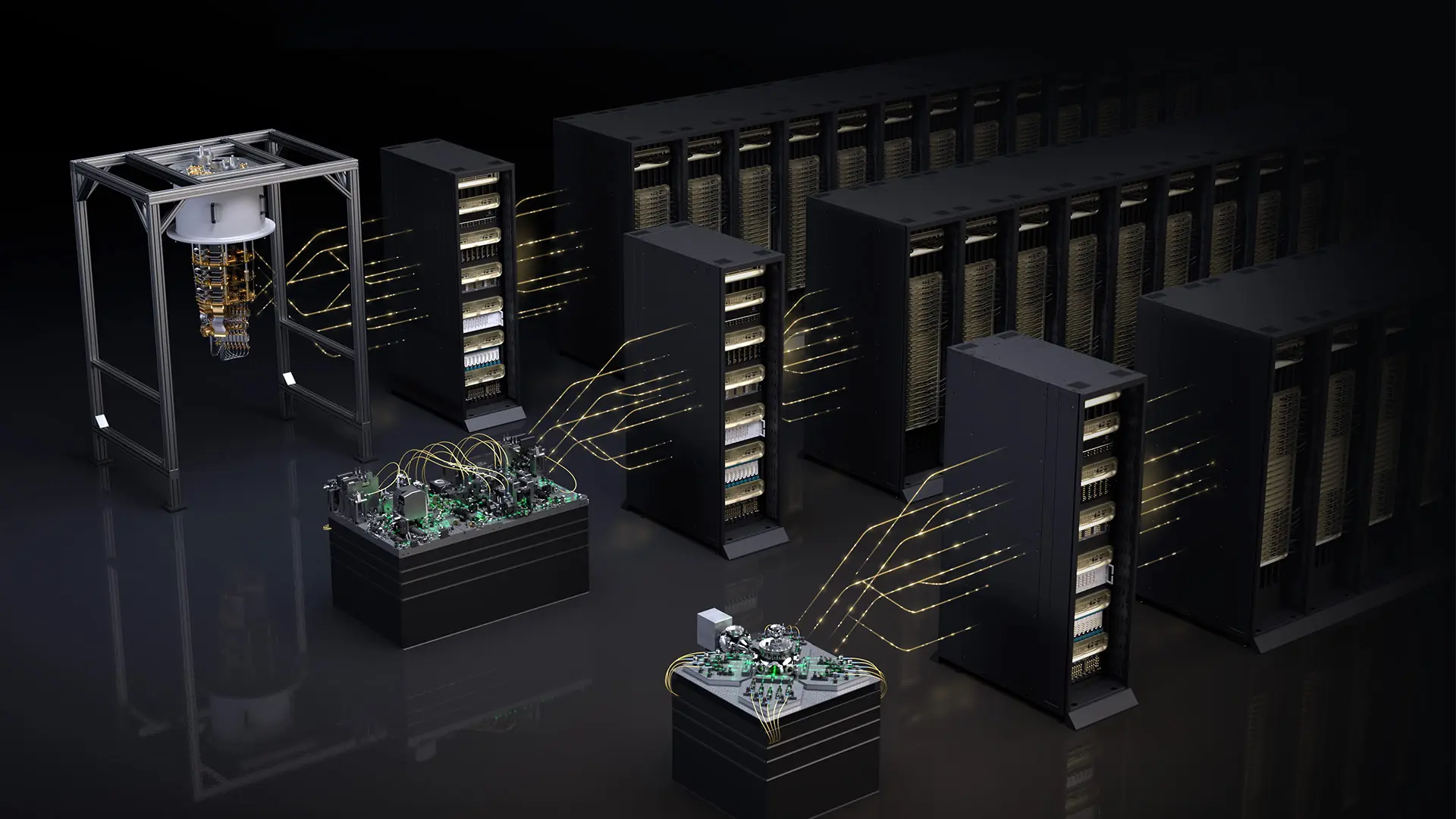
That reframing turns quantum computing into a systems-integration challenge rather than a hardware race. Leading roadmaps now describe quantum-centric supercomputing, in which a quantum processor is one accelerator in a data centre alongside thousands of GPUs, reached through the same job scheduler and the same network. It explains why a chip company, a controls company and a cloud company can all claim to lead the same market, because each owns a different part of the path between a business problem and a quantum answer. The orchestration layer is the connective tissue that makes that path a single workflow instead of a pile of disconnected tools.
The hybrid execution model
The defining feature of a hybrid workload is that it is a loop, not a single shot. A classical program prepares a quantum circuit, sends it to the processor, waits for measurement results, processes those results and then decides what circuit to send next. The quantum processor never runs on its own for long, because a circuit typically runs for microseconds to milliseconds, depending on the hardware, before noise degrades it, so the interesting computation lives in how the classical side steers many short quantum runs toward an answer. Understanding quantum-classical orchestration starts with understanding that this loop is the real unit of work.
Inside one turn of the loop, the classical machine does most of the labour. It encodes the input data into a form the circuit can use, compiles the circuit for the specific device, schedules the job onto an available processor and applies error mitigation to the raw counts that come back. Only a thin slice in the middle is quantum, which is why people describe the quantum processor as a co-processor or an accelerator rather than a computer in its own right. The classical host owns the program, the memory and the control flow, and it borrows the quantum device for the one operation it cannot do efficiently itself.
How fast that loop has to turn is the single most important design parameter. Some workloads are content to wait seconds or minutes between quantum runs, while others must close the loop in microseconds or the qubits decohere before the classical side can react. The whole architecture of an orchestration stack, from the network used to the place the classical compute physically sits, follows from that one number, and it is the reason a generic cloud connection works for some jobs and fails completely for others.
Variational algorithms as the canonical pattern
The clearest example of orchestration in practice is the family of variational algorithms, because they put the classical computer firmly in charge. A variational circuit has tunable parameters, and the job is to find the parameter values that minimise some cost, such as the energy of a molecule. The quantum processor evaluates the cost for a given set of parameters, the classical optimizer reads that value, proposes better parameters and sends a fresh circuit, and the loop repeats until the cost stops improving. The quantum device is a fast evaluator, while all the decision-making sits on classical hardware.
Two algorithms have become the standard reference points. The Variational Quantum Eigensolver, or VQE, searches for the lowest-energy state of a system and is the workhorse of quantum chemistry and materials simulation. The Quantum Approximate Optimization Algorithm, or QAOA, tackles combinatorial optimization problems such as scheduling and routing by tuning a circuit that encodes the problem. Both run the same loop: a classical optimizer steering a parameterised quantum circuit, which is exactly why they are taught as the canonical quantum-classical orchestration pattern and why so much of the tooling is built to make that loop efficient.
The parameter optimization itself happens entirely on classical hardware, often a CPU or GPU running a standard optimization library, and this is where orchestration earns its keep. A poorly built loop wastes most of its time moving data and waiting in a queue between evaluations, so the value of a good platform is measured in how little overhead it adds to each turn. The same pattern drives much of quantum machine learning, where a classical training loop adjusts the parameters of a quantum model, so the techniques that make variational chemistry fast also make hybrid learning practical.
The orchestration software stack
It helps to picture quantum-classical orchestration as a stack of layers, because most companies specialise in one or two of them rather than the whole tower. A real workload passes through every layer on its way from a high-level idea to a pulse hitting a qubit and back again, so the parts that matter are the ones that own a layer cleanly or knit several together. The layers below run from the most human-friendly at the top to the most physical at the bottom.
High-level frameworks at the top
At the top sit the frameworks a developer actually writes code in, such as Qiskit, Cirq, PennyLane and similar libraries. They let a programmer describe a circuit and a hybrid loop in Python without thinking about the device underneath, and they expose the variational pattern as a few lines rather than a hand-built control program. This layer is where most users live, and a good orchestration platform tries to keep that experience unchanged no matter which machine eventually runs the job.
Compilation, transpilation and synthesis
Below the framework, a compiler turns the abstract circuit into instructions a specific processor can run, a step usually called transpilation. It remaps the program onto the qubits that physically exist, respects which qubits can talk to which, and rewrites gates into the native set the hardware supports, all while trying to keep the circuit short enough to finish before noise wins. Synthesis tools push this further by generating an efficient circuit from a high-level description in the first place. This layer is unglamorous but decisive, because the same algorithm can succeed or fail on real hardware depending on how well it is compiled, much as the choice of superconducting or trapped-ion hardware changes what a good compilation even looks like.
Scheduling, queues and middleware
In the middle sits the runtime and middleware that manage jobs, schedule resources and move data between classical and quantum machines. This is where a quantum job becomes just another task in a queue rather than a special case, with a scheduler deciding when a circuit runs, a queue manager handling contention for scarce hardware and a runtime keeping a long hybrid workload alive across many iterations. Without this layer the loop would stall every time it waited for a free processor, so middleware is what lets an orchestration platform run a workflow that lasts hours rather than a single circuit.
Resource management across QPUs, CPUs and GPUs
Below the middleware sits resource management, the bookkeeping that tracks which processors are available and assigns each piece of work to the right one. A mature stack treats QPUs, CPUs and GPUs as a single pool, so an optimizer can run on a GPU, a heavy classical preprocessing step on a CPU cluster and the circuit itself on whichever quantum device fits. Doing this well means co-locating compute so data does not travel far, and it is the difference between a platform that merely reaches a QPU and one that handles quantum-classical orchestration across a whole heterogeneous machine.
Control hardware at the bottom
At the base sit the controllers that turn digital instructions into the precise microwave or laser pulses a qubit understands and read the qubit state back out. This is where the real-time loop is tightest, because gates fire on a nanosecond timescale, and a full measure-decide-act feedback loop closes in hundreds of nanoseconds to a few microseconds, far faster than any software layer above. The control hardware is also where error-correction decoding plugs in, since a decoder has to act inside this loop, and it is the rung a generic cloud can never reach because the physics demands the classical compute sit right next to the qubits.
How quantum slots into high-performance computing
The most consequential trend in quantum-classical orchestration is the move to treat a quantum processor as just another accelerator inside a supercomputing centre. For years a QPU was a separate cloud service that a researcher reached through a bespoke portal, completely outside the machinery that runs the centre. The shift now under way is to make a quantum device bookable through the same job scheduler that allocates CPU and GPU nodes, so a scientist requests quantum time the same way they request any other resource.
In practice this means wiring a QPU into a workload manager such as Slurm, the scheduler that most supercomputers already use to queue and allocate jobs. Once a quantum device appears as a resource the scheduler understands, a hybrid job can ask for some GPU nodes and a slice of QPU time in one request, and the centre handles the rest. This is the integration that turns quantum from a side experiment into a first-class part of the data centre, and it is why so many recent products are built around standard HPC interfaces rather than proprietary ones.
NVIDIA has done more than anyone to shape how this looks, through its CUDA-Q programming model and the broader hybrid runtime approach it encourages. CUDA-Q lets a developer write a single program that mixes GPU and QPU work and compiles it for both, so the GPU supercomputer and the quantum processor are addressed from one codebase rather than two toolchains. The deeper concern at this layer is latency and co-location, because if the classical compute that steers a circuit sits in a distant cloud, the round trip is too slow for anything tightly coupled. Putting the GPUs in the same room as the QPU, on a fast local link, is what makes a real-time hybrid loop possible at all.
Cloud access and orchestration models
Not every workload needs a QPU in the next rack, and for most users today the quantum processor lives in someone else’s cloud. The cloud model gives a developer access to machines they could never own, with the provider handling maintenance, calibration and queueing, and it is the on-ramp through which almost everyone meets quantum hardware for the first time. The trade-off is latency and control, since a job submitted over the public internet cannot close a microsecond loop, so cloud access suits loosely coupled work far better than tightly coupled work. Our quantum cloud providers guide covers the access side of this in more depth.
On-premises access sits at the other end of the spectrum, where an organisation installs a QPU in its own facility or its own HPC centre. This is expensive and rare, but it removes the network entirely and lets the classical and quantum hardware sit on a fast local link, which is the only way to get a genuinely tight loop. The choice between cloud and on-premises is really a choice about how fast the two halves of a workload need to talk, and many serious users end up running prototypes in the cloud before moving production work on-premises.
Above both models sits the most valuable quantum-classical orchestration idea of all, which is multi-backend abstraction. A vendor-agnostic layer lets an organisation write a program once and run it across many different machines without a rewrite, choosing the best backend for each job and avoiding lock-in to any single hardware maker. This portability is the prize that several software companies compete for, because the enterprise that controls the neutral layer controls which machines its customers actually use. Without it, every change of hardware would mean rewriting the whole workflow, which no serious user will accept.
Error mitigation and correction in the loop
Quantum hardware is noisy, so a large part of quantum-classical orchestration is dealing with errors, and the work splits into two distinct jobs. Error mitigation is the cheaper, near-term approach, in which classical post-processing cleans up noisy results after the fact for example by running circuits at deliberately amplified noise and extrapolating back toward the zero-noise answer. It needs no extra qubits, which is why it dominates today, but it does demand real classical compute and careful orchestration to run the additional circuits and combine their outputs correctly.
Error correction is the deeper, harder goal, in which many physical qubits encode one protected logical qubit and a classical decoder watches for errors and corrects them as the computation runs. This is the most demanding orchestration task there is, because the decoder has to process each round of syndrome data at least as fast as the hardware produces it, otherwise a backlog builds faster than it can be cleared.
The decoder also has to return answers quickly enough to steer the next operation when a measurement result decides what happens next, which keeps the whole classical loop on a microsecond budget. Our explainer on the surface code covers the leading error-correcting code, and the wider field is mapped in our roundup of quantum error correction companies.
Orchestration matters for correction precisely because the decoding is classical compute that has to keep pace with the quantum hardware in real time. A decoder that lags behind falls hopelessly out of sync, so this is where specialised hardware, fast local links and tight scheduling all converge. It is also why error correction cannot be treated as a feature bolted onto a cloud service, since the whole point is to run classical logic inside the quantum loop, which only a purpose-built control stack can do.
Real workflow patterns and what makes orchestration hard
In the field, a few workflow patterns recur across very different industries. A chemistry team runs a variational eigensolver to estimate a molecule’s energy, a logistics team runs an optimization loop to schedule vehicles, and a finance team runs a hybrid solver to balance a portfolio. In each case the shape is the same: heavy classical preprocessing, a loop of short quantum evaluations steered by a classical optimizer, then classical post-processing to turn raw counts into a decision. The application differs but the orchestration pattern barely changes, which is exactly why a general platform can serve all of them.
What makes building these workflows genuinely hard comes down to a handful of stubborn problems. Latency is the first, because the speed of the classical-quantum round trip caps how tightly a loop can run. Queueing is the second, since quantum processors are scarce and shared, so a job can wait far longer in line than it spends computing, which wrecks any loop that needs frequent quantum calls. Heterogeneous hardware is the third, as every device has different qubits, gates and error rates, so code that runs well on one machine may need real rework for another.
Data movement is the quiet fourth problem that ties the others together. Shuttling parameters, circuits and results between a classical optimizer and a quantum processor adds overhead on every iteration, and when the two sit far apart that overhead dominates the runtime. Good quantum-classical orchestration attacks all four at once by co-locating compute, reserving hardware to beat the queue, abstracting over device differences and minimising how much data crosses the boundary. The same discipline shows up wherever hybrid systems chase an advantage, including the demonstrations behind quantum supremacy, where the classical side did enormous work around a short quantum run.
Tight and loose coupling
Not all hybrid workflows need the same speed, and the split between loose and tight coupling drives most of the architecture. Loose coupling submits a circuit, waits for the result and then submits the next one, tolerating seconds or minutes of network delay, which is why variational algorithms and most cloud hybrid jobs sit here. Tight coupling instead exchanges data inside a single quantum operation on a microsecond budget, the regime real-time error correction lives in, as the error correction section above describes, and it is why that tier needs dedicated control hardware and fast local links rather than a general cloud connection.
The practical lesson is that quantum-classical orchestration is not one product but a spectrum, and the right tier depends on the job. A finance optimization that runs a variational loop overnight is happy with loose coupling and a managed cloud service, while an error-corrected workload that has to decode syndromes in real time needs the tightest hardware loop money can build. Choosing a platform therefore starts with an honest read of how fast the classical and quantum halves of your problem actually need to talk to each other.
Standards and the NVQLink ecosystem
For years the orchestration layer was a thicket of proprietary interfaces, with each hardware vendor exposing its own control protocol. NVQLink, which NVIDIA announced in October 2025, is the strongest attempt yet to standardise it. The architecture is an open specification for connecting GPU supercomputers directly to QPU control systems with the low latency that real-time error correction and adaptive control demand, and NVIDIA developed it with roughly 17 quantum hardware groups and nine scientific labs. You can read the architecture details on the NVIDIA NVQLink quantum-classical orchestration page.
Standardisation is also happening one layer up, at the interfaces that let any QPU plug into a classical scheduler. The Quantum Device Management Interface, or QDMI, defines a backend-agnostic way to discover a device, query its capabilities and manage a job lifecycle, while the Quantum Resource Management Interface, or QRMI, exposes a quantum resource to classical managers such as Slurm so a QPU can be requested like any other node. The two efforts are starting to overlap, and a 2026 survey behind the openQSE reference architecture argues they now need to converge toward one compatible model. That survey analysed nine production quantum-HPC stacks to propose a single vendor-neutral design, a strong sign that quantum-classical orchestration is maturing from bespoke integrations into a standardised discipline.
Companies building the orchestration layer
With the concept in place, the table below lists the companies whose core product is genuinely the classical-quantum coordination layer rather than the qubits themselves. They are grouped by where they sit in the stack, from the real-time control hardware at the bottom, through middleware and HPC integration, up to the managed cloud platforms and the networked architectures at the edge. The big general-purpose clouds appear here in their orchestration role, where their hybrid-job services run the loop itself, while their broader access function belongs in our quantum cloud providers and quantum software companies guides. For the underlying machines these platforms drive, see our quantum hardware companies roundup.
| Company | What it orchestrates | Link |
|---|---|---|
| Control hardware and in-loop compute | ||
| NVIDIA | CUDA-Q, DGX Quantum and the open NVQLink fabric linking GPUs to QPU controls | site |
| Quantum Machines | OPX1000 controller and the QUA language for nanosecond control and feedback | site |
| Riverlane | Deltaflow real-time error-correction decoding inside the control loop | site |
| Q-CTRL | Fire Opal AI error suppression as a component other stacks call | site |
| SEEQC | Single-flux-quantum digital control co-located on-chip with the qubits | site |
| Zurich Instruments | ZQCS control system with sub-microsecond feedback for error correction | site |
| Runtime, compilers and middleware | ||
| IBM | Qiskit Runtime primitives plus Qiskit Serverless on Apache Ray | site |
| Classiq | High-level synthesis that targets one program at many backends | site |
| ParityQC | ParityOS compiler mapping problems onto hardware-native layouts | site |
| Kipu Quantum | Unified access to multiple backends with algorithm compression | site |
| Quandela | Perceval framework and Quandela Cloud for photonic hybrid workloads | site |
| Quantinuum | Nexus platform and the Tierkreis asynchronous workflow engine | site |
| HPC system integrators | ||
| Bull (Qaptiva) | HPC-native Qaptiva environment, formerly Eviden | site |
| ParTec | QBridge extending HPC schedulers to manage QPUs | site |
| Fujitsu | AI workload broker routing jobs across CPU, emulator and QPU | site |
| Intel | Intel Quantum SDK, an LLVM C++ compiler and simulator, a research effort with no recent release | site |
| Dell Technologies | Quantum Intelligent Orchestrator, a prototype scheduling across QPU, CPU and GPU | site |
| IQM | HPC Integration Service built on the open QDMI interface | site |
| Pasqal | QRMI runtime and CUDA-Q integration for Slurm workflows | site |
| Quantum Brilliance | Room-temperature diamond accelerators co-located in HPC racks | site |
| Qoro Quantum | Composer scheduling and Maestro simulation across mixed hardware | site |
| Cloud and managed hybrid platforms | ||
| Microsoft | Azure Quantum integrated hybrid jobs and sessions | site |
| AWS (Amazon Braket) | Braket Hybrid Jobs automating the classical-quantum loop | site |
| Rigetti | Quantum Cloud Services for low-latency hybrid access | site |
| qBraid | Neutral multi-backend routing across 30-plus devices | site |
| Strangeworks | Enterprise routing plane plus the Quantagonia solver engine | site |
| BlueQubit | Quantum-software-as-a-service over GPU simulators and QPUs | site |
| Terra Quantum | TQ42 enterprise hybrid cloud and no-code studio | site |
| QuTwo | QuTwo OS routing enterprise AI workloads to classical or quantum | site |
| Qilimanjaro | SpeQtrum multimodal service over analog, digital and HPC compute | site |
| D-Wave | Leap hybrid solvers that split large optimisation problems | site |
| QC Ware | Forge and Promethium, classical-first tools with a quantum on-ramp | site |
| Aqarios | Luna platform routing optimisation workloads across backends | site |
| Multiverse Computing | Singularity hybrid solvers for finance plus CompactifAI | site |
| Distributed and networked orchestration | ||
| Aliro Quantum | AliroNet entanglement routing across distributed QPUs | site |
| Welinq | Quantum-memory interconnects that join QPUs into one machine | site |
| Nu Quantum | Qubit-Photon Interface networking multiple QPUs in a data centre | site |
One company sits slightly above this list as an integrator of integrators. HPE used its Discover event in June 2026 to announce a hybrid quantum-supercomputing programme that wires its Cray platform to eight quantum partners at once, including Intel, IQM, Qblox, Quantinuum, QuEra Computing, Quantum Machines, Rigetti and Riverlane. Rather than build qubits, HPE positions itself as the supercomputing fabric these vendors plug into, which makes its partner roster a useful map of who the integrators consider essential. Other names worth knowing include Qblox and Keysight in control electronics, the open-source Munich Quantum Software Stack, Covalent for workflow tooling, and Google Quantum AI, whose Cirq framework and qsim simulator shape how a generation of developers first learns the hybrid loop.
What to watch through 2026
The clearest near-term milestone is real-time error correction sustaining a useful application at scale, since that is the moment tight-coupling orchestration proves it can do real work rather than a laboratory demonstration. Watch for decoding hardware that keeps logical qubits alive through long computations, because that is the hardest orchestration problem and the one that gates everything beyond it. Progress here will tell you more about the field than any single qubit-count announcement, and it connects directly to the wider context set out in our complete guide to quantum computing.
The second theme is consolidation around standards and platforms. NVQLink adoption will widen, the synthesis and access players will keep fighting to be the portability layer enterprises standardise on, and the line between a quantum cloud and an HPC centre will keep blurring as supercomputers add QPUs as bookable accelerators. The QDMI and QRMI interfaces are edging together, the openQSE survey has put a reference architecture on the table, and the major HPC centres are increasingly unwilling to lock themselves into one proprietary protocol. If that convergence holds, the bespoke integrations of today should give way to a standardised layer that any backend can plug into, which would lower the cost of building hybrid systems for everyone in the market.
Frequently asked questions
What is quantum-classical orchestration?
Quantum-classical orchestration is the software and control layer that coordinates classical computing resources, such as CPUs, GPUs and supercomputers, with quantum processing units inside a single workflow. The classical side prepares the problem, suppresses errors, decodes results and decides what to compute next, while the quantum processor runs the short circuit at the heart of the task. Almost every practical quantum workload is hybrid, so this coordination layer is where much of the near-term commercial value sits.
Why does a quantum computer need a classical computer?
A quantum processor can hold a fragile superposition and run a short circuit, but it cannot load data, store results, suppress its own noise or choose its next step. Classical machines handle all of that surrounding work, and the quality of a result depends heavily on how well the two are coordinated. That dependence is why the field now talks about quantum-centric supercomputing rather than standalone quantum computers, with the quantum device acting as an accelerator the classical host calls.
What is the hybrid execution model?
The hybrid execution model is a loop rather than a single computation. A classical program prepares a circuit, sends it to the quantum processor, reads the measurement results, processes them and then decides what circuit to send next, repeating until it reaches an answer. The quantum device never runs alone for long because a circuit typically lasts microseconds to milliseconds depending on the hardware, so the real computation lives in how the classical side steers many short quantum runs.
What are variational algorithms like VQE and QAOA?
Variational algorithms are the canonical orchestration pattern, where a classical optimizer tunes the parameters of a quantum circuit to minimise a cost. The Variational Quantum Eigensolver, or VQE, finds the lowest-energy state of a system and is used for chemistry and materials, while the Quantum Approximate Optimization Algorithm, or QAOA, solves combinatorial problems such as scheduling and routing. In both, the quantum processor is a fast evaluator and the classical hardware does the decision-making.
What does the orchestration software stack look like?
The stack runs from high-level frameworks such as Qiskit and Cirq at the top, down through compilation and transpilation, then scheduling, queue management and middleware, then resource management across QPUs, CPUs and GPUs, and finally control hardware at the bottom. A real workload passes through every layer on its way from an idea to a pulse hitting a qubit and back. Most companies specialise in one or two layers rather than owning the whole tower.
How does quantum computing integrate with HPC?
Quantum slots into high-performance computing when a QPU becomes bookable through the same job scheduler, such as Slurm, that allocates CPU and GPU nodes in a supercomputing centre. A hybrid job can then request GPU time and quantum time in one go, and tools like NVIDIA CUDA-Q let a developer write a single program that spans both. The key concern is latency and co-location, because a real-time loop needs the classical compute physically close to the quantum processor.
What is the difference between tight and loose coupling?
Loose coupling submits a circuit, waits for the result and then submits the next one, with seconds or minutes between steps, which suits variational algorithms and most cloud hybrid jobs. Tight coupling exchanges data inside a single quantum operation on a microsecond timescale, which is what real-time error correction demands. Tight coupling needs dedicated hardware and cannot be served by a generic cloud connection, so it is the harder and more strategic engineering problem.
How does error correction depend on orchestration?
Real-time error correction is fundamentally an orchestration task, because a classical decoder has to consume each round of syndrome data as fast as the hardware produces it and return answers quickly enough to steer the next operation. That keeps the classical loop on a microsecond budget inside purpose-built control hardware, which is why error correction cannot be bolted onto an ordinary cloud service.
Is quantum-classical orchestration the same as a quantum cloud?
They overlap but are not the same thing. A quantum cloud mainly provides managed access and simple hybrid jobs, whereas orchestration spans the deeper layers of control hardware, runtime middleware, compilers and real-time error correction. Vendor-agnostic software layers add portability on top of clouds, while specialist control and decoding companies work below them at the hardware loop, so orchestration is the broader discipline that a cloud is only one part of.



See today’s quantum computing news on Quantum Zeitgeist for the latest breakthroughs in qubits, hardware, algorithms, and industry deals.