- Building electronic devices one atom at a time
- Solar cells at Durham and electrons at the Cavendish
- Moving to Australia for a proposal about phosphorus
- How you put an atom exactly where you want it
- The single atom transistor
- The published record in one place
- From atomic wires to qubits and gates
- Founding Silicon Quantum Computing
- What the company sells and what it claims
- What the approach still has to prove
- The technique outlives the results
- Frequently asked questions
Michelle Simmons is the Australian physicist who worked out how to build electronic devices one atom at a time, and then founded Australia’s first quantum computing company to take the method to market. She is Scientia Professor of physics at UNSW Sydney, director of the Australian Research Council’s Centre of Excellence for Quantum Computation and Communication Technology, and founder and chief executive of Silicon Quantum Computing. Her laboratory made the first transistor whose working part is a single phosphorus atom placed on purpose rather than found by luck. It has since built wires four atoms wide, qubits and a two-qubit gate by the same method.
The method is easy to describe. Carrying it out is another matter. A clean silicon surface is coated with a single layer of hydrogen, and the tip of a scanning tunnelling microscope then lifts individual hydrogen atoms away in a chosen pattern. Phosphine gas is admitted so that phosphorus bonds only where the silicon is bare, and fresh silicon is grown over the top to seal the pattern inside the crystal. Every step has to happen in ultra-high vacuum without disturbing the one before it, which is why very few groups in the world have ever managed the whole sequence.
The bet she has made is easy to state and still unresolved. Placing atoms one at a time gives qubits that are identical by construction, and the published record on her route stands at eleven of them in one device. Her former colleague Andrew Dzurak‘s company Diraq accepts variation between devices in exchange for making them with standard chip-industry tools, so far on a 300 mm pilot line at imec, the Belgian chip research institute. Nobody has yet run the comparison at a scale that settles it, no independent benchmark of her company’s two products exists, and the company’s own target for a universal fault-tolerant machine is 2033.
None of this was where she began. Her doctorate, from Durham University in 1992, was on cadmium telluride solar cells, and most of the following decade went on the physics of electrons in cold semiconductors at the Cavendish Laboratory in Cambridge. She moved to Sydney at the end of the 1990s to join a programme built around a proposal that nobody yet knew how to realise. The twenty years she spent realising it produced the single-atom transistor of 2012, the title of Australian of the Year in 2018 and, a year before that, a company of her own.
She is Scientia Professor at UNSW Sydney, and she directs the ARC Centre of Excellence for Quantum Computation and Communication Technology, the national centre for this work. She founded Silicon Quantum Computing in 2017 and has run it as chief executive ever since. She holds all three at once.
Her group’s 2012 paper in Nature Nanotechnology reported a transistor whose active element is a single phosphorus atom, placed to an accuracy of one silicon lattice site. Placing an atom deliberately, rather than doping a region and hoping, is the distinction the whole programme rests on.
A companion 2012 paper in Science showed that doped silicon wires only four atoms wide still obey Ohm’s law, which nobody could take for granted at that width. Had the resistance climbed sharply instead, atomic-scale circuits would have had no route to a working device.
She was named Australian of the Year in 2018, elected a Fellow of the Royal Society the same year, and received the Prime Minister’s Prize for Science in 2023. The Royal Society went on to award her its Bakerian Medal and Lecture, so the recognition has come from her own discipline as well as from the public.
Silicon Quantum Computing, which she founded in 2017, is the commercial vehicle for the atomic precision manufacturing her laboratory developed over the previous two decades. Getting that technique off a laboratory bench and onto something resembling a production line is the harder half of the work, and it is the half that is not finished.
Building electronic devices one atom at a time
Very few groups anywhere in the world can build an electronic device by placing its atoms one by one. Hers was the first to make a transistor that way. The record UNSW keeps of her work lists the world’s smallest transistor, the narrowest conducting wires, three-dimensional atomic electronics and the first two-qubit gate between atom-based qubits in silicon. It also notes two Federation Fellowships and a Laureate Fellowship from the Australian Research Council, a run UNSW says only a small number of Australian researchers share.
Size gets the attention. Control is what sets the work apart. A phosphorus atom sits where the design says it should, to within a single site of the silicon lattice, so two devices built to the same drawing behave the same way. That reproducibility is what a manufacturing process needs and what a laboratory curiosity does not, and it is the reason the technique became a company rather than a run of papers.
The short version of the career
Her career has run through four places. She took her doctorate at Durham in 1992 and spent most of the 1990s in the Cavendish Laboratory’s semiconductor physics group in Cambridge, before moving to Sydney at the end of that decade. At UNSW she has been a Scientia Professor since 2009 and director of the national centre since 2010, with a five-year Laureate Fellowship from the Australian Research Council beginning in 2013. Since 2017 she has also run the company she founded to sell what the laboratory had learned to make.
The honours came in a cluster once the results were in. In 2018 she was named Australian of the Year and elected a Fellow of the Royal Society, which later awarded her its Bakerian Medal and Lecture. In 2023 she received the Prime Minister’s Prize for Science, the country’s highest award for a scientist.
Solar cells at Durham and electrons at the Cavendish
Her 1992 Durham doctoral thesis is on the characterisation of cadmium telluride solar cell layers grown by metal-organic vapour phase epitaxy. In practice it was measurement work. She examined thin crystal films grown for solar cells to find out what had actually been made. The two questions it asks are what the layer looks like once it has formed, and how well it turns light into current.
Twenty years later she would be putting single atoms into a crystal with a microscope tip, and that work rests on the two skills a solar cell thesis teaches. The first is knowing how crystals grow and what defects they carry. The second is the habit of measuring the difference between what you intended to make and what you actually made.
The Cambridge interval
She then spent most of the 1990s in the Semiconductor Physics Group at the Cavendish Laboratory in Cambridge, publishing from 1993 into the late 1990s alongside Michael Pepper and David Ritchie. The work was about how charge moves through semiconductor structures at very low temperatures, where the behaviour of individual electrons stops being a correction and becomes the thing you measure. She is first author on a 1994 paper, Optimization of high mobility two-dimensional hole gases, which is a fair sample of the period.
Crystal growth and electron transport are separate trades that are rarely learned by the same person, and she now had both. Someone who can grow a crystal layer and then measure a single conduction channel running through it is holding the two halves of atomic-scale fabrication in one pair of hands.
Andrew Dzurak, who would later found the silicon spin qubit company Diraq, was working in the same Cambridge laboratory in the same years. His 1993 paper on Coulomb blockade oscillations in the thermopower of a quantum dot carries Michael Pepper among its co-authors as well. The Australian silicon programme drew much of its early expertise from that one building. Two of its competing approaches trace back to people who overlapped there.
Moving to Australia for a proposal about phosphorus
In 1998 Bruce Kane published A silicon-based nuclear spin quantum computer in Nature, proposing that quantum information be stored in the nuclear spins of individual phosphorus atoms embedded in isotopically purified silicon. The paper was precise about the physics that would make such a machine work, and silent on how anyone was supposed to get the atoms into position. That silence is the gap Michelle Simmons spent the next twenty years filling.
Michelle Simmons moved to Australia at the end of the 1990s to join that programme, and her published affiliation switches from the Cavendish Laboratory to UNSW around the turn of the century. By 2001 she was on a Physical Review B paper with Jeremy O’Brien, Andrew Dzurak, Robert Clark and Kane himself, under the title Towards the fabrication of phosphorus qubits for a silicon quantum computer. The title was honest about where the field stood. The work was about getting atoms onto a surface, not yet computing with them.
The division of labour that followed shaped Australian quantum computing for twenty years. One line of work pursued qubits made from quantum dots in transistor-like structures. The other took the harder and more literal reading of Kane’s proposal, which is to put the actual atoms in the actual places. Simmons took the second.
How you put an atom exactly where you want it
The technique her group refined is called hydrogen resist lithography. A clean silicon surface takes a coat of hydrogen at one atom per silicon bond, after which nothing else will stick to it anywhere at all. Knocking that hydrogen off a few chosen sites with the microscope tip leaves a stencil a few atoms across, cut into a surface that is otherwise sealed shut.
Phosphine gas then does the job that ordinary chip lithography does with light and a patterned mask, except that the pattern here is atomic. Phosphorus bonds only where the hydrogen has been removed, so the shape the tip cut is exactly the shape the dopant takes. Fresh silicon grown over the top seals the pattern inside the crystal, and every stage of it happens in ultra-high vacuum.

Why nobody else does this
Every stage has to happen in ultra-high vacuum without disturbing what came before. That is the difficulty. The buried atoms then have to be found again and contacted electrically, which is a separate engineering problem from placing them. UNSW says the group leads the field internationally in making precision atomic electronic devices in silicon, for both conventional and quantum computing.
Placing the atoms is only half the job, because they have to be wired together, and nobody knew whether a conductor four atoms wide would still behave like a wire. The 2012 Science paper Ohm’s Law Survives to the Atomic Scale, led by Bent Weber with Michelle Simmons as final author, showed that doped silicon wires that narrow keep a resistivity independent of their dimensions. That is precisely what separates an interconnect from a tunnel barrier, and it is what an atomic-scale circuit needs in order to be a circuit.
The single atom transistor
The result her name is most attached to is A single-atom transistor, published in Nature Nanotechnology in 2012 with Martin Fuechsle as first author and Michelle Simmons as final author. The device holds one phosphorus atom between a source, a drain and a gate, all of it buried inside silicon grown over the top layer by layer. The atom itself is the working part of the device, rather than a region of silicon doped with many of them.
The paper gives the placement accuracy as one silicon lattice site, which is one atomic position in the crystal. The tolerance on the finished device is therefore a single step of the lattice in any direction. Earlier single-dopant transistors had been found rather than designed, in devices where an atom happened to have landed somewhere useful, and none of them could make that claim.
Why placement rather than size is the achievement
A transistor built around a single atom is the smallest such device physics permits, and that is what makes the headline. The claim that matters more to a manufacturer is repeatability, because a process has to make the same device twice and then a thousand times. A record held once gets you none of the way there.
Her group had already shown in a 2010 paper in Nature Nanotechnology that few-electron quantum dots could be made in single-crystal silicon by the same approach. The 2012 results are the point at which the technique became a platform rather than a demonstration.
The published record in one place
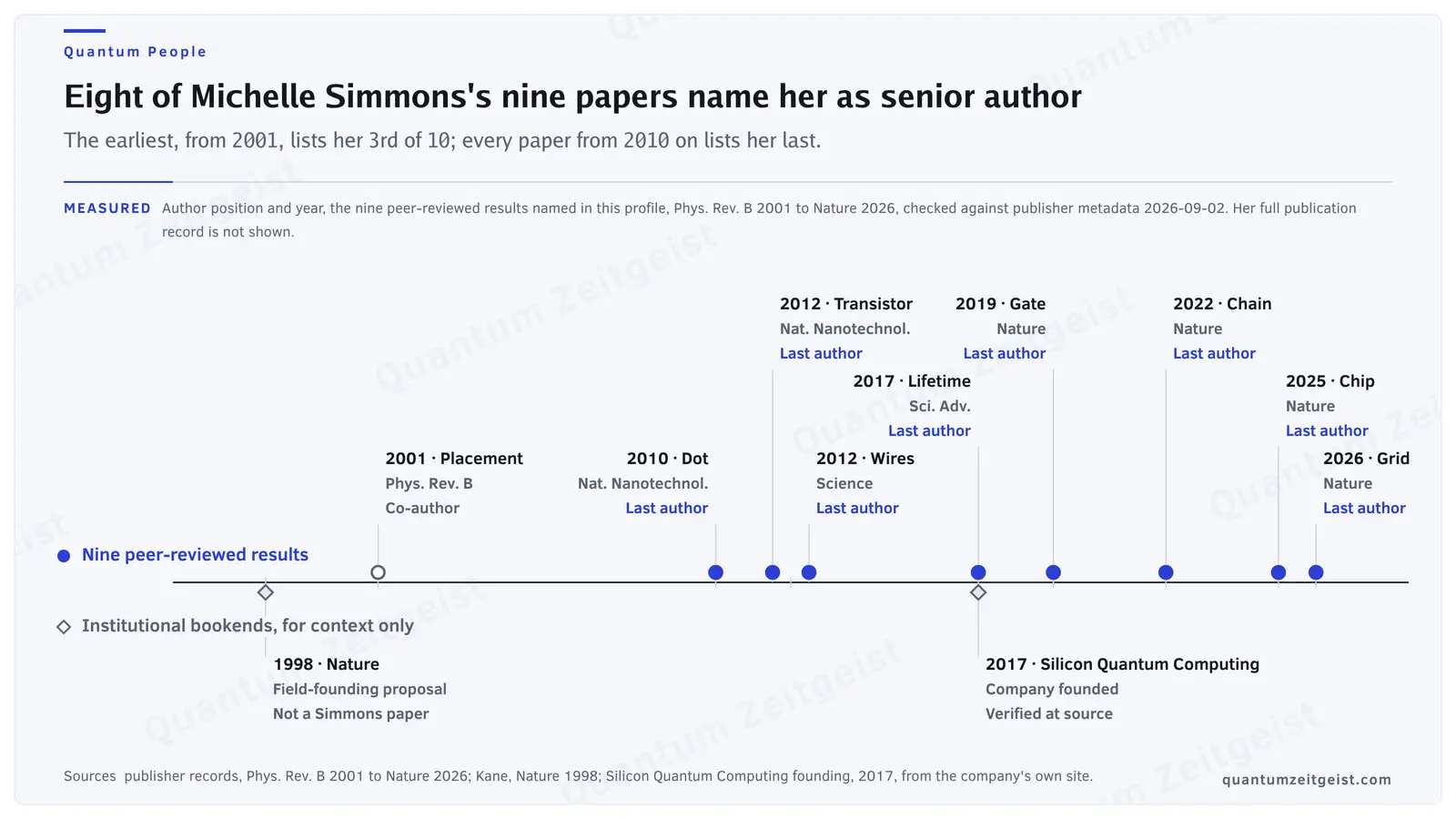
Seven papers carry the programme’s first two decades, from the 2001 work on placing phosphorus atoms on a silicon surface to the 2022 atom-by-atom simulator, and she is last author on six of them. The two results since, the eleven-qubit processor of December 2025 and the 15,000-site array of February 2026, complete the timeline above and are taken up below in the section on what the approach still has to prove. In this group the final position in the author list marks the senior researcher, not the most junior. Every citation below is checked against publisher metadata, and her position in each author list is given.
| Result | Where published | Headline finding | Her role |
|---|---|---|---|
| Phosphorus qubit fabrication in silicon | Phys. Rev. B 64, 161401 (2001) | Placing single phosphorus atoms on a silicon surface by STM | Co-author |
| Spectroscopy of few-electron single-crystal silicon quantum dots | Nature Nanotechnol. 5, 502 (2010) | Few-electron quantum dots built by atomic precision lithography | Last author |
| A single-atom transistor | Nature Nanotechnol. 7, 242 (2012) | One phosphorus atom placed deterministically to one lattice site | Last author |
| Ohm’s law survives to the atomic scale | Science 335, 64 (2012) | Four-atom-wide doped silicon wires behave as ordinary conductors | Last author |
| Atomically engineered electron spin lifetimes of 30 s in silicon | Sci. Adv. 3, e1602811 (2017) | Electron spin lifetimes of thirty seconds in an engineered device | Last author |
| A two-qubit gate between phosphorus donor electrons in silicon | Nature 571, 371 (2019) | The first entangling gate between atom-based qubits in silicon | Last author |
| Engineering topological states in atom-based semiconductor quantum dots | Nature 606, 694 (2022) | An atom-by-atom quantum simulation of a topological chain | Last author |
From atomic wires to qubits and gates
Placing an atom is only useful if the electron bound to it can be controlled, measured and entangled with another. In 2019 her group published A two-qubit gate between phosphorus donor electrons in silicon in Nature, with Yu He as first author and Michelle Simmons as final author.
A platform without an entangling operation has qubits but not a computer, because every quantum algorithm needs two qubits to act on each other rather than one at a time. The quantum dot branch of the Australian programme had shown such a gate in 2015, and the atom-based route had not managed one until this paper.
Accepting the Prime Minister’s Prize in October 2023, Michelle Simmons told the UNSW newsroom that her group had already settled the question. “With atomic precision placement of just two types of atoms in our devices, phosphorus and silicon, we have proven that we can optimise the speed and quality of qubits, essential for realising an error corrected quantum computer.” The gate she was describing had been published in 2019 without a fidelity figure, and the number that would test the claim did not reach print until December 2025.
The simulator that came out of the same technique
In 2022 the group published Engineering topological states in atom-based semiconductor quantum dots in Nature. The paper describes a chain of quantum dots, each placed atom by atom, arranged so that the chain as a whole behaves like a textbook model of a topological insulator. The device runs no program and stands in for the material itself, which makes it analogue simulation rather than gate-based computing, built on the same fabrication line as everything else.
It also points at a nearer-term use for the technology than a fault-tolerant computer. A machine that reproduces the physics of a molecule or a material by arranging atoms to match it does not need error correction to be useful. That puts a saleable product a good deal closer than a fault-tolerant machine would be.
Founding Silicon Quantum Computing
Silicon Quantum Computing was founded in 2017, a date the company gives on its own about page, and the UNSW newsroom calls it Australia’s first quantum computing company and a UNSW start-up. The description holds on the dates. QuintessenceLabs in Canberra dates from 2008 but sells quantum cybersecurity rather than computing, and Q-CTRL, the other Sydney quantum company of that year, was founded in November 2017 and writes control software rather than building machines. Michelle Simmons is its founder and chief executive, and she has kept her university roles alongside the job rather than leaving to run it full time.
That double role is close to the whole point of the company. Atomic precision took roughly two decades of publicly funded research to develop, and the company is the route by which that work turns into products rather than papers. The university was never set up to do that part, and the laboratory has gone on making the technique while the company has to make it pay.
What the company says about itself
Its about page claims more than 200 patents and patents pending, more than 250 refereed journal publications, and more than fifty doctorates and doctoral candidates on staff. It also states a target of universal fault-tolerant quantum computers by 2033. Those are the company’s own figures. They are reproduced here as its claims rather than as independently verified facts.
The same page states that the work is built on more than twenty-five years of materials engineering, which is a fair description of the line running from the university laboratory to the company. UNSW’s own account of the 2023 Prime Minister’s Prize describes the company as the only one in the world that manufactures with atomic precision. That is a superlative other groups working with the same technique would contest.
What the company sells and what it claims
Silicon Quantum Computing lists two products in market and a third to come, describing Watermelon as a quantum feature generator for machine learning and Quantum Twins as a quantum analogue simulator for materials design. A gate-based Chilli series is listed on the same page as forthcoming.
Those descriptions come from the company’s own site and are presented here as marketing claims. No independent benchmark of either product against a classical alternative has been published that this profile could find.
Selling the analogue simulator before the gate-based processor is a coherent order in which to do things. Arranging atoms into a pattern is what this fabrication method is good at, and wiring up millions of identical control lines is not. It also means revenue can arrive before fault tolerance does, which matters a great deal to a hardware company working to a 2033 target.
What the approach still has to prove
Every phosphorus atom is identical to every other phosphorus atom, which is something no lithographically defined quantum dot can offer. In a field where nearly every device has to be tuned individually, that uniformity is worth a great deal. The cost of it is speed, because a microscope tip that places atoms one at a time is not an obvious route to a processor with a large qubit count.
The published record on her route now stands at eleven qubits in one device. In December 2025 her group reported An 11-qubit atom processor in silicon in Nature, two registers of phosphorus nuclear spins coupled through their electrons. Its two-qubit gate between nuclear spins ran at 99.90 per cent fidelity, the first in silicon to cross 99.9 per cent, and its second two-qubit gate, between electrons, at 99.64 per cent. Every single-qubit gate but one exceeded 99.90 per cent, reaching 99.99 on the best qubit, while entangled states spanning the two registers came in lower, between 87 and 97 per cent. Six years earlier the same route had two qubits and no published gate fidelity, so the pace has picked up, and eleven is still eleven.
The much larger number the company quotes belongs to a different kind of device. The 15,000-site array behind Quantum Twins, reported in Nature in February 2026, is an analogue simulator whose dots stand in for atoms in a lattice, and what it showed was a metal-insulator transition rather than a sequence of gates. The best-known estimate of what a useful fault-tolerant machine needs is Craig Gidney’s. In May 2025 he put a computer able to break RSA-2048 at under a million physical qubits, using the surface code and assuming a 0.1 per cent error rate. That is down from the 20 million he and Martin Ekerå had estimated in 2021. The distance between eleven gate-model qubits and the company’s 2033 target is the number to hold in mind.
The company states a one-week chip manufacturing cycle on its own site, which is fast for a research device and says nothing at all about volume. What a weekly cycle would mean for a production line making processors at a large qubit count is not something the company’s own figures answer.
The comparison with the other silicon route
Diraq, founded by her former UNSW colleague Andrew Dzurak in 2022, takes the opposite bet. It accepts the device-to-device variation that comes with lithographically defined dots, in exchange for using the processes a commercial foundry runs. In September 2025 that approach produced a peer-reviewed result in Nature on four two-qubit devices made on imec’s 300 mm pilot line in Leuven, which is a research line rather than a merchant foundry. Their two-qubit gate fidelities ran between 99.04 and 99.56 per cent. Imec’s own release says the devices were selected at random rather than picked as the best of a batch. That is a specific kind of evidence for which, as far as this profile has been able to establish, the atomic precision route has not yet published an equivalent.
Neither position is obviously correct, and both are still arguments rather than outcomes. The question that decides it is whether uniform qubits made slowly beat variable qubits made fast, and nobody has yet run that comparison at a scale that would answer it.
On the numbers alone the two routes are close. The atom route holds the best single gate, at 99.90 per cent against 99.56, though its second two-qubit gate at 99.64 sits inside Diraq’s range. The foundry route holds the reproducibility claim, four devices chosen without cherry-picking that all cleared 99 per cent. Which of those matters more is the question the next five years will answer, and it is not one that either company’s marketing can settle.
The technique outlives the results
Three things make her matter beyond her own results, and the first is a fabrication capability that did not exist until she built it. The Royal Society’s Bakerian citation puts it as ‘seminal contributions to our understanding of nature at the atomic-scale by creating a sequence of world-first quantum electronic devices in which individual atoms control device behaviour’. A new technique outlives the first result it produces, because everyone who works in the field afterwards gets to use it.
The second is what the technique answered, because the single atom transistor and the four-atom wires told the whole of nanoelectronics whether the laws governing ordinary conductors survive at the limit of miniaturisation. They do survive, which was not the safe assumption at the time. The answer matters to anyone shrinking a circuit, whether or not they care about quantum computing.
The third reason is institutional. She has run a national research centre and founded Australia’s first quantum computing company. Since being named Australian of the Year in 2018 she has been one of the most visible scientists in the country, which has given a technical argument about silicon an unusually large public platform.
Frequently asked questions
Who is Michelle Simmons?
What is the single atom transistor?
What is atomic precision manufacturing?
What did Michelle Simmons study?
What is Silicon Quantum Computing?
Did Michelle Simmons build a two-qubit gate?
What awards has Michelle Simmons received?
How does her approach differ from Diraq’s?
What are Watermelon and Quantum Twins?
Why does Michelle Simmons matter in quantum computing?


See today’s quantum computing news on Quantum Zeitgeist for the latest breakthroughs in qubits, hardware, algorithms, and industry deals.