He turned searching into a quantum advantage, giving the field one of its two founding algorithms.
Who Lov Grover is
Lov Grover is an Indian-American computer scientist whose 1996 quantum search algorithm became one of the defining results of the field. He is remembered above all for a single, deceptively simple idea: that a quantum computer can find a marked item in an unsorted collection far faster than any classical machine can. That idea has echoed through nearly every part of quantum computing since.
Born in 1961 in Meerut, India, Grover trained as an electrical engineer before turning his attention to the strange logic of quantum information. His work sits alongside the achievements of researchers like Peter Shor, and the two of them are routinely named as the authors of the quantum algorithms that started everything. Where Shor showed quantum machines could break cryptography, Grover showed they could search.
A quiet revolution in search
What makes Grover distinctive is that his contribution did not require exotic structure in the problem being solved. Many quantum speedups depend on hidden periodicity or algebraic patterns, and they vanish the moment those patterns are absent. Grover’s result applied to the most generic task imaginable, finding a needle in an unstructured haystack, and that generality is exactly why it has proven so durable.
Education and early career
Grover earned his bachelor’s degree in electrical engineering from the Indian Institute of Technology Delhi in 1981. From there he crossed to the United States for graduate study, taking master’s degrees in electrical engineering at Caltech and in physics at Stanford. He completed his doctorate in electrical engineering at Stanford in 1984, with a thesis on new concepts in free-electron lasers. His early training was rooted in circuits and engineering rather than in pure physics, and that practical grounding shaped how he approached problems later in his career.
In 1984 Grover joined Bell Laboratories, the storied research institution that produced the transistor, the laser, and much of the foundation of modern information theory. He spent his first years there in computer-aided design, building a VLSI CAD system based on simulated annealing that was used to lay out several thousand AT&T commercial chips. He then taught as a visiting professor at Cornell from 1987 to 1994 before returning to the Bell Labs CAD group, and quantum computation was at first something he pursued in his spare time. Bell Labs gave him both the freedom and the intellectual company to pursue a question that, at the time, looked highly speculative.
From engineering to quantum information
The move from circuit design to quantum algorithms was not an obvious one in the early 1990s. Quantum computing was still a young and uncertain discipline, with only a handful of concrete algorithms to its name. Grover’s willingness to take the subject seriously, and to ask whether everyday computational tasks could be accelerated, set the stage for the breakthrough that would carry his name.
The 1996 breakthrough
In 1996, while at Bell Labs, Grover published a fast quantum mechanical algorithm for database search. The problem he tackled was as fundamental as computing gets: given a large collection of items with no useful ordering, find the one item that satisfies a particular condition. Classically there is no clever shortcut, and on average you must inspect roughly half of the items, which means the work grows in proportion to the size of the collection.
Grover’s algorithm changed that arithmetic. Instead of needing a number of steps proportional to the number of items N, it finds the marked item in roughly the square root of N steps. For a database of a million entries, that is the difference between hundreds of thousands of operations and around a thousand, a saving that grows more dramatic as the problem gets larger.
Why the quadratic speedup matters
A quadratic speedup is more modest than the exponential leap that Shor’s factoring algorithm promises, yet it is far more broadly useful. Search sits underneath an enormous range of computational problems, from optimization to constraint satisfaction to brute-force attacks on cryptographic keys. Because so many tasks can be cast as a search, Grover’s quadratic gain reaches into corners of computer science that the narrower exponential speedups never touch.

How the algorithm works
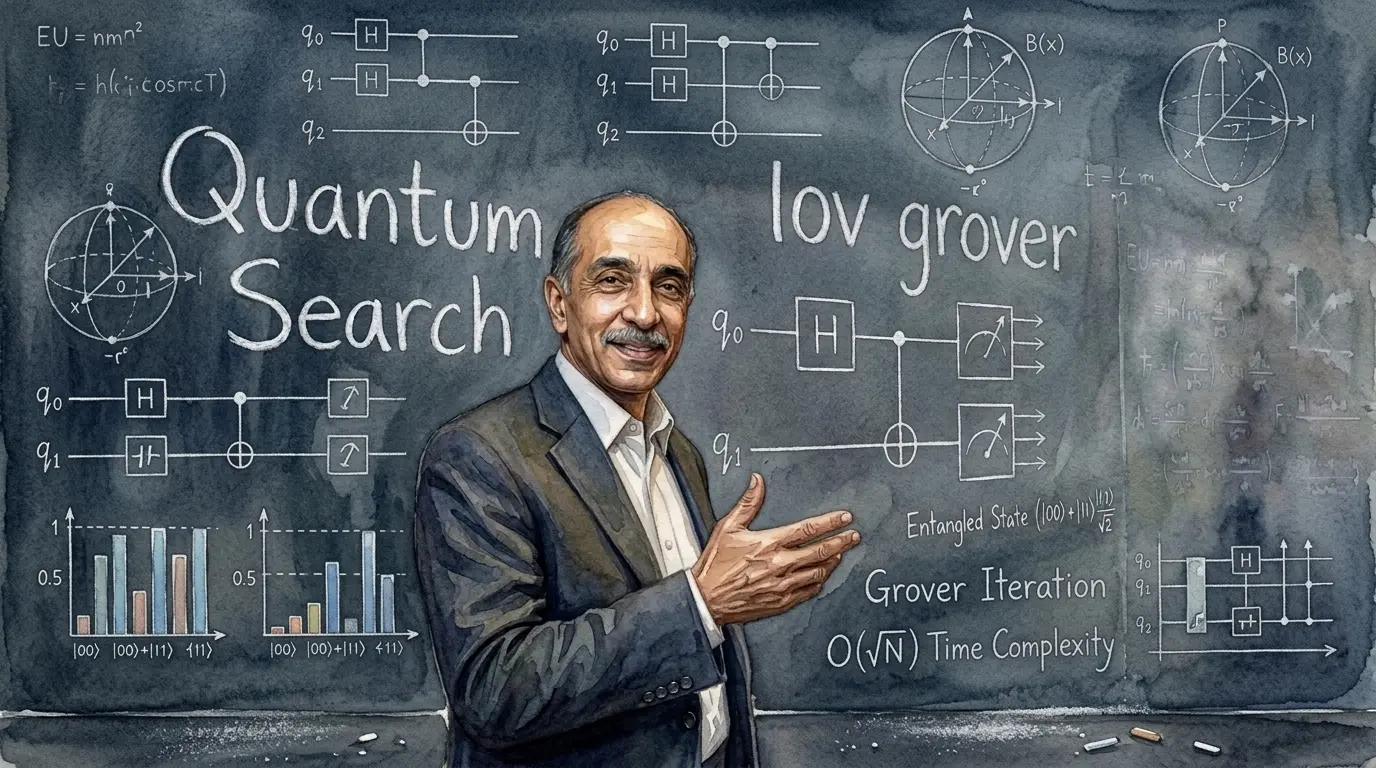
Grover’s algorithm does not read a stored table. It needs a function that recognises the right answer when handed a candidate, and the count of N refers to how many candidates that function could be asked about. Loading N real records into quantum memory would itself cost N steps and consume the advantage. The engine inside Grover’s algorithm is a technique now called amplitude amplification. A quantum computer holds all the possible answers in superposition at once, each with its own probability amplitude, and the algorithm repeatedly nudges those amplitudes so that the correct answer grows louder while the wrong answers grow quieter. After about 0.785 times the square root of N of these gentle rotations, the right answer dominates and a measurement reveals it with high probability. The count matters, because the probability rises and then falls again. Keep iterating past the optimum and the answer degrades.
This amplification proceeds through interference rather than brute inspection. Each iteration reflects the quantum state about carefully chosen axes, steadily rotating it toward the target. The geometry is elegant: the whole computation can be pictured as a rotation in a two-dimensional plane, with every step turning the state a little closer to the marked item.
Amplitude amplification turned out to be more than a one-off trick for search. It became a reusable building block, a subroutine that other quantum algorithms call upon whenever they need to boost the chance of finding a good solution. That portability is part of why Grover’s ideas have spread so widely across the algorithmic toolkit of quantum computing.
Why the result is provably optimal
One of the most striking facts about Grover’s algorithm is that it cannot be beaten. Charles Bennett, Ethan Bernstein, Gilles Brassard and Umesh Vazirani proved that for unstructured search, no quantum algorithm can do asymptotically better than a number of queries proportional to the square root of N. Grover credits Bernstein for that argument in his own paper, and Christof Zalka later closed the remaining gap, showing the algorithm is optimal exactly rather than approximately. Grover’s method does not merely speed up search; it hits the theoretical ceiling for how fast quantum search can ever be.
This optimality gives the result a permanence that few algorithms enjoy. Many techniques are eventually superseded by cleverer successors, but Grover’s bound has held because it is a theorem about how many queries any quantum algorithm must make, not a claim about hardware. When a problem genuinely has no exploitable structure, the square-root speedup is the best available.
A ceiling that defines the field
Knowing the optimal bound also tells researchers where not to waste effort. The bound applies to the black-box setting, where the algorithm may only query the test function and cannot inspect how it works. Grover said so himself, noting that algorithms exploiting a problem’s internal structure, Shor’s factoring among them, are not bound by it. In this way the result acts as a fixed point, a piece of bedrock against which other ideas are measured.
Grover and Shor as the two pillars
Quantum computing is often introduced through two foundational algorithms, and Grover’s is one of them. The other is Shor’s algorithm for factoring large numbers, published in 1994. Together they marked the moment when quantum computing stopped being a purely theoretical curiosity and started to look like a genuine threat and opportunity for real computation.
The contrast between the two is instructive. Shor’s algorithm delivers an exponential speedup, but only for a narrow class of problems built on hidden periodic structure, most famously the factoring that secures much of modern cryptography. Grover’s algorithm delivers a smaller quadratic speedup, but it applies to almost anything that can be framed as a search, which is a vast territory.
Narrow and exponential versus broad and quadratic
Neither algorithm makes the other redundant. Shor’s narrow exponential power and Grover’s broad quadratic reach cover complementary ground, and most surveys of quantum advantage begin by setting them side by side. Understanding why one is sharp and rare while the other is gentle and ubiquitous is one of the first lessons in the subject.
Lasting influence and recognition
Grover’s algorithm has become a fixture of textbooks, lecture courses, and research papers, and it is frequently the second algorithm anyone studying quantum computing learns. Its influence is visible in fields ranging from optimization to machine learning, where amplitude amplification is invoked to sharpen the odds of finding good outcomes. The 1996 paper remains one of the most cited results in the discipline.
Recognition has followed in due course. The Indian Institute of Technology Delhi named Lov Grover a Distinguished Alumni Awardee in 2021. Its citation calls the search algorithm one of the most significant original results in quantum computation and information processing, and quotes John Preskill: “If quantum computers are being used 100 years from now, I would guess that they will be used to run Grover’s algorithm or something like it”. He was promoted to Distinguished Member of Technical Staff at Bell Labs in 2002 and retired from the labs in 2008, working as an independent researcher since then. That career places him in the lineage of researchers who turned the institution into a powerhouse of computing ideas.
A standard tool, not a museum piece
Decades after its publication, Grover’s algorithm is not treated as a historical artifact but as a living component of how people think about quantum advantage. Companies building quantum hardware and software still benchmark against it, and students still implement it as a first real taste of quantum speedup. Few results from the 1990s remain so squarely at the center of an active field.
Why Lov Grover matters in quantum computing
Lov Grover matters because he handed quantum computing one of its two founding algorithms and, with it, a source of advantage that touches an extraordinary range of problems. Search is everywhere in computation, and by showing that quantum machines can search faster, he made the case that quantum advantage would not be confined to a single exotic application. That breadth is his enduring gift to the field.
His algorithm also carries a rare guarantee of optimality, which means it will never be replaced by a faster method for unstructured search. The combination of broad applicability and provable best-possible performance gives the result a permanence that few contributions in computer science can claim. It is a fixed star by which other quantum algorithms continue to navigate.
When the history of quantum computing is told, Grover’s name sits beside Shor’s at the very beginning of the story. The quadratic speedup he discovered, and the amplitude amplification technique that powers it, have grown into staples of the quantum toolkit. That is why, thirty years on, Lov Grover remains one of the people whose work defines what quantum computers are good for.
Frequently asked questions
Who is Lov Grover?
What is Grover’s algorithm?
When did Grover invent his algorithm?
What is the speedup that Grover’s algorithm provides?
What is amplitude amplification?
Is Grover’s algorithm the best possible?
How does Grover’s algorithm differ from Shor’s algorithm?
Where was Lov Grover educated?
Why does Grover’s algorithm still matter today?




See today’s quantum computing news on Quantum Zeitgeist for the latest breakthroughs in qubits, hardware, algorithms, and industry deals.