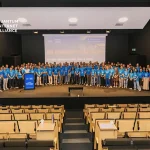
From August 24-28, 2026, the Jülich Supercomputing Centre will host a summer school focused on the practical applications of quantum computing, bridging digital and analog architectures. Organized jointly by the Jülich UNified Infrastructure for Quantum computing (JUNIQ) and the NRW-funded EPIQ project, the event is a collaboration between a major research institution and the quantum start-up eleQtron from Siegen. The program will combine lectures with hands-on sessions, with a particular emphasis on mathematical frameworks like QUBO and Ising Models used in quantum optimization. Participants will gain practical experience utilizing quantum computing resources accessible through the cloud-based JUNIQ platform, exploring how different paradigms can integrate into scientific and industrial workflows.
EPIQ represents a collaboration between Forschungszentrum Jülich and eleQtron, a quantum start-up based in Siegen, demonstrating a partnership intended to accelerate innovation. The program’s curriculum extends beyond theoretical foundations to encompass practical methodologies, with hands-on sessions dedicated to quantum annealing, simulation, and gate-based computing. Participants will specifically explore QUBO and Ising Models, mathematical frameworks crucial for tackling quantum optimization challenges, and gain experience utilizing the cloud-based JUNIQ platform. Organizers state that particular emphasis will be placed on real-world applications in optimization, scientific computing, and energy systems, with the intent to translate quantum capabilities into tangible scientific and industrial workflows. Open to students and researchers at all career stages, especially Master’s and PhD candidates, the summer school offers free participation including access to computing resources, meals, and local transportation. A poster session will provide a forum for attendees to share their research interests, fostering a collaborative environment for advancing quantum computing knowledge and application.
Researchers are actively exploring the strengths of specialized architectures like quantum annealers and analog simulators alongside gate-based systems, moving beyond the widely publicized pursuit of universal, fault-tolerant machines. The JUNIQ/EPIQ Summer School, scheduled for August 24-28, 2026, reflects this broadening focus by dedicating significant curriculum space to all three paradigms. This exploration isn’t merely theoretical; the program emphasizes integration of these different approaches into practical scientific and industrial workflows, acknowledging that no single quantum method will likely dominate all applications. A key component will be hands-on sessions focused on QUBO and Ising Models, mathematical frameworks central to many quantum optimization algorithms. These sessions demonstrate a commitment to equipping participants with immediately applicable skills, moving beyond abstract concepts to concrete problem-solving techniques. This deliberate effort to bridge the gap between academic research and tangible industrial impact aims to foster a new generation of quantum computing practitioners.


See today’s quantum computing news on Quantum Zeitgeist for the latest breakthroughs in qubits, hardware, algorithms, and industry deals.