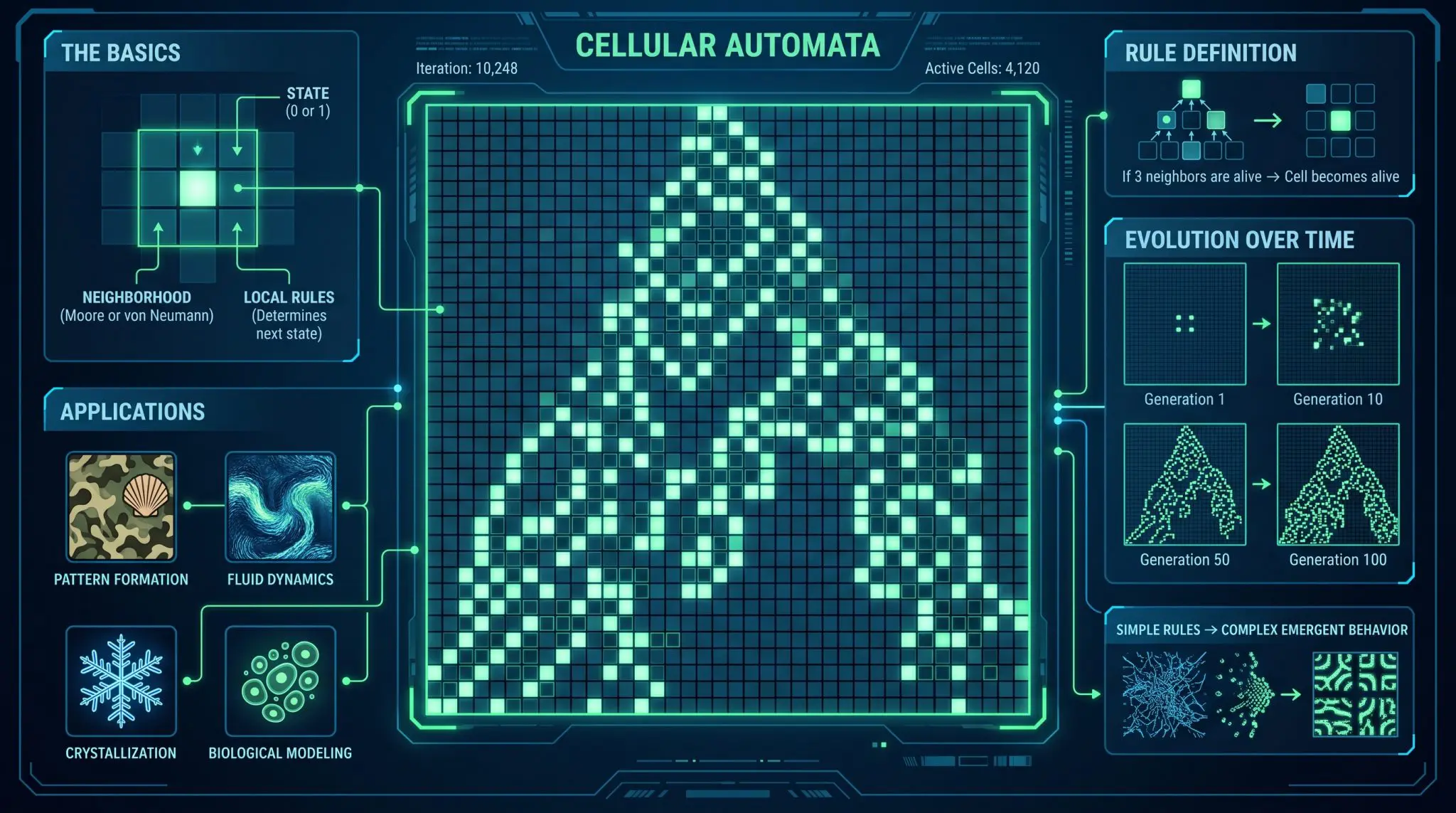
Researchers have recently demonstrated quantum cellular automata using programmable atomic arrays, shifting these theoretical models into physical implementation. These systems utilize midcircuit measurements and qubit resets to engineer synthetic open-system dynamics, enabling the exploration of complex behaviors reminiscent of classical models like Conway’s Game of Life and Wolfram’s Rule 30 automaton. This work applies quantum cellular automata to model quantum transport, a key area where the role of quantum correlations in driven exclusion dynamics remains largely unexplored, particularly within nonequilibrium steady states.
Atomic Arrays Realize Quantum Cellular Automata: A TASEP Implementation
Programmable atomic arrays have enabled the first experimental realization of quantum cellular automata, shifting the study of these systems from theoretical models to physical implementation. Researchers focused on a specific implementation of the totally asymmetric simple exclusion process, or TASEP, a model frequently used to describe transport phenomena at the microscopic scale. These systems model particle transport using stochastic dynamics on lattices, finding applications in areas ranging from RNA polymerization to traffic modeling.
The TASEP and its asymmetric counterpart have become foundational nonequilibrium models, possessing a rich phenomenology and solvable classical states. Each cell in the quantum version consists of a qubit, with update rules replaced by local unitary gates. The experimental setup relies on a two-species atom array, modeled as a system of qubits paired with ancillary qubits. These system and ancillary qubits interact through repeated application of a local quantum gate, designated G.
Following a complete sweep across the lattice, the ancilla qubits are measured and reinitialized, effectively propagating the quantum state forward in time. The gate G itself is composed of two unitary gates: U, which encodes coherent interactions within the system, and D, which induces ancilla-mediated dissipation. Swap operations are integrated to emphasize the nearest-neighbor range of the gate U and maintain consistent qubit order, without affecting the underlying transport dynamics. Researchers explicitly designed the automaton rule to include a parametrized gate U(ω) that implements coherent nearest-neighbor hopping of excitations.
This gate acts only on the system qubits, while the system-ancilla component, D(τ), implements the stochastic TASEP update rule upon tracing over the ancilla. To simulate open-boundary TASEP dynamics, the team implemented a driven system, injecting excitations at the left boundary with probability α and ejecting them at the right boundary with probability β. These boundary processes utilize additional ancillary qubits interacting locally with the boundary qubits. The classical TASEP exhibits three distinct nonequilibrium phases, including a high-density phase, a low-density phase, and a maximum current phase, separated by coexistence lines and transitions.
Results indicate that even though standard entanglement witnesses do not detect quantum correlations, the steady states exhibit clear quantum signatures beyond entanglement. The authors conclude that given the simplicity and paradigmatic nature of the TASEP, these results indicate that quantum features beyond entanglement can appear even in minimal models of dissipative transport, suggesting that these findings could have broad implications for understanding quantum transport in more complex systems.
Qubit Clusters and the QCA Gate: U and D Operations
Programmable atomic arrays have enabled a new approach to simulating quantum transport using quantum cellular automata, specifically realizing the totally asymmetric simple exclusion process (TASEP). This implementation moves beyond theoretical models by physically enacting the dynamics of interacting qubits, each representing an agent in the transport process. The system utilizes clusters of qubits, system qubits paired with ancillary qubits, and applies a quantum gate, designated G, to these clusters to model the TASEP’s stochastic behavior. Researchers chose τ = 0.75 for their simulations and considered various values of ω.
Large-scale simulations were conducted to determine the steady states arising from the interplay between coherent and stochastic transport. The average lattice occupation in the finite-size NESS was analyzed.
Dissipative Dynamics via Ancilla Measurement and Reinitialization
The researchers demonstrated a method for engineering synthetic open-system dynamics using programmable atomic arrays, a technique centered on midcircuit measurements and qubit resets. This work moves beyond theoretical models by realizing these automata physically, opening avenues for exploring quantum transport phenomena previously inaccessible through simulation alone. These ancillary qubits are not merely passive observers; their measurement and subsequent reinitialization introduce controlled dissipation into the system, effectively mimicking the stochastic nature of the TASEP.
This process allows for the simulation of open-system dynamics, where the system exchanges energy and information with its environment. The automaton rule, realized by the quantum gate G, consists of a two-qubit system gate U followed by a three-qubit gate D, with the gate U encoding coherent interactions within the system and gate D inducing ancilla-mediated dissipation.
This work builds on the recent advancements in programmable Rydberg atom arrays, which provide a scalable platform for realizing many-body quantum dynamics. The ability to precisely control the interactions between individual atoms allows for the implementation of complex quantum circuits, such as the QCA described here. The researchers emphasize that this approach is not limited to the TASEP; the same principles can be applied to model other complex systems, potentially opening up new avenues for exploring quantum transport and many-body physics.
Quantum TASEP: Kraus Map and System State Propagation
The foundation of this approach lies in the construction of a quantum circuit model where each lattice site is represented by a qubit, signifying either an occupied or vacant state. Neighboring qubits are paired with ancillary qubits, forming clusters that interact via a specifically designed quantum gate, G. The repeated application of this gate, coupled with ancilla measurement and reinitialization, effectively propagates the quantum state forward in time via a global Kraus map, K. The researchers investigated the nonequilibrium phase diagram of this QCA implementation of the quantum TASEP through large-scale simulations and characterized the resulting NESS.
The average lattice occupation in finite-size NESS was also analyzed.
Beyond Entanglement: Quantum Signatures in Nonequilibrium Steady States
Programmable atomic arrays have moved quantum cellular automata from theoretical models into physical systems, enabling a detailed examination of quantum transport phenomena previously inaccessible to experiment. The research team investigated the nonequilibrium phase diagram of a quantum TASEP, the totally asymmetric simple exclusion process, implemented within this QCA framework, employing large-scale simulations. However, the quantum implementation introduces complexities not present in its classical counterpart, particularly concerning the role of quantum correlations in driving transport.
The simulations reveal a surprising result: standard entanglement witnesses, tools typically used to detect quantum correlations, fail to identify quantum features in the resulting nonequilibrium steady states. This finding challenges conventional understanding of quantum transport, indicating that entanglement is not a prerequisite for observing quantum mechanical influences in driven, dissipative systems.
This setup allows for a precise tuning of the driving forces and a detailed exploration of the resulting phase diagram. The ability to realize these quantum cellular automata in programmable atomic arrays represents a step toward understanding and harnessing the power of quantum transport.
👉 More information
🗞 Nonequilibrium Phases and Quantum Correlations in Synthetic Transport Models
✍️ Uddhav Sen, Federico Carollo and Sascha Wald
🧠 DOI: http://link.aps.org/doi/10.1103/2cvx-6hqz

See today’s quantum computing news on Quantum Zeitgeist for the latest breakthroughs in qubits, hardware, algorithms, and industry deals.