
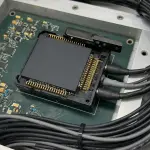
BTQ Technologies (Nasdaq: BTQ) and ICTK (KOSDAQ: 456010) have completed the design of a security chip integrating physically unclonable function technology, establishing hardware-rooted authentication for a growing range of connected devices. The chip combines BTQ’s compact, low-power QCIM cryptographic accelerator architecture with ICTK’s VIA PUF technology, creating a platform for unique device identification and cryptographic agility at the silicon level. The companies state the design supports both classical and post-quantum cryptographic functions, addressing increasing demands for security performance and resilience in IoT, AI, and industrial systems. This milestone follows a US$15 million development agreement signed in October 2025 to co-develop QCIM, with production preparation now underway.
QCIM and VIA PUF Integration for Hardware-Rooted Security
The collaboration, indicated by the Nasdaq ticker BTQ for BTQ Technologies, signals growing investor focus on quantum-based security solutions and a strategic move towards securing networks with advanced technology. This chip provides unique device authentication, cryptographic acceleration, and trusted device identity directly at the silicon level, targeting applications in IoT, AI, and critical infrastructure. QCIM, BTQ’s soft IP cryptographic accelerator, is engineered to be compact and low-power, a crucial design consideration for resource-constrained devices. By executing cryptographic operations within the memory subsystem, QCIM minimizes latency, power consumption, and data movement while maintaining crypto-agile security across diverse chip architectures. ICTK, a Korean chip company trading on KOSDAQ as 456010, contributes its VIA PUF technology, which generates unique hardware identities based on microscopic manufacturing variations.
This integration combines cryptographic agility with device-level authentication, verifying a device’s authenticity and trustworthiness for use in high-assurance networks. Olivier Roussy Newton, CEO and Chairman of BTQ, said that recent U.S. Executive Orders accelerating quantum innovation and post-quantum cybersecurity highlight that trusted quantum infrastructure is rapidly becoming a national priority. The development builds upon a memorandum of understanding signed in May 2025, and was further solidified by a US$15 million development and joint investment agreement in October 2025, outlining a roadmap encompassing joint design, validation, and eventual mass production. ICTK’s established partnerships within telecommunications and financial services, including relationships with LG U+, underscore the growing demand for PUF-based hardware roots of trust in regulated industries.
BTQ anticipates shipping test chips to customers by year-end for validation, enabling mass production and global market entry. Roussy Newton added that the company believes its QCIM and PUF platform is well-positioned to support this transition by enabling hardware-rooted trust, secure device identity, and cryptographic agility for critical infrastructure, connected devices, AI systems, and industrial networks. The resulting platform addresses the emerging market for quantum-era security semiconductors, building a trusted infrastructure for connected devices and next-generation computing systems.
We believe our QCIM and PUF platform is well-positioned to support this transition by enabling hardware-rooted trust, secure device identity, and cryptographic agility for critical infrastructure, connected devices, AI systems, and industrial networks.
Olivier Roussy Newton, CEO and Chairman of BTQ


See today’s quantum computing news on Quantum Zeitgeist for the latest breakthroughs in qubits, hardware, algorithms, and industry deals.