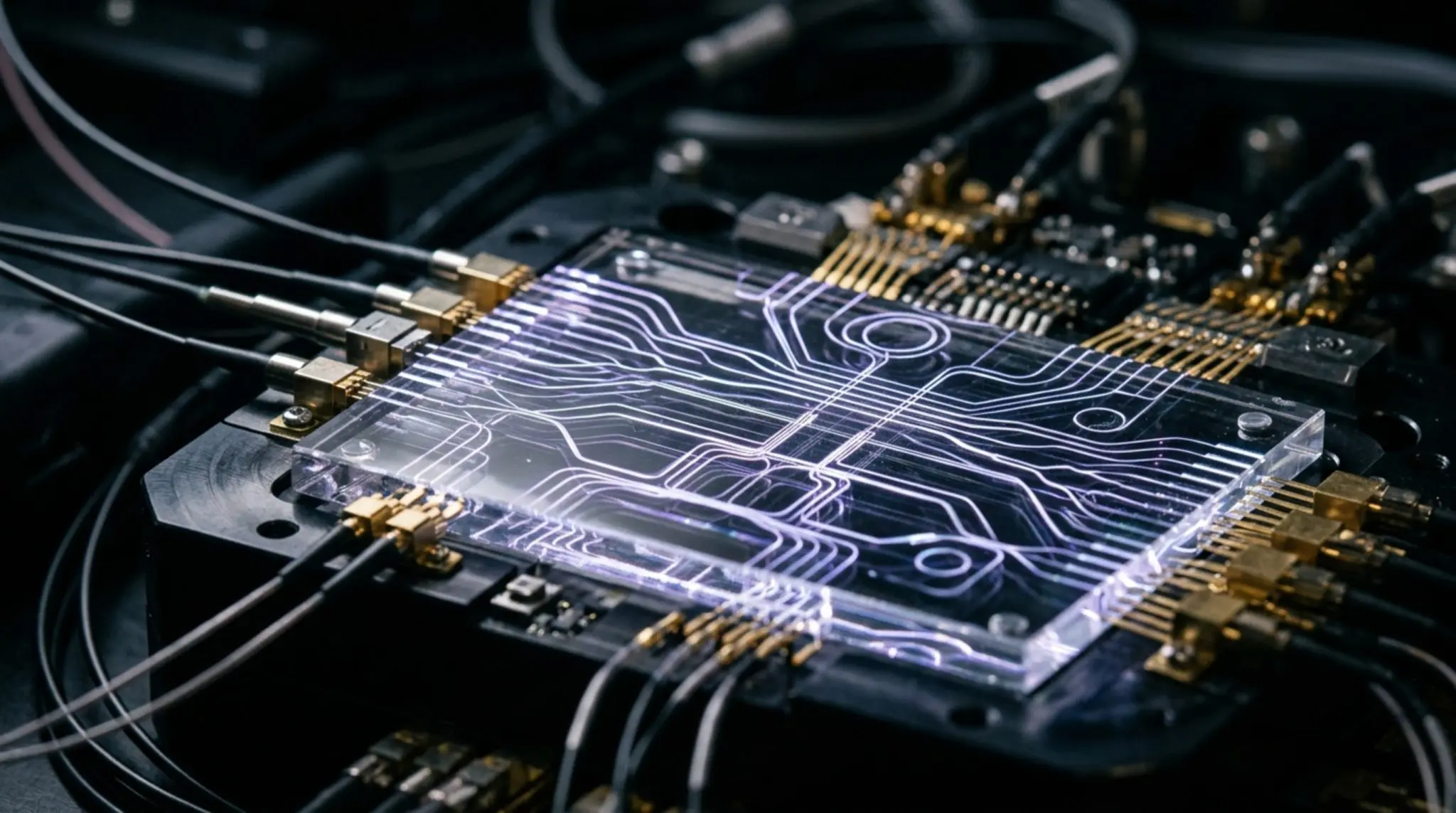
Researchers led by Christian Reimer have created an integrated optical circulator on a thin-film lithium niobate chip achieving 37 dB peak isolation, a level previously difficult to attain in non-magnetic designs. This circulator operates across a 14 THz bandwidth, encompassing the full O- and C+L optical telecom bands important for high-capacity fiber optic communication. Demonstrating practicality, the device successfully transmitted 400G/polarization data using standard hardware; these results establish a scalable route to broadband on-chip circulation relevant to industry-standard optical fiber transmission systems.
Thin-Film Lithium Niobate Enables Broadband Electro-Optic Circulation
Achieving 37 decibels of peak isolation, a new optical circulator design minimizes signal interference in fiber optic systems, a level previously difficult to obtain in integrated devices lacking magnetic materials. This performance benchmark surpasses many existing non-magnetic circulator designs and suggests a pathway toward more reliable high-speed data transmission. The device relies on a thin-film lithium niobate platform to establish non-reciprocity, the one-way transmission of light, without the need for bulky or energy-intensive magnetic components.
Unlike Kerr-based isolators requiring high-power pump lasers, this approach operates efficiently without altering the signal’s wavelength or necessitating complex filtering. The architecture utilizes cascaded travelling-wave Mach-Zehnder modulators, driven by electrical sinusoidal signals, to direct light flow. Existing acousto-optic devices, while capable of high isolation, often depend on resonant structures and substantial electrical power; this new circulator circumvents those limitations.
Brillouin-related interactions have also demonstrated non-reciprocity, but extending them to broadband, multi-port circulation demands increased pump distribution and routing complexity, a challenge this design avoids. The research builds upon prior work in integrated photonics on thin-film lithium niobate, as detailed in Express 28, 24452-24458 (2020), and integrated lithium niobate electro-optic modulators operating at CMOS-compatible voltages, published in Nature 562, 101-104 (2018). The team’s work offers a compelling alternative to traditional circulator designs, potentially enabling more compact, efficient, and scalable optical networks.
Cascaded Mach-Zehnder Modulators Achieve 37dB Isolation
The demonstrated circulator achieves up to 37 decibels of peak isolation, a performance level attained by combining cascaded travelling-wave Mach-Zehnder modulators with a novel dual-amplitude and frequency modulation (AM-FM) technique. This approach circumvents limitations of earlier designs that relied on constant phase offsets, which restricted achievable isolation to approximately 25 decibels.
By replacing constant phase with a time-varying function, the cascaded device induces both amplitude and frequency modulation, significantly enhancing signal separation. In the port 2 to 1 direction, the first modulator carves pulses from the optical signal, while the second depletes any remaining pulses with a relative π/2 phase shift; this is termed the dual-amplitude modulation method.
The researchers also showcase an alternative method, utilizing two sine waves with a relative π/2 phase offset, maximizing bandwidth efficiency. “We showcase two methods to achieve isolation,” the paper reports, detailing the differing approaches to signal manipulation. The design’s effectiveness stems from the way optical modes propagate alongside the radio frequency drive along the electrodes, with the propagation direction dictating phase accumulation.
Specifically, the RF drive signals are configured to allow modulation-free transmission in the counter-propagation direction, while simultaneously inducing destructive interference in the co-propagation direction, establishing non-reciprocity. To further improve isolation, the team replaced a constant phase offset with a time-dependent function, ϕ(t) = π/2, 0. 75sin(4π fRF t).
Travelling-Wave Design Minimizes Loss and Drive Power
The demonstrated circulator achieves 37. 4 decibels of isolation, exceeding simulated limits by 2. 2 decibels, likely due to harmonic compression within the radio frequency amplifier used to drive the device. Detailed analysis of operating power, found in the supplementary materials, positions this travelling-wave design as more power-efficient than alternative magnet-free circulator technologies, including those relying on resonant modulation or acousto-optic effects.
The AM-FM modulation method exhibits a lower performance penalty of 2. 5 decibels compared to the AM-AM method. Maintaining precise control over the radio frequency phase offset, specifically at π/2, is key to effectively cancelling pulses generated by the initial modulator within the cascaded system; port 2 to 1 isolation is particularly sensitive to this parameter.
Achieving maximal isolation and minimal loss, with a required RF drive of Vπ, further optimizes performance, demonstrating the sensitivity of the design to precise control parameters. Beyond isolation, the circulator’s low loss is a key feature; the AM-AM method achieves less than 0. 1 decibel of excess loss between ports 1 and 2, despite an inherent 0. 84 decibel passive loss within the system.
This combination of high isolation and low loss, coupled with broad bandwidth spanning the O- and C+L-bands, makes the device broadly applicable to integrated photonic systems. “We demonstrated a magnet-free travelling-wave electro-optic circulator that combines cascaded TFLN MZMs with 2 × 2 MMIs for broadband, high-contrast circulation across the O- and C+L-bands,” the paper reports, highlighting the core components and operational range of the new design.
O- and C+L Band Operation Supports 14 THz Bandwidth
Optical isolation exceeding 30 decibels was sustained across the entire O-band using the AM-FM modulation method, a performance level important for minimizing signal interference in dense wavelength-division multiplexing systems. This consistent isolation, reaching a peak of 37.4 decibels at 1,350 nanometers, demonstrates the circulator’s ability to effectively separate signals travelling in opposite directions within a fiber optic cable. Measurements confirm that excess loss remains below 0.04 decibels for port 1 to 2, indicating minimal signal degradation during circulation.
The AM-FM approach also delivers an 11-terahertz isolation bandwidth with greater than 15-decibel isolation, a range that encompasses a substantial portion of the critical optical spectrum. Characterization involved optimizing key parameters at band centers, 1,570 nanometers for the C+L-band and 1,310 nanometers for the O-band, before conducting wavelength sweeps to assess performance consistency.
While port 2 to 3 loss increases as isolation decreases with this method, the overall performance remains competitive, particularly when considering the broad bandwidth achieved. For the AM-AM method, isolation of at least 15 decibels was maintained across the full C+L-band, equivalent to a 14-terahertz circulation bandwidth.
Peak isolation reached 25.8 decibels at 1,630 nanometers with a 5.45-gigahertz radio frequency, and port 1 to 2 excess loss remained below 0.07 decibels across the entire band. Passive losses were measured at 0.84 decibels, a figure that, when combined with the achieved isolation, highlights the efficiency of the design.
BiDi Coherent Transmission Demonstrates 400G/polarization
Successful transmission of 96-Gbaud 32QAM at both 20 and 40 kilometers, below the SD-FEC thresholds, confirms net 400G/polarization data transmission using the newly developed circulator; this performance demonstrates a viable path toward integrated, broadband circulation for future optical transceivers. This BiDi same-wavelength coherent transmission was achieved utilizing commercial Ciena WaveLogic 5 Extreme coherent transceivers, each capable of 800 gigabits per second per wavelength with dual polarization and 96-Gbaud 32QAM modulation.
The experimental setup employed a single ITLA, an integrated tunable laser assembly, serving as both the transmit laser and the receiver local oscillator, streamlining the system architecture. The 2 to 3 path within the circulator exhibits minimal loss, measured at 4.9 decibels at 1,310 nanometers. The integration of this circulator onto the transmitter photonic integrated circuit, or PIC, at both ends of the link offers a significant advantage over bulky conventional circulators.
While the experiments utilized a turnkey circulator on the east side for validation, the potential for full integration promises further size and power reductions. Characterization of the AM-FM modulation method was conducted separately, demonstrating the versatility of the design; the low-bandwidth AM-AM method was used for these BiDi coherent transmission experiments. The TFLN PICs used in the experiments were designed and manufactured by HyperLight Corporation, highlighting a collaborative approach to advancing optical communication technology.
RF Modulation Techniques Enhance Non-Reciprocity
Achieving 37. 4 decibels of peak isolation in the O-band, this new circulator design surpasses many existing integrated non-reciprocal devices, demonstrating a substantial improvement in preventing unwanted signal interference. The performance stems from careful modulation of radio frequency signals driving the thin-film lithium niobate, enabling a significant contrast against signal loss in the counter-propagating direction. Isolation bandwidth exceeds 11 terahertz, and reaches 14 terahertz in the C+L-bands, a range encompassing key wavelengths for modern fiber optic communication networks.
Two distinct modulation techniques were employed to break reciprocity, each with unique characteristics; one relies on only two single-tone sine waves, simplifying integration with standard RF oscillators. The second, combining amplitude and frequency modulation, further enhances performance, delivering stronger overall spectral isolation than the simpler method. Counter-propagation of the optical signal accumulates phase differently than co-propagation, a phenomenon exploited to achieve non-reciprocity by carefully selecting the RF drive frequency and voltage.
Even with fixed parameters, both the amplitude-frequency modulation and amplitude-amplitude methods maintain isolation exceeding 15 decibels across bandwidths of 11 and 14 terahertz, respectively. Driven at the 3-decibel compression point of the RF amplifier, the measured 37. 4-decibel isolation slightly exceeded simulated limits of 35. This architecture achieves non-reciprocity without magnetic materials, resonant structures, or nonlinearities, while also avoiding the need for ideal square-wave modulation typically required by single Mach-Zehnder isolators.
Integration with PIC Architectures for Scalability
The demand for increased capacity in short-reach data centers is driving exploration of same-wavelength bidirectional optical fiber transmission, a technique that effectively doubles spectral efficiency within existing fiber infrastructure. This approach simplifies coherent transceiver designs, including architectures known as ‘coherent lite’, by reducing the number of physical fibers required for communication. Recent work demonstrates the potential of integrating non-reciprocal devices, essential for isolating signals, directly onto photonic integrated circuits to facilitate this transmission method.
Beyond enabling higher data rates, compatibility with existing systems remains paramount for widespread adoption. Several studies detail challenges integrating magneto-optic isolators and circulators, citing lattice mismatch, magnetic biasing requirements, and high-temperature processing steps as limitations when working with complementary metal-oxide-semiconductor processes. These hurdles have spurred investigation into magnet-free alternatives, including those using optical nonlinearities, acousto-optic modulation, and travelling-wave electro-optic modulation.
A 2026 publication in Photonics details an integrated electro-optic isolator on thin-film lithium niobate, showcasing a pathway toward scalable, CMOS-compatible solutions. Further research published in 2026 at the Optical Fiber Communications Conference and Exhibition highlights advancements in on-chip waveguide amplifiers for multi-band optical communications, alongside heterogeneous integration of III-V semiconductor lasers on thin-film lithium niobate platforms via wafer bonding. These developments are crucial for building complex photonic systems, including those incorporating high-performance isolators and circulators.
One study, appearing in Nature in 2026, even demonstrates a 120 GOPS photonic tensor core in thin-film lithium niobate, suggesting the platform’s potential for both inference and in situ training, while another details a programmable 200 GOPS Hopfield-inspired photonic Ising machine. These advancements in photonic computing further underscore the versatility of the thin-film lithium niobate platform and its suitability for integration with complex PIC architectures.
Non-Reciprocal Phase Shift Equation Defines Device Operation
Defining optical signal propagation, a non-reciprocal phase shift equation incorporating drive voltage, material properties, and wave velocities dictates the precise manipulation of light needed for circulation within the device. Specifically, the equation accounts for both optical and electrical wave velocities, alongside RF attenuation, to control the phase shift induced on the signal as it travels along the electrode length. This level of control is critical for achieving isolation and directing light flow within the integrated circuit.
Performance optimization relies on five key parameters: RF frequency, phase offset, RF power, and the biases of each Mach-Zehnder modulator, tuned to maximize signal isolation and minimize loss across the C+L and O bands. Experimentally, researchers employed both AM-AM and AM-FM methods to characterize three-port operation, selecting the O-band for the AM-FM method due to its higher bandwidth requirements. 75sin(4π fRF t), to enhance isolation capabilities.
This adjustment allows the cascaded device to induce both amplitude and frequency modulation, effectively shifting from a simple isolation mechanism to a circulation response. The architecture’s design incorporates 2×2 multimode interferometers, each adding a relative π/2 phase shift between outputs, positioning port 3 at minimum bias; this configuration strategically overlaps modulating pulses in time rather than depleting them. This overlap results in approximately 4. 4 dB of average power attenuation in the port 2 to 3 direction, a trade-off that transforms the travelling-wave isolation into a functional circulation response.
Demonstrations using commercial 800G/λ optical transceivers at 20 and 40 km distances confirm performance exceeding industry standards, and the design’s compatibility with existing transmitter photonic integrated circuit architectures paves the way for fully integrated solutions. “We demonstrate this circulator in same-wavelength BiDi coherent optical transmission,” the researchers report, highlighting the system’s ability to handle bidirectional communication on a single wavelength.



See today’s quantum computing news on Quantum Zeitgeist for the latest breakthroughs in qubits, hardware, algorithms, and industry deals.