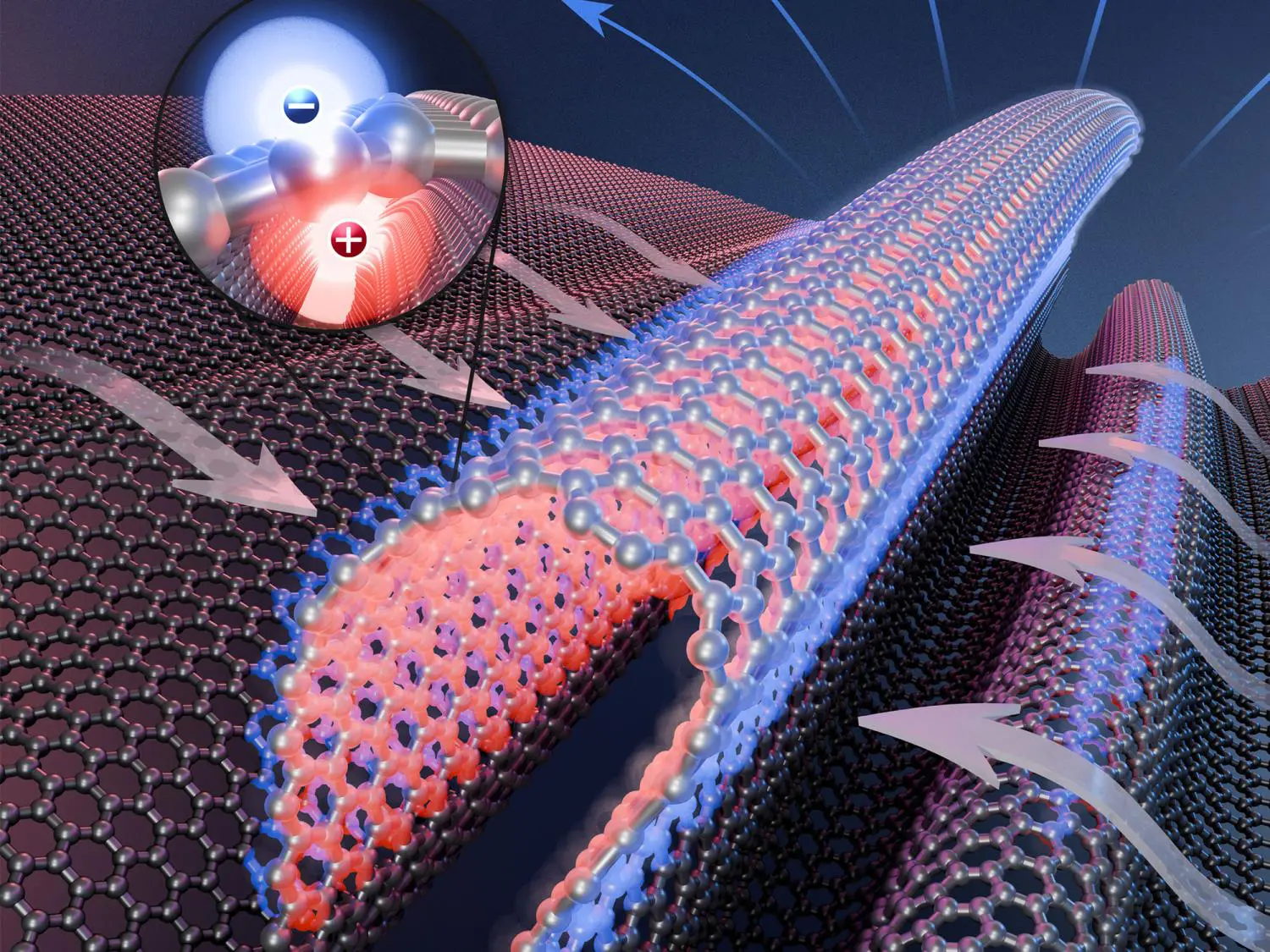
The exceptionally thin structure of graphene, just one atom thick, is key to a newly observed effect that could reshape electronics. Physicists and engineers report that tiny wrinkles in graphene can alter its electrical properties through flexoelectricity, a phenomenon where uneven bending generates an electric dipole.
Vincent Meunier, P. Breneman Chair and Professor at Penn State, explains that scientists may one day control electricity in atomically thin materials by changing their shape, potentially leading to more responsive sensors and ultrathin devices. “One of my driving forces is to try to identify interesting ideas to examine that may seem unreachable today, but could be applied years down the line,” Meunier said.
Flexoelectricity in Graphene: Wrinkling Predicts Electrical Polarization
The observed flexoelectric effect in graphene hinges on the material’s singular one-atom thickness; this extreme thinness amplifies the impact of even minute structural distortions. Researchers discovered that sharply curved wrinkles within graphene act as localized electrical speed bumps, generating current when approximately one volt of electricity is applied.
This response isn’t tied to the wrinkle’s height, but rather its sharpness, allowing for potential tuning of electrical behavior at the nanoscale, according to the study published in Advanced Materials. Sathvik Ajay Iyengar, lead author and now at the University of California, Berkeley, explained, “Comparing the sharply curved wrinkles with flat graphene allowed us to clearly identify the role of extreme curvature.” The magnitude of electrical polarization generated by these graphene wrinkles is substantial; the team estimates it to be between 100,000 and 10 million times stronger than in larger, conventional flexoelectric systems.
Polarization, the separation of electrical charges within a material, is directly linked to the curvature of the graphene, demonstrating a novel method for controlling electricity through physical shape rather than chemical alteration. Vincent Meunier, P. Breneman Chair and Professor, noted, “To observe this effect practically, you need to have ultra-clean materials, which at the time of the prediction was difficult to achieve.” He added that recent advancements in fabrication technology have made these observations possible.
Initial observations of these unusual electrical signals arose from revisiting data collected by Iyengar and Manoj Tripathi, now at South Dakota Mines, during earlier experiments. “When Sathvik showed me the measurements he and Manoj had collected, we realized that the unusual signals could provide an experimental connection to an idea we had predicted many years earlier,” Meunier said.
Iyengar further validated the findings by comparing experimental results with computer models and mathematical calculations, confirming a near-perfect correlation. He calculated the predicted effect for the specific geometry of the wrinkles and found the fit was almost perfect. Understanding how graphene’s shape influences electrical behavior provides scientists with an additional tool for designing future technologies. At the nanoscale, electrons shift slightly toward one side of the sharply bent wrinkles, creating opposing electrical charges akin to a miniature battery.
Earlier studies of flexoelectricity often focused on gentler bends or relied on external pressure, making it difficult to isolate the effect; this research, however, focused on extreme curvature to achieve clearer results. “Understanding how they influence electrical behavior gives scientists another tool for designing future technologies using the structure of a material itself,” Meunier stated. This approach could lead to more responsive sensors and the development of ultrathin electronic devices, bypassing the need for doping or new materials altogether.
One of my driving forces is to try to identify fun ideas to examine that may seem unreachable today, but could be applied years down the line.
Vincent Meunier, Department Head of Engineering Science and Mechanics, P. Breneman Chair and Professor, Penn State
Experimental Validation of Bent Graphene’s Electrical Response
The degree to which graphene bends, not its overall size, dictates its electrical response according to new research validating a decades-old theoretical prediction. Detailed measurements of graphene’s shape, local electrical energy, and current were obtained using specialized microscope probes, allowing for direct comparison between sharply wrinkled and flat sections of the material.
This validation confirms a prediction made nearly 20 years ago by Meunier and Sergei V. Kalinin, now at the University of Tennessee, that sharply bending graphene could rearrange electrons and produce an electrical response. “At that scale, the electrons in graphene shift slightly toward one side, creating two opposite electrical sides like the ends of a tiny battery,” said Iyengar, illustrating the nanoscale phenomenon.
The sharpness of the wrinkle, they found, proved far more influential than its height, suggesting a pathway to control electrical behavior through precise manipulation of graphene’s geometry. “That tells us we can potentially tune electrical behavior by carefully controlling curvature at the nanoscale,” Meunier added. Advancements in fabrication technology enabled this effect, as the ability to create and measure such minute bends was previously unattainable. According to Meunier, these advancements allowed the team to apply and test the theoretical effect across incredibly tiny bends.
The implications extend to the development of more responsive sensors and ultrathin electronic devices, offering a potential alternative to traditional methods of modifying graphene’s electrical properties through chemical doping or material additions. “Imagine bending a flexible ruler, except the bend is squeezed into a space smaller than a billionth of a meter,” Iyengar described, conveying the scale at which this phenomenon occurs, and opening possibilities for novel device designs.
When Sathvik showed me the measurements he and Manoj had collected, we realized that the unusual signals could provide an experimental connection to an idea we had predicted many years earlier.
Vincent Meunier, Department Head of Engineering Science and Mechanics, P. Breneman Chair and Professor, Penn State




See today’s quantum computing news on Quantum Zeitgeist for the latest breakthroughs in qubits, hardware, algorithms, and industry deals.