Humans search for explanations with relentless curiosity; a query of returns over 530 million Google results. Raphael Bousso at the University of California, Berkeley, is attempting to quantify this innate drive, tackling a fundamental problem in physics where quantum calculations predict an infinite amount of activity within spacetime.
Bousso is using gravity to resolve this contradiction, potentially leading to a theory of quantum gravity and a better understanding of black holes, a pursuit made more pressing by the February 2016 detection of gravitational waves. “We want to know how to describe our universe, we want to know how did that start,” says Bousso.
Entanglement Entropy and Quantum Decoherence in Schrödinger’s Cat
Bousso, supported by a grant exceeding $140,000 from the FQXi, is examining how this quantity changes as a quantum system interacts with its environment, even with just a few photons of heat capable of initiating the decoherence process. This investigation aims to move beyond simply acknowledging decoherence and towards quantifying the degree of interaction between a system and its surroundings. Calculating entanglement entropy presents a significant challenge; attempts to sum all connections between regions inside and outside a quantum system initially yield infinite values.
Physicists have previously circumvented these infinities in weak gravity scenarios, allowing for sensible calculations of entanglement entropy and, consequently, decoherence levels. However, Bousso is now questioning what if gravity becomes strong? This line of inquiry focuses on situations where standard methods fail, such as near the center of a black hole or within the confines of extreme gravitational fields.
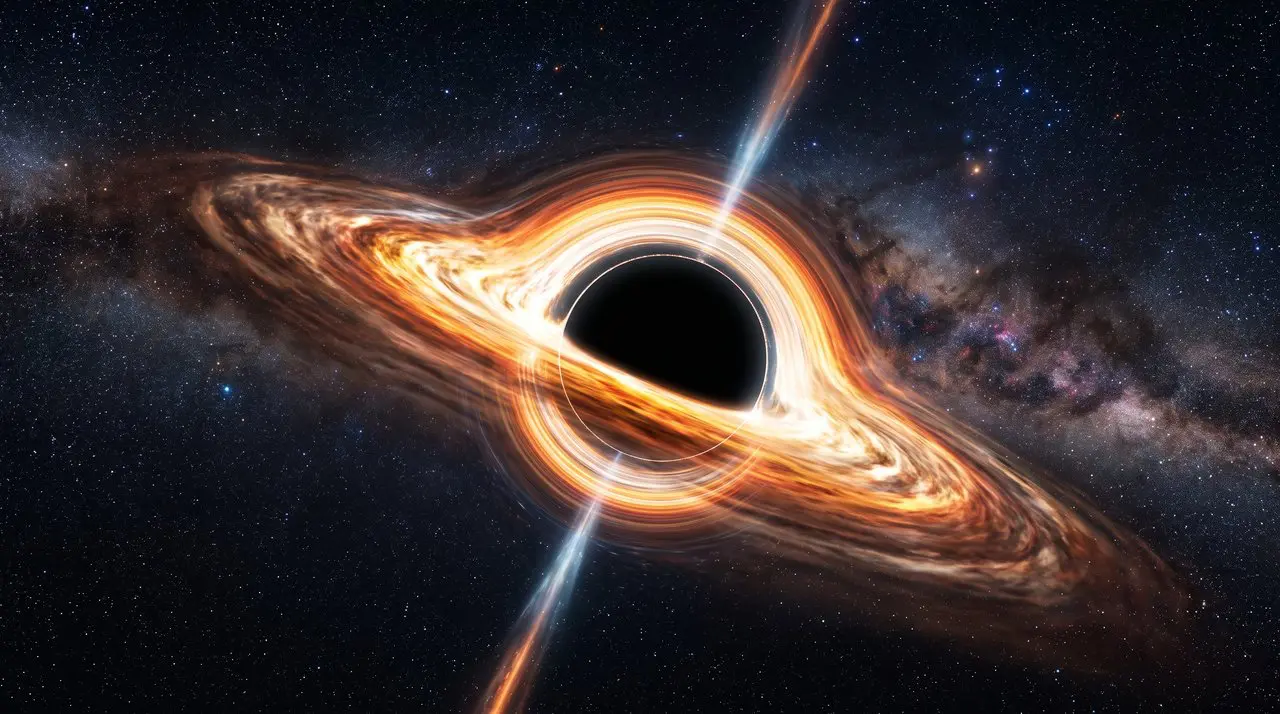
To address this, Bousso proposes combining entanglement entropy with gravitational entropy, a quantity proportional to the surface area of a black hole’s event horizon. He is investigating whether this combined approach can provide a quantifiable measure of events in cosmological settings without resulting in infinite answers, potentially offering insights into black hole physics and the development of a theory of quantum gravity.
Bousso frames the question succinctly: “What happens inside the black holes that we now know happily merge somewhere far away and make gravitational waves?” His work seeks to provide a framework for understanding the fate of information and matter in these extreme environments, potentially resolving long-standing paradoxes in theoretical physics and offering a more complete picture of the universe’s fundamental laws.
It will surely lead to new insights into gravity and quantum mechanics.
Leonard Susskind, Stanford University
Gravitational Entropy Applied to Black Hole Spacetime Quantification
This approach focuses on cosmological settings where gravity is intense, such as near the event horizon of a black hole, a region where previously successful methods for managing infinities break down. The physicist proposes that incorporating gravitational entropy, a quantity directly related to a black hole’s surface area, with entanglement entropy could provide a finite, meaningful measure of quantum events. The ability to model events within black holes, now known to merge and emit these ripples through spacetime, requires a robust framework for handling strong gravity.
Leonard Susskind, a physicist at Stanford University, expressed his approval of Bousso’s work, stating, “I strongly applaud Bousso’s bold attempt to quantify this network.” Raphael Bousso is no different, except he has a physicist’s penchant for precision. He wants to quantify just how much, notes the source material, highlighting the drive behind this research. By integrating gravitational entropy, Bousso hopes to create a system that provides sensible answers even when gravity is at its strongest, potentially unlocking a deeper understanding of black hole physics and the origins of the universe.
What happens inside the black holes that we now know happily merge somewhere far away and make gravitational waves?
Raphael Bousso, University of California, Berkeley

See today’s quantum computing news on Quantum Zeitgeist for the latest breakthroughs in qubits, hardware, algorithms, and industry deals.