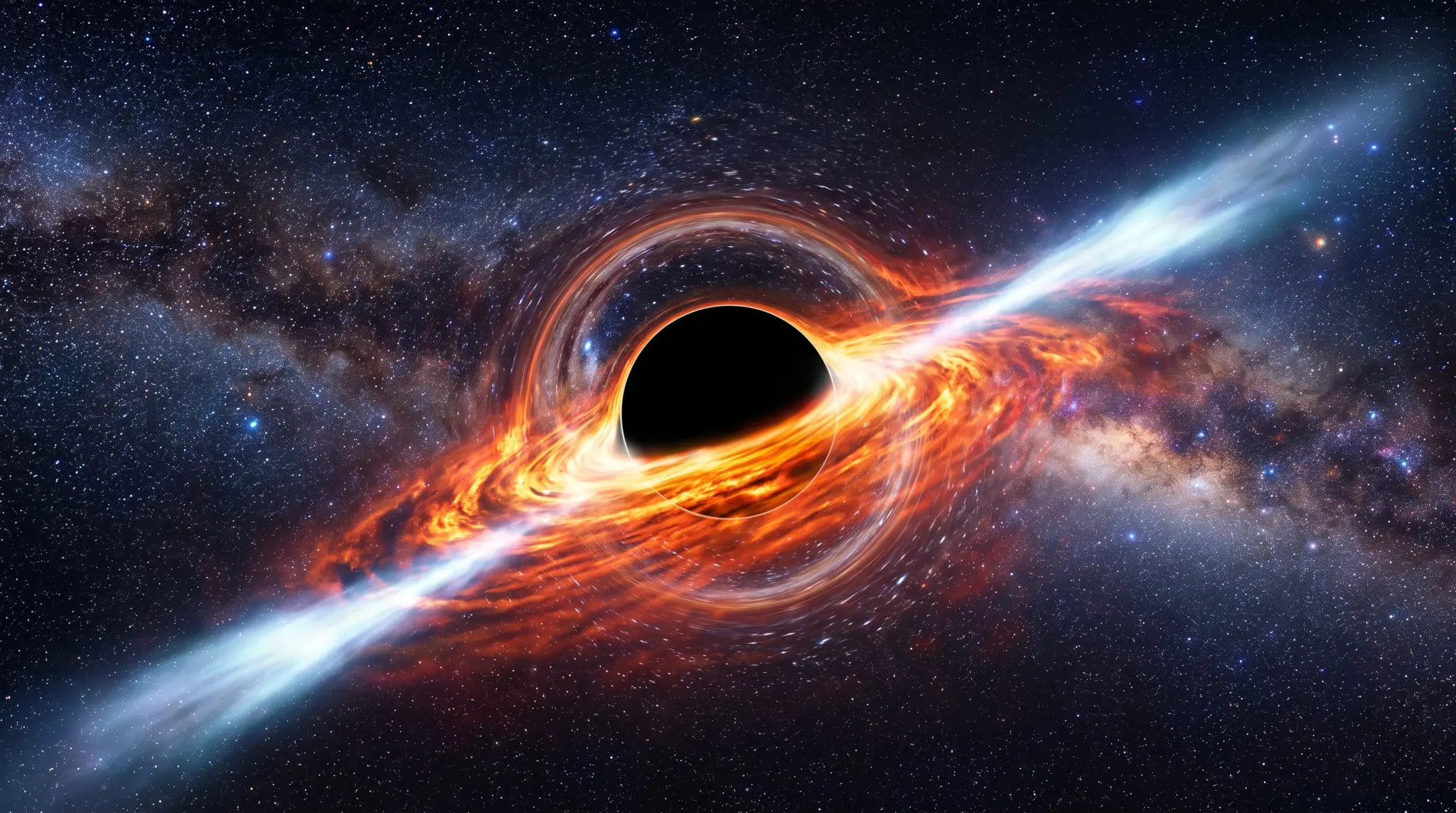
Researchers at Curtin University and the Institute for Advanced Study have discovered a universal timing mechanism governing the powerful jets launched by black holes. The team, co-led by Andrew Mummery and Adelle Goodwin, showed that both stellar-mass black holes and supermassive giants fire these jets at the same critical juncture in their feeding cycles, confirming that size does not influence timing.
“We really wanted to figure out this massive puzzle,” said Mummery, explaining the team’s focus on understanding why some black holes jet immediately after consuming a star while others delay for months or years. By tracking tidal disruption events, stars torn apart by black holes, the researchers revealed this consistent two percent threshold governing jet formation, offering new insight into these immense cosmic “burps.”
Tidal Disruption Events Reveal Universal Jet-Launching Phases
The timing of powerful jet launches from black holes appears independent of their size, a finding shown through the study of stars torn apart by these cosmic objects. Researchers meticulously analyzed twenty tidal disruption events, narrowing their sample to ten high-quality events to model both the rate at which black holes consume material and the precise moment radio outflows, or jets, begin.
This discovery resolves a long-standing puzzle regarding the variability in jet emission following tidal disruption events. Previously, scientists observed delays ranging from months to years between a supermassive black hole shredding a star and the subsequent firing of its jets; the new analysis indicates this delay is not universal, and jet launch can occur almost immediately.
Andrew Mummery, Martin A. and Helen Chooljian Member, and Adelle Goodwin, a Forrest Research Foundation Fellow at Curtin University’s International Centre of Radio Astronomy Research in Western Australia, co-led the research. “Why do some supermassive black holes blast out radio jets right after shredding a star, while others just sit there looking completely dormant, only to suddenly fire up their jets months or even years later?” The team identified two distinct phases governing jet launch.
By concentrating on tidal disruption events, they circumvented the typical challenge of studying supermassive black holes, which evolve over immense timescales. These events compress a black hole’s feeding episode into a period of years, providing a unique observational window. It was during an astrophysics conference in Madrid that Mummery and Goodwin realized the same underlying rule dictating jet launches in small black holes appeared to universally apply to supermassive ones.
The Institute for Advanced Study announced the title of the original news piece, “ias scholar reveals universal rule black hole burps,” highlighting the significance of the collaboration’s findings. The analysis published in Nature Astronomy as “A universal critical accretion rate for black hole jet formation,” utilized multi-wavelength observations from telescopes globally, including facilities in America, Australia, India, South Africa, and space. When a black hole disrupts a star, it doesn’t neatly consume all the material, but instead creates a chaotic environment.
“When a black hole tears apart a star, it does not swallow everything neatly,” Mummery explained. The team hopes their work will unlock further understanding of these powerful cosmic phenomena.
When a black hole tears apart a star, it does not swallow everything neatly.
Adelle Goodwin, Forrest Research Foundation Fellow at Curtin University’s International Centre of Radio Astronomy Research
Two Percent Eddington Limit Governs Black Hole “Burps” Across Sizes
This universal behavior centers on a critical accretion rate, the rate at which a black hole consumes material, reaching approximately two percent of the Eddington limit, already known to trigger jet formation in much smaller black holes. This inconsistency challenged existing models and prompted the investigation into a potential unifying principle. The fact that both stellar-mass black holes and their supermassive counterparts exhibit this behavior suggests a fundamental scaling law governing jet formation, independent of size. This predictive capability will be important for future observations with telescopes as they come online.
The team’s findings allow astronomers to anticipate jet launches, optimizing observation schedules for facilities like the Square Kilometre Array radio telescope project, slated to begin data collection in 2028. By focusing observations around the predicted timeframe, scientists can maximize their chances of capturing these fleeting and energetic events, furthering understanding of black hole physics and galactic evolution.
We hope that our work will pave the way for even more profound discoveries about our universe.
Andrew Mummery, Martin A. and Helen Chooljian Member at the School of Natural Sciences




See today’s quantum computing news on Quantum Zeitgeist for the latest breakthroughs in qubits, hardware, algorithms, and industry deals.