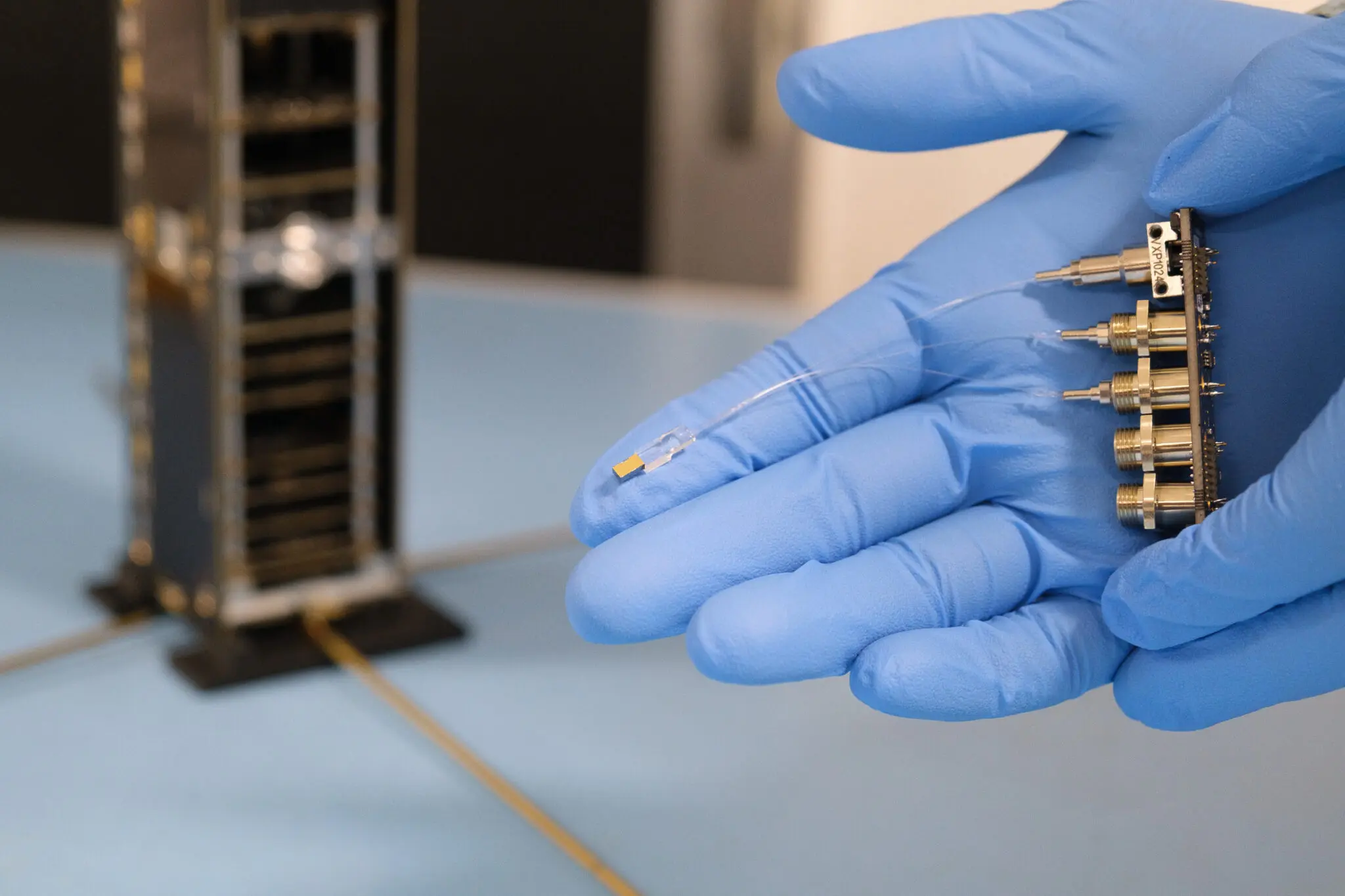
Twenty years after initially developing the Life Marker Chip for the European Space Agency’s Mars exploration program, TU Delft is preparing to test a successor in orbit, the company says. The upcoming PocketQube mission will carry the TriPleX photonic chip, core technology of the Life Marker Chip for origin of life (LMC OOL) programme, into space for the first time.
Researchers aim to assess the chip’s stability under real space conditions, an important step toward future missions targeting ocean worlds like Enceladus. “In space, PRISM will measure how stable the sensor is under real conditions,” says planetary exploration researcher Dr. Niels Ligterink.
TriPleX PRISM Chip Enables In-Orbit Refractive Index Sensing
The PocketQube mission will rigorously test the PRISM (PocketQube Refractive Index Sensing Module), a TriPleX photonic chip designed to detect minute shifts in liquid refractive indices, a capability central to identifying molecules like amino acids, an important step toward biosignature detection on distant worlds. This chip, fabricated from Dutch silicon nitride, represents an advance in compact sensing technology for space exploration, enabling the potential for in-situ analysis of extraterrestrial samples. LioniX International developed the PRISM hardware, using expertise in photonic integrated circuits, microfluidics, and micro-electromechanical systems to create a highly sensitive and miniaturized instrument.
This in-orbit demonstration is not merely a technological validation; it’s an important assessment of the chip’s resilience against the harsh realities of space, including temperature fluctuations and radiation exposure, according to the project teams at TU Delft’s Faculty of Aerospace Engineering. “We will monitor how factors such as temperature changes and radiation affect the system over time,” they stated, emphasizing the importance of long-term stability for future deep-space missions targeting ocean worlds like Enceladus. The PRISM chip builds directly on technology initially developed twenty years ago for the Life Marker Chip, originally intended for Mars exploration, demonstrating a sustained commitment to astrobiological instrumentation.
The Netherlands Space Agency supports the mission, recognizing the potential for Dutch leadership in photonics-enabled space instrumentation, and the PocketQube platform offers a rare opportunity for the LMC OOL project. “PocketQubes are ideal for testing new technologies like this,” a spokesperson noted, highlighting the benefits of small satellites for rapid prototyping and in-flight validation.
“This mission is set to be among the first demonstrations of TriPleX, a Dutch silicon nitride (SiN) photonic chip, in space,” said René Heideman, Senior Business Developer at LioniX International, adding that through this collaborative effort between Delfi and PRISM, TU Delft showcases a pathway for translating laboratory research into validated space-based technologies, using both internal expertise and national partnerships, including its long-standing collaboration with TNO through QuTech.
PocketQubes are ideal for testing new technologies like this.
Dr. Stefano Speretta, of TU Delft’s Space Systems Engineering section
Life Marker Chip Origins & Development for Exoplanetary Research
SurfiX uses the technology originally developed for the Life Marker Chip in advanced diagnostic tools within the biomedical industry, demonstrating its adaptability beyond planetary exploration. This transition highlights the dual-use potential of the photonic chip, initially conceived for detecting life on Mars twenty years ago but now serving terrestrial healthcare needs. The continued refinement of this core technology underscores a commitment to innovation extending across multiple scientific disciplines.
LioniX International’s long-standing involvement with the Life Marker Chip, beginning with its initial development, has positioned the company as a key player in advancing compact life detection instruments, according to TU Delft. The PRISM payload, featuring an asymmetric Mach-Zehnder Interferometer photonic chip, laser, and photodiode, coupled with the Delfi-Connect satellite bus, represents an advancement in miniaturized sensing capabilities. This chip functions by detecting minute changes in the refractive index of liquids, a principle applicable to identifying molecules like amino acids, potential biosignatures on other worlds.
The launch, currently planned for early 2027, will mark the next milestone. By building, testing, and flying new technologies quickly, researchers and students gain valuable experience. Real-world experimentation is often the fastest route to better technology.
Delfi-Connect PocketQube Platform Validates Space-Based Photonics
The Delfi-Connect satellite platform will carry the first TriPleX photonic chip into orbit, a development extending technology initially designed for Mars exploration to future missions targeting ocean worlds. This deployment represents a milestone for LMC OOL, increasing its technology readiness level, a key requirement for missions to icy moons and similar destinations, the company says.
TU Delft’s involvement extends beyond the chip itself; the university’s Space Systems Engineering section spearheaded the integration and testing. This mission builds on TU Delft’s longstanding expertise in superconducting and silicon-spin qubits, alongside partnerships with QuTech and TNO, further solidifying its position in quantum research and technology transfer.




See today’s quantum computing news on Quantum Zeitgeist for the latest breakthroughs in qubits, hardware, algorithms, and industry deals.