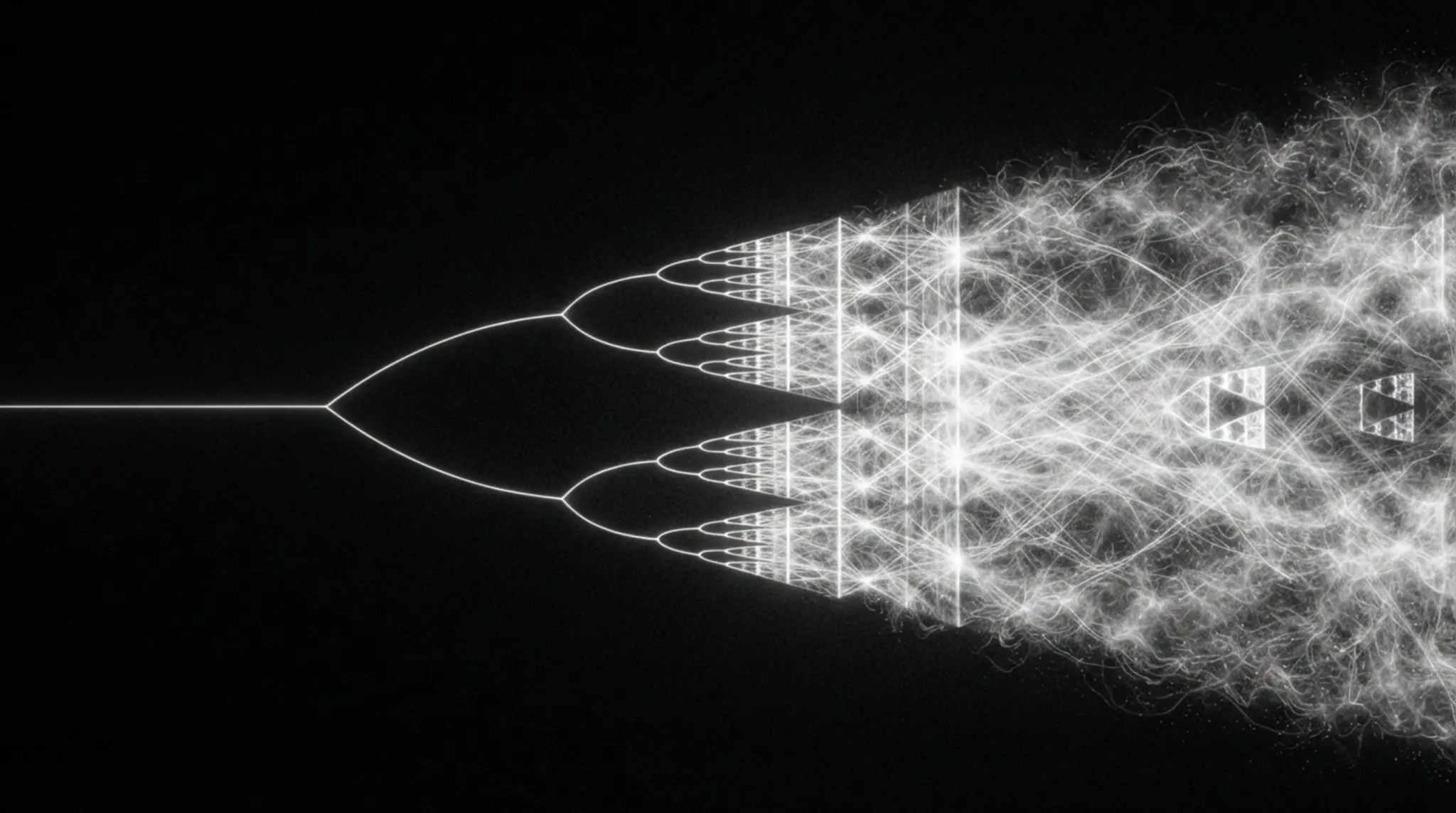
It is now possible to compute finite-time dynamical sensitivity within traversable wormholes using out-of-time-ordered correlators (OTOCs). Examination of quantum fluctuations of a circular probe string passing through a wormhole throat revealed approximately exponential OTOC growth, indicating how quickly small changes can have large effects on the system. Even seemingly stable structures within wormholes exhibit chaotic behaviour from tiny quantum disturbances. This work introduces a technique for assessing instability by measuring how rapidly these disturbances spread; it avoids reliance on previously complex theoretical models.
The findings provide fundamental insight into traversable wormholes and suggest they may be inherently fragile formations despite appearing classically static. Researchers from Ningbo University and Guangxi University of Science & Technology investigated chaotic behaviour within traversable wormholes using a novel technique involving quantum fluctuations of a circular “probe” string. Stable-appearing structures inside these theoretical tunnels exhibit sensitivity to minute disturbances, achieved by calculating how quickly those disturbances spread without relying on complex existing models.
An out-of-time-ordered correlator (OTOC), essentially measuring how predictably two events happen in sequence, was used as a key diagnostic tool; rapidly decreasing predictability indicates chaos. Like calculating the energy required for a roller coaster to complete its track, the researchers employed what’s known as the worldsheet action to describe the probe string’s journey through spacetime. The findings raise questions about wormhole fragility and whether their traversability is compatible with inherent instability; further details of the analysis explore precisely how these quantum effects manifest within specific wormhole geometries.
Real time dynamics reveal exponential growth of quantum chaos near traversable wormholes
An approximately exponential growth rate has been demonstrated for out-of-time-ordered correlators (OTOCs), which measure dynamical sensitivity. This increase progresses from undetectable levels to finite values when examining quantum fluctuations around traversable wormholes. Previously, quantifying such real-time behaviour required complex holographic models or reliance on asymptotic boundaries. The new non-holographic framework applies quantum-chaos diagnostics directly to probes moving through curved spacetime, circumventing limitations inherent in earlier approaches focused on Euclidean spectral correlations and thermodynamic phase transitions.
Consequently, instability can be assessed using only worldsheet fluctuations and real-time calculations, enabling application across diverse wormhole geometries without prior assumptions about the system’s ultimate fate. Rates quantifying dynamical sensitivity were calculated to determine how many quantum fluctuations amplify as probes traverse wormholes; finite growth intervals associated with initial throat passage for both transverse polarizations of a simulated string were also found.
Specifically, dimensionless rates relative to physical time decreased as energy increased compared to the scale of the wormhole’s ‘throat’, its narrowest point, yet remained positive across tested parameters. Further manipulation of geometry via a “solid-angle deficit”, measuring how sharply the wormhole curves, narrowed amplifiable modes and suppressed rate measurements, even nearly eliminating radial signals in stronger defects while angular channels retained some polarization dependence at lower energies.
Quantum string analysis reveals insights into traversable wormhole interiors
Scientists have long sought ways to probe the interiors of exotic spacetime geometries like traversable wormholes, hoping to understand their potential for interstellar travel or as windows into other universes. A new method applicable to any curved space has been devised by examining how quickly tiny changes grow within simulated strings travelling through wormhole structures; it is not limited to those mirroring our universe via holography. Although currently focused on ‘Gaussian fluctuations’, representing only initial disturbances and not fully capturing expected chaotic behaviour from many interacting particles, this represents a strong step forward in probing extreme spacetime environments.
Calculations reveal a method for assessing dynamical sensitivity within traversable wormholes without relying on holographic techniques or assumptions about long-term system behaviour. Establishing quantifiable indicators of instability marks an advance beyond previous investigations needing complex theoretical frameworks to understand exotic spacetime geometries like wormholes. This allows researchers to move past reliance on such intricate models when studying these phenomena. The ability to assess stability directly through observed fluctuations offers new avenues for exploring the fundamental properties of traversable wormholes and their potential implications for physics.
The research demonstrated that quantum fluctuations of a circular probe string exhibit finite, exponential growth while traversing a simulated Ellis, Bronnikov wormhole throat. This work provides quantifiable indicators of instability in curved spacetime without relying on complex theoretical frameworks or assumptions about long-term behaviour.
👉 More information
🗞 Probing quantum chaos near a wormhole throat with a circular string
✍️ Ai-chen Li, Xin-Fei Li and Xuanting Ji
🧠 ArXiv: https://arxiv.org/abs/2609.09613


See today’s quantum computing news on Quantum Zeitgeist for the latest breakthroughs in qubits, hardware, algorithms, and industry deals.