- The chip industry already makes the device he wants to use
- He learned to build small devices before he had a use for them
- Australia bet on silicon in 1998 and he was there from the start
- In 2010 his team read one electron’s spin in a single shot
- A transistor becomes a qubit when it holds one electron
- He is last author on six of the eight results that carry his name
- One kelvin buys far more cooling power
- Taking the argument out of the university in 2022
- The foundry result that tested the whole claim
- The money is raised and the product date is 2029
- Four qubits at 99 per cent is not yet a machine
- He made silicon a working platform, then bet on manufacturing
- Frequently asked questions
Andrew Dzurak is the Australian physicist and engineer who with Andrea Morello built the first qubit made from a single atom in silicon and then founded Diraq, the Sydney company that makes silicon spin qubits on ordinary chip-industry production lines. He is Scientia Professor in Quantum Engineering at UNSW Sydney, and he held an Australian Research Council Laureate Fellowship from 2019 until it closed in May 2025.
He was final author on the 2010 paper that first read out a single electron spin in silicon, and on the 2015 paper that reported the first two-qubit logic gate in the material. For most of the last fifteen years his argument has been the same one. The transistor is the most manufactured object in human history, and it is the right thing to build a quantum computer out of.
The appeal of the argument is easy to state. Delivering it is not. If the qubit is a slightly modified transistor, then the machinery for making it already exists at a scale no purpose-built quantum production line will match. The industry’s problem then shifts from inventing a manufacturing base to borrowing one.
In 2022 he took that argument out of the university and founded Diraq, and in September 2025 it met its most serious public test. Qubits designed by the company and made on a 300 millimetre pilot line at imec, the Belgian chip research institute, were reported in Nature to exceed 99 per cent fidelity.
That held on four devices from one wafer, which imec’s release characterises as a random selection and the paper itself describes as a chosen design tested four times, a difference this profile goes on to weigh. That is evidence at the level of a few qubits. Diraq’s own product date of 2029 depends on the same result holding at the level of a machine, and nobody has shown that yet.
He is Scientia Professor in Quantum Engineering at UNSW Sydney and founder and chief executive of Diraq, the company that spun out of the university in 2022. For the fifteen years before that he was founding director of the New South Wales node of the Australian National Fabrication Facility, so his background is in how devices get built.
With Andrea Morello he was final author on the 2010 Nature paper that read out the state of a single electron spin in silicon. He was a co-author on the 2012 paper that turned a single phosphorus donor into a qubit. Reading one spin had to come first, because nothing can be used as a qubit until its state can be measured.
His group reported the first two-qubit logic gate in silicon in Nature in 2015, built from reconfigured CMOS transistor structures rather than custom quantum hardware. That gate was the first quantum logic operation between two such qubits, and two-qubit operations are what quantum algorithms are built out of.
In 2020 a UNSW team with him as final author reported a silicon quantum processor unit cell operating above one kelvin. That is far warmer than the few hundredths of a degree most solid-state qubits need, and the extra cooling power available there lets control electronics sit closer to the qubits.
In September 2025 Diraq and imec reported in Nature that spin qubits made on imec’s 300 millimetre platform exceeded 99% fidelity on one- and two-qubit gates. Imec’s release says the devices measured were picked at random. The paper itself reports four devices of a chosen design, all from a single 300 millimetre wafer. One wafer supports a claim about uniformity within that wafer, and a claim about manufacturing still needs wafer-to-wafer and run-to-run evidence that has not been published.
The chip industry already makes the device he wants to use
His working life has been spent on one question, whether the silicon chip industry can be persuaded to make quantum computers. Andrew Dzurak’s UNSW staff page lists him as Professor and Scientia Professor in Quantum Engineering, and as founder and chief executive of Diraq. Australian Research Council records show that his Laureate Fellowship ran from 2019 until it closed in May 2025.
He took a bachelor’s degree with first-class honours and the University Medal in Physics from the University of Sydney in 1987, and a doctorate in physics from the University of Cambridge in 1993. UNSW credits him with more than 200 research papers, over 30 of them in the Science and Nature families, and more than 30 patents across twelve families.
The short version of the career
Andrew Dzurak returned to Australia after Cambridge and joined UNSW. There he became founding director of the New South Wales node of the Australian National Fabrication Facility, a post he held from 2007 to 2022.
He and Andrea Morello shared the 2011 UNSW Eureka Prize for Scientific Research, awarded for reading the spin of an electron bound to a single atom. In 2026 he was elected a Fellow of the Australian Academy of Science, and on 2 September 2026 the Australian Institute of Physics named him the winner of its Walter Boas Medal for research on silicon-based quantum computing. Running a fabrication facility rather than only a research group matters here, because his later argument is about how things are made.
The scientific results that carry his name run from single-electron spin readout in 2010 to an eight-qubit device made on a foundry line, reported in July 2026. Between those two points sit the first qubit made from a single atom in silicon, the first two-qubit gate in silicon, and the demonstration that such a device can run above one kelvin.
He learned to build small devices before he had a use for them
His Cambridge papers from the early 1990s carry a Cavendish Laboratory address and concern hot ballistic electrons, quantum point contacts and quantum dots, the structures that had only recently been discovered. He is the first author on one of them, a 1993 study titled Observation of Coulomb blockade oscillations in the thermopower of a quantum dot. Charles Smith and Michael Pepper are among the co-authors, and the paper is typical of what he was doing then.
None of that work is quantum computing, though it is exactly the practical training the field would later need. Making very small electrical structures and measuring them a few hundredths of a degree above absolute zero is the same craft whether the object being measured is a quantum dot or a qubit.
The skills involved are unglamorous. They are the difference between a laboratory that produces results and one that does not. Somebody has to pattern a gate electrode a few tens of nanometres wide, cool it to that temperature and hold it, then tell a real signal apart from the noise of the wiring.
Andrew Dzurak carried that combination back to UNSW in 1994, by his own account, arriving in time for the Australian programme that would define the next two decades of his career. Because he could build things as well as measure them, he was useful across the whole of that programme.
Australia bet on silicon in 1998 and he was there from the start
In 1998 Bruce Kane, then at UNSW, published A silicon-based nuclear spin quantum computer in Nature. The proposal was to store quantum information in the nuclear spins of individual phosphorus atoms embedded in silicon, controlled by gate electrodes on the surface.
The idea gave Australian physics an unusually concrete national programme, and the ARC Centre for Quantum Computer Technology was established in 2000 to pursue it. Andrew Dzurak was part of that effort from the beginning, and his name is on a 2001 paper in Physical Review B. The co-authors include Michelle Simmons, Robert Clark, Bruce Kane and Jeremy O’Brien, and the title is Towards the fabrication of phosphorus qubits for a silicon quantum computer.
Silicon can be stripped of the noise that spoils other hosts
Silicon can be stripped of most of the nuclear spins that spoil other hosts. Natural silicon contains about 5% of the isotope silicon-29, which carries a nuclear spin and disturbs any electron spin nearby. Isotopic enrichment strips that fraction down until the electron sits in something close to a magnetically silent background. Diamond and germanium can be purified the same way, and what silicon adds is that the purification happens inside the industry’s own material.
The second property mattered more in the end, because the entire semiconductor industry is already built around silicon. Any qubit that can be made from the same materials by the same processes inherits several decades of manufacturing investment.
In 2010 his team read one electron’s spin in a single shot
A qubit is useless unless its state can be measured, and measuring the spin of a single electron in a solid is much harder than storing one. The technique that solved it converts spin into charge, so that an electron in one spin state can leave the device and an electron in the other cannot. A single-electron transistor sitting alongside then detects which of the two happened, and that is the readout.
In 2010 a UNSW team published Single-shot readout of an electron spin in silicon in Nature, with Andrea Morello as first author and Andrew Dzurak as the final author. The measurement worked on one electron in one experimental run rather than by averaging over many repetitions, which is the standard a qubit readout has to meet.
Two years later the same collaboration reported A single-atom electron spin qubit in silicon, with Jarryd Pla as first author, controlling the spin of a single phosphorus donor and reading it out. That work with Andrea Morello is what his UNSW page describes as the demonstration of the world’s first silicon quantum bits.
A transistor becomes a qubit when it holds one electron
The donor experiments proved the physics, but placing individual atoms at precise sites is demanding work that does not obviously scale to millions of devices. The alternative his group pursued was to trap the electron electrostatically in a quantum dot formed under the gate of a silicon metal-oxide-semiconductor structure. The trap sits inside a structure that looks very much like an ordinary transistor, and that resemblance is the whole point.
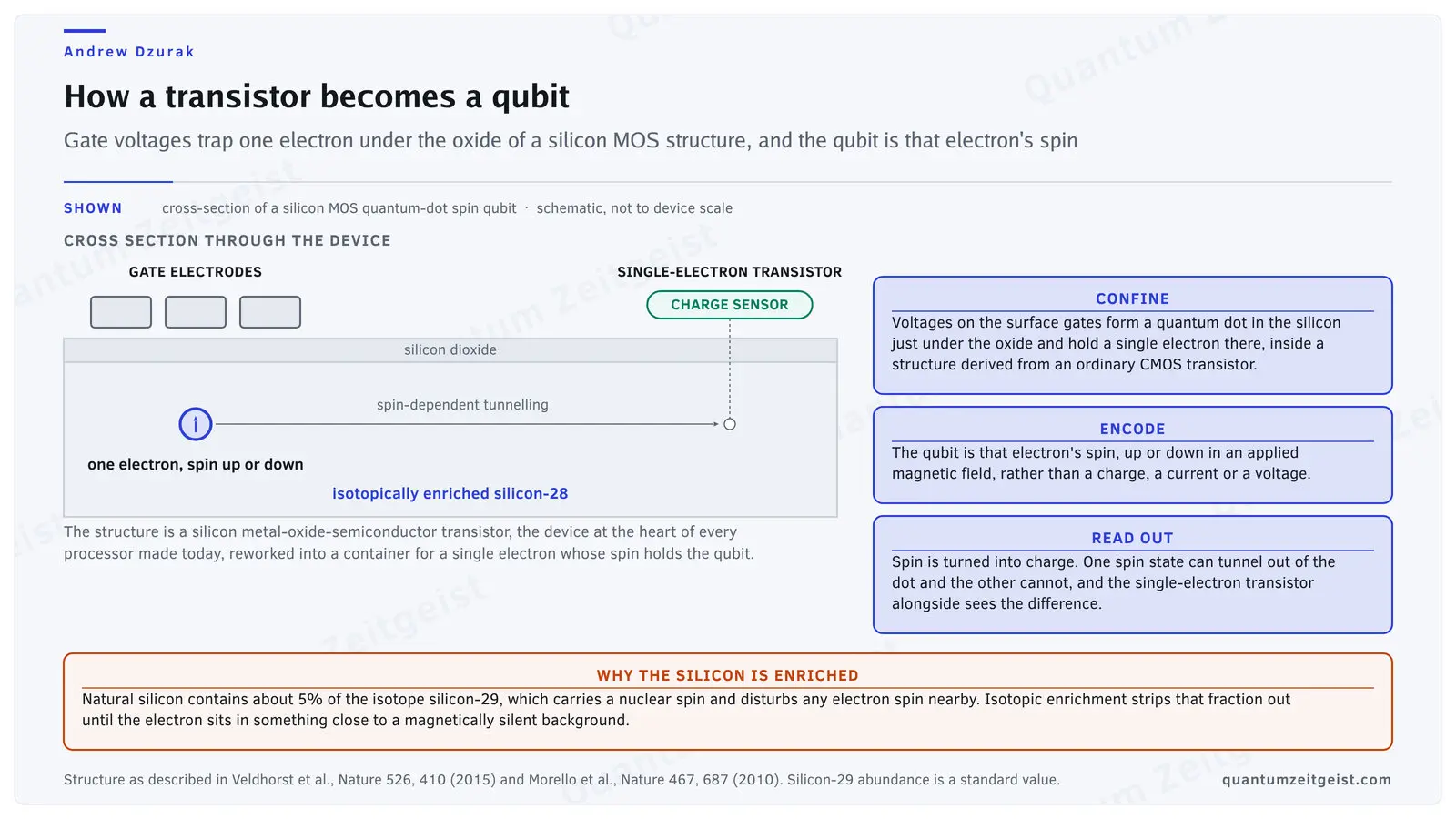
In 2014 Menno Veldhorst and colleagues, with Andrew Dzurak as final author, reported An addressable quantum dot qubit with fault-tolerant control-fidelity in Nature Nanotechnology. The following year the same team published A two-qubit logic gate in silicon in Nature, the first quantum logic gate between two such qubits.
A platform without a two-qubit gate has qubits but not a computer
Until a two-qubit gate exists, a platform has qubits but not a computer, because entangling operations are what make quantum algorithms possible at all. Doing it in a structure derived from standard CMOS meant that the manufacturing argument could be made about a working device rather than about a plan.
Physics World named the demonstration of CMOS-based quantum logic among its top ten scientific breakthroughs of 2015, as his UNSW page records. In 2019 his group published Fidelity benchmarks for two-qubit gates in silicon in Nature, moving the conversation from whether the gate worked to how well.
He is last author on six of the eight results that carry his name
Eight results carry his name, and his position in each author list is given because in large collaborations it says who led the work. Every citation is checked against publisher metadata.
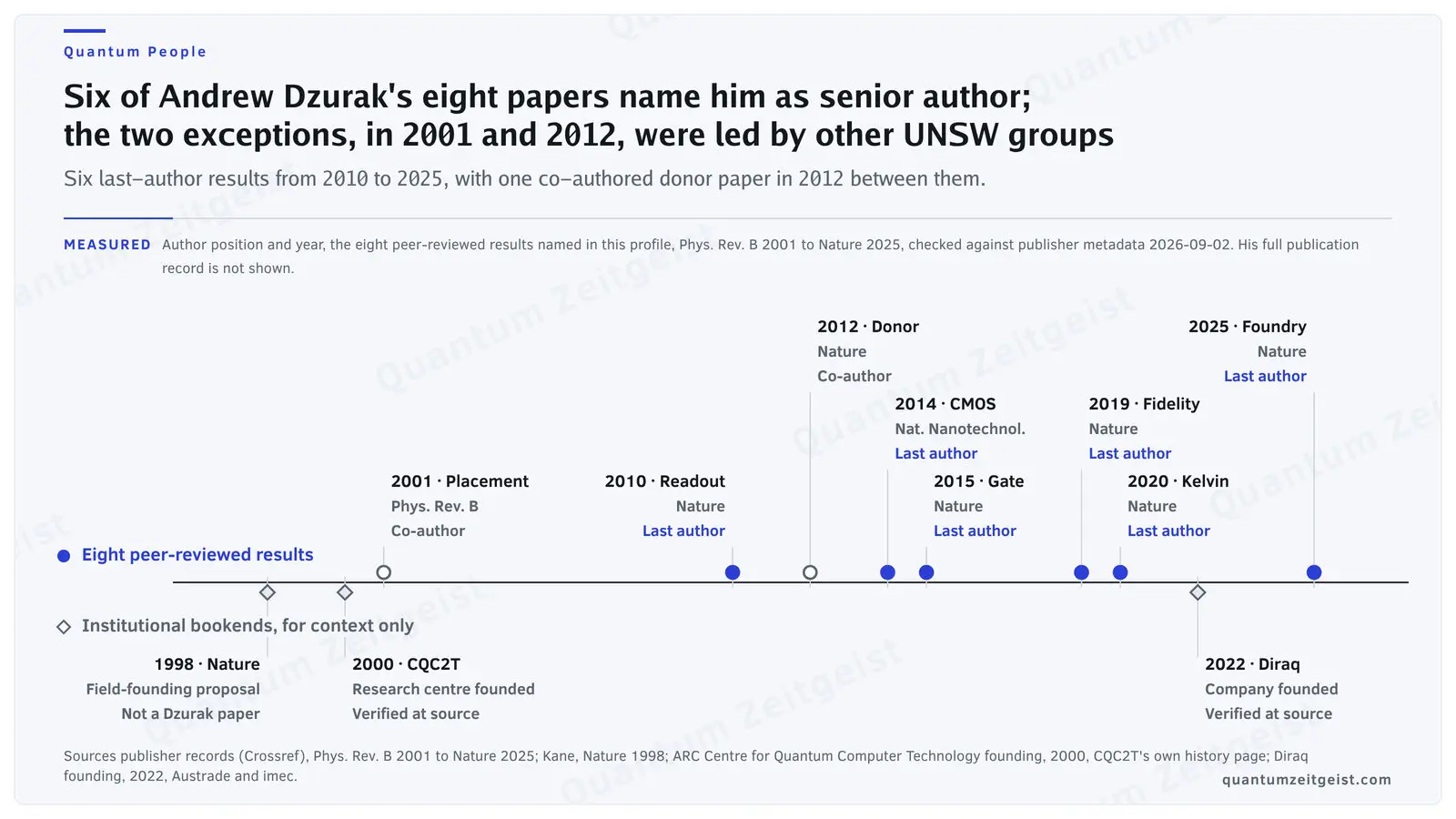
| Result | Where published | Headline finding | His role |
|---|---|---|---|
| Phosphorus qubit fabrication in silicon | Phys. Rev. B 64, 161401 (2001) | Placing single phosphorus atoms on a silicon surface | Co-author |
| Single-shot readout of an electron spin in silicon | Nature 467, 687 (2010) | One electron’s spin measured in a single experimental run | Last author |
| A single-atom electron spin qubit in silicon | Nature 489, 541 (2012) | Coherent control of a single phosphorus donor electron spin | Co-author |
| Addressable quantum dot qubit with fault-tolerant control fidelity | Nature Nanotechnol. 9, 981 (2014) | A CMOS-style quantum dot qubit above the fault-tolerance threshold | Last author |
| A two-qubit logic gate in silicon | Nature 526, 410 (2015) | The first two-qubit logic gate between silicon quantum dot qubits | Last author |
| Fidelity benchmarks for two-qubit gates in silicon | Nature 569, 532 (2019) | Systematic benchmarking of silicon two-qubit gate performance | Last author |
| Operation of a silicon quantum processor unit cell above one kelvin | Nature 580, 350 (2020) | Qubit operation above one kelvin rather than in the millikelvin range | Last author |
| Industry-compatible silicon spin-qubit unit cells exceeding 99% fidelity | Nature 646, 81 (2025) | Four foundry-made devices exceeding 99% fidelity, chosen at random according to imec | Last author |
One kelvin buys far more cooling power
Almost every solid-state quantum computer runs in a dilution refrigerator at a few hundredths of a degree above absolute zero, and the cooling power available at that temperature is measured in microwatts. That budget is the reason control electronics have to sit outside the fridge, connected by one wire per qubit, which becomes impossible long before the qubit count reaches a useful number.
In 2020 a UNSW team with Chih Hwan Yang as first author and Andrew Dzurak as final author published Operation of a silicon quantum processor unit cell above one kelvin in Nature. One kelvin does not sound warm, but the cooling power available there is far greater than at twenty millikelvin, which changes what can be placed next to the qubits.
Diraq has continued to make this a central part of its case, stating on its technology page that its quantum processing unit is designed to fit a single server rack. Diraq has not built that machine. On 1 September 2026 it announced plans to install an eight-qubit system, cooling and control electronics included, in an Equinix data centre in Sydney, which is a long way short of the utility-scale processor the single-rack figure describes. The single-rack figure is an engineering target and not a measured result.
Taking the argument out of the university in 2022
Diraq was founded in 2022 as a spin-out from UNSW Sydney. The company’s February 2026 funding release and imec’s September 2025 release both give that date. Its stated mission is to become the leading global provider of quantum computing hardware, and its stated method is to turn transistors into qubits using existing semiconductor foundries rather than commissioning custom manufacturing.
The company’s own about page records more than 130 team members across Australia and the United States, more than 60 patents and more than 200 papers. It also claims more than 40 publications in the Nature and Science families, and more than $140 million raised. Those are the company’s figures as its about page stated them on 2 September 2026, rather than independently audited ones, and they are presented here as such. Neither that page nor Diraq’s own release about the National Reconstruction Fund investment states which dollar it means, so the two figures may not be in the same currency.
DARPA put Diraq on a list of eleven to evaluate
DARPA named Diraq as one of eleven companies selected for Stage B of its Quantum Benchmarking Initiative on 6 November 2025. The programme is designed to test whether any quantum computing approach can reach utility scale within the coming decade. DARPA said the eleven were selected at this time, so the count is a snapshot rather than a standing figure. Selection puts the approach on a list worth evaluating, and it says nothing yet about whether it works.
The company also lists NVIDIA, Dell Technologies, GlobalFoundries and imec among its partners, two semiconductor manufacturers and two computing companies. That mix fits a business whose case is that quantum processors should be made and deployed like conventional chips.
The foundry result that tested the whole claim
On 24 September 2025 imec and Diraq announced results published in Nature under the title Industry-compatible silicon spin-qubit unit cells exceeding 99% fidelity. The devices were designed by Diraq and fabricated on imec’s 300 millimetre spin qubit platform, on an isotopically enriched silicon-28 layer chosen to suppress magnetic noise from residual nuclear spins.
According to imec’s own release, the measurements returned fidelities above 99.9% for state preparation and measurement, and fidelities systematically exceeding 99% for one- and two-qubit gate operations. Error correction only works when errors are rare enough for the correction machinery to keep up with them.
Four devices from one wafer, and imec says they were not the best ones
The release also says how the devices were chosen, and that may matter more than the fidelity numbers. Academic cleanrooms typically select the best-performing devices for measurement, producing what the field calls hero devices.
In this study, the release says, the four devices were selected at random from one wafer rather than picked for performance. The paper’s own Methods put it differently: “We chose the design that we estimated would have optimal device parameters, and we tested four of these devices.” The paper adds a further sixteen devices from the same wafer, one of the same design and fifteen of different designs. Those had a direct-current cryo-probe check of electrostatic control rather than a qubit measurement.
The two accounts are not the same. Random selection would make this a reproducibility result, while a chosen design tested four times is a good-design result, and the paper supports the second reading more plainly than the first. Kristiaan De Greve, a fellow and program director for quantum computing at imec and himself a co-author of the paper, is quoted in the release on that point. “For the first time,” he said, “silicon MOS-based quantum-dot spin-qubit devices realized with industrial manufacturing techniques perform as well as academic hero devices.”
Andrew Dzurak put the commercial framing in the same release, which imec and Diraq issued on 24 September 2025. “Achieving utility scale in quantum computing hinges on finding a commercially viable way of producing high-fidelity qubits at scale,” he said. Utility scale and commercially viable are the industry’s terms for a destination nobody has reached, and neither describes anything the measured devices did.

The money is raised and the product date is 2029
Diraq’s own announcement of a $20 million strategic equity investment from Australia’s National Reconstruction Fund Corporation, dated 3 February 2026, sets out what the money is for. The company states that it backs an ambition to deliver a first product in 2029, described as a quantum computer capable of genuine quantum advantage. In a white paper released on 27 August 2026 the company put numbers on that ambition, 150,000 physical qubits and up to 1,000 logical qubits by 2029, then more than two million physical qubits by 2031. The same release records more than 70 staff and PhD students in Australia.
The investor list in that release names ICM and Quantonation among the deep-tech backers, along with the Australian superannuation funds Hostplus, NGS Super and UniSuper. The Australian investors named are John Higgins Family Office, Taronga Ventures, Main Sequence Ventures, Co:Act Capital and Uniseed.
A product date at the end of the decade is a commercial statement rather than a scientific one. The published fidelity work behind it can be checked, and the date cannot, so the 2025 Nature paper is the part of this that carries weight.
Four qubits at 99 per cent is not yet a machine
The 2025 result concerns unit cells, meaning small groups of qubits. It is not a processor. Demonstrating that a two-qubit device works reproducibly on an industrial line is a necessary step toward millions of qubits, and it is a long way short of showing that millions of them work together.
The number has since moved. In July 2026 the same collaboration reported eight qubits operating coherently on a device from the same 300 millimetre line, in Nature Communications, with De Greve and Dzurak again among the final authors. Eight qubits is a larger unit cell, and it is still not a machine.
On two-qubit gates, the measure that matters for a computer, the route has moved a long way. It went from a 94.7 per cent Clifford gate fidelity in the 2019 benchmarking paper to 99.04 to 99.56 per cent across the four foundry devices of 2025. Single-qubit control was already at 99.6 per cent in 2014. The 2020 unit cell held 98.6 per cent on single-qubit gates while running at about 1.5 kelvin, some seventy times warmer than the usual few hundredths of a degree. The two lines measure different things, and only the two-qubit one has crossed 99 per cent recently.
Set that against the other silicon route, the one his UNSW colleague took. Michelle Simmons’s atom-placement group at UNSW and Silicon Quantum Computing reported an eleven-qubit atom processor in Nature in December 2025. Its best two-qubit operation, a controlled-Z between two nuclear spins, reached 99.90 per cent, and the paper gives a range of 99.10 to 99.99 per cent across all its single- and two-qubit gates. Diraq’s 99.04 to 99.56 per cent is the spread across four devices from one wafer.
The two sets of numbers are not on the same basis, and the difference is larger than it looks. Silicon Quantum Computing measured by interleaved randomized benchmarking. Diraq measured by gate set tomography, which the Diraq paper itself calls “generally a higher bar for fidelities than the more commonly used interleaved randomized benchmarking, which often overestimates fidelities”.
The physics differs too. A nuclear spin is far more isolated than an electron spin and holds coherence longer, so a nuclear gate is expected to score higher, and the cost comes later in the slower job of addressing and coupling nuclei at scale. No published comparison yet puts the two routes on the same operation under the same benchmark, and until one does neither number ranks the other.
Spin qubits also have a variability problem that silicon’s material purity does not solve. Each quantum dot sits in a slightly different local electrostatic environment, so the tuning that makes one qubit work does not automatically transfer to its neighbour. Calibrating very large arrays of them is an open engineering question across the whole spin-qubit field.
Superconducting and trapped-ion machines are years ahead
Superconducting and trapped-ion machines are years ahead on qubit count and on demonstrated error correction, which is the position spin qubits have to overturn. The counter-argument is that those platforms will meet a manufacturing wall that silicon has already climbed, and nobody has yet shown which of those two claims decides the outcome.
The manufacturing thesis now has real evidence behind it at the level of a few qubits. At the level of a machine it has none. Four years after founding, that is a defensible position. It is not the same thing as being right.
He made silicon a working platform, then bet on manufacturing
Andrew Dzurak led or co-led the experiments that turned silicon from a theoretical proposal into a working qubit platform. That run goes from single-electron spin readout in 2010 through to the first two-qubit gate in silicon in 2015. Those results are the reason the spin-qubit field exists in its present form.
He then made a specific and testable argument about why that platform should win. Borrowing the semiconductor industry’s manufacturing base, he argued, beats building a new one. In September 2025 that argument produced its first hard evidence, a peer-reviewed result on four devices from one wafer on an industry-compatible line. What it has not yet produced is the wafer-to-wafer and run-to-run evidence a manufacturing claim needs.
The remaining question is whether an argument that holds for two qubits holds for a million, and that is not something anyone can currently answer. What distinguishes his position is that the claim has been framed precisely enough to be checked.
- What is a qubit, a beginner’s guide
- What is quantum error correction
- Australia quantum computing companies
- The quantum logical-qubit leaderboard
- Top superconducting quantum computing companies
- A commercial history of quantum computing
- What is quantum entanglement
- Chris Ballance, the trapped-ion founder profile
Frequently asked questions
Who is Andrew Dzurak?
What is Diraq?
What is a silicon spin qubit?
What did the 2015 two-qubit gate in silicon show?
What did the 2025 Diraq and imec Nature paper report?
Why does operating above one kelvin matter?
Who did Andrew Dzurak work with on the first silicon qubits?
What is the Kane proposal and how does it relate to his work?
How is Diraq funded?
Why does Andrew Dzurak matter in quantum computing?




See today’s quantum computing news on Quantum Zeitgeist for the latest breakthroughs in qubits, hardware, algorithms, and industry deals.