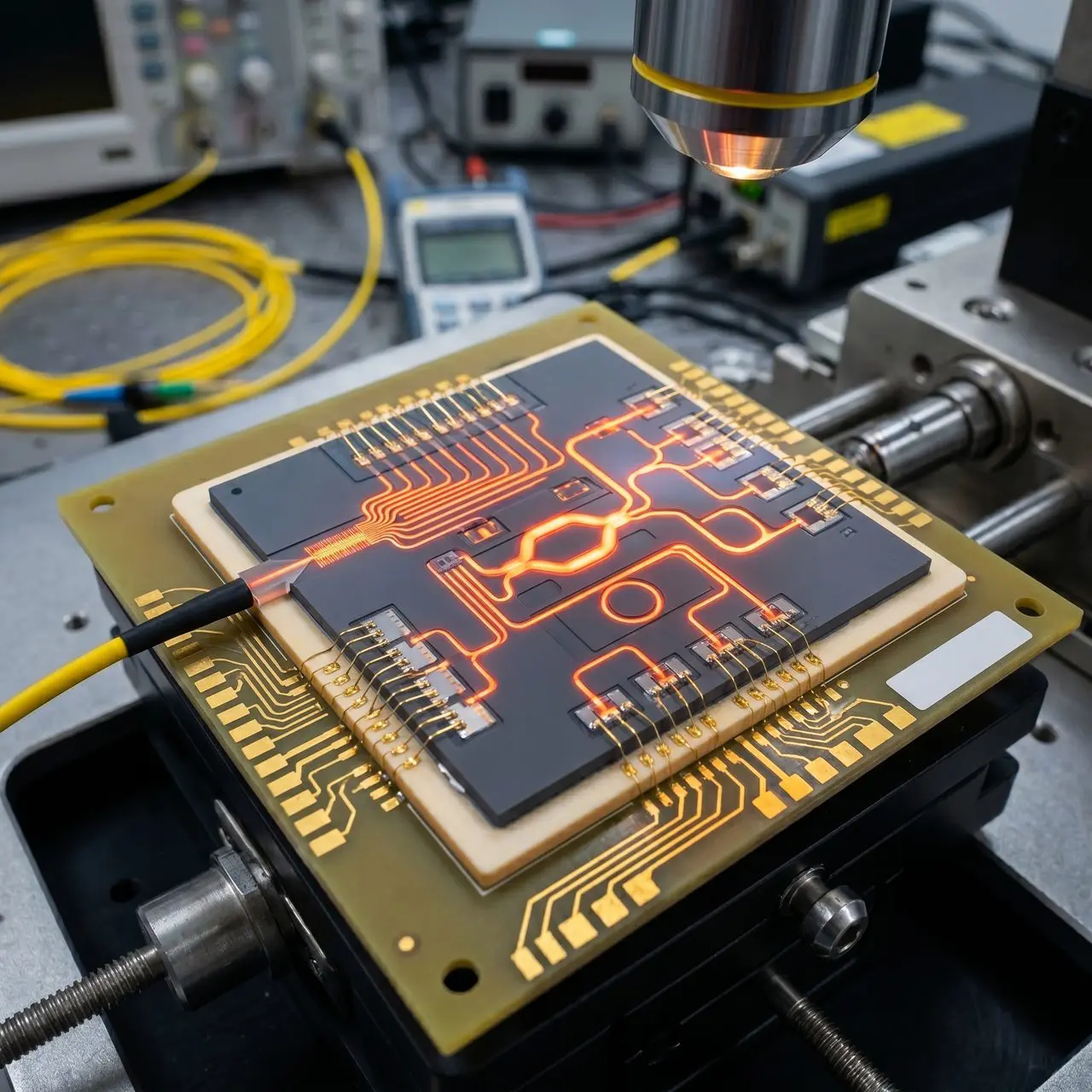
Researchers at Stanford University have created an optical device that generates 22 THz of mid-infrared light on a chip, a frequency previously difficult to achieve with compact technology. The device, an optical parametric oscillator integrated on thin-film lithium niobate, emits broadly tunable radiation between 2.7 and 3.4 µm, a spectral range vital for environmental, chemical, and biological sensing.
This work establishes a platform for compact, widely tunable mid-infrared sources, potentially enabling more portable and accessible sensing applications. The team reports this device achieves electrical control of emission wavelengths, ranging from coarse, multi-THz scales down to continuous, sub-100-GHz tuning.
Ultra-wideband Lithium Niobate Chip for Mid-Infrared Generation
The device operates between 2.7 and 3.4 µm. This spectral range is particularly crucial for applications in environmental monitoring, chemical analysis, and biological sensing, where identifying specific molecular signatures relies on precise mid-infrared illumination. The device’s ability to access this region efficiently addresses a long-standing limitation in mid-infrared laser technology. The newly developed optical parametric oscillator utilizes a design inspired by near-infrared tunable lasers, incorporating the Vernier effect to achieve ultra-wideband tunability.
This effect, implemented with two racetrack resonators possessing slightly different free spectral ranges, allows for broad wavelength control using low-power electrical signals. By shifting the resonance of one cavity, the overlapping points, and thus the emitted wavelength, can be precisely adjusted. This electrical control extends from coarse, multi-THz scales down to continuous, sub-100-GHz mode-hop-free tuning ranges, offering a dynamic capability not readily available in traditional mid-infrared sources. The team successfully integrated much of the functionality and precision of bulk optical parametric oscillators onto a single chip.
Fabrication of the device relies on a periodically-poled lithium niobate section, engineered to support broadband parametric gain. The researchers optimized the lithium niobate waveguide geometry to minimize group velocity mismatch and group velocity dispersion, maximizing the bandwidth of the generated mid-infrared light. According to the published paper, “Achieving these dispersion parameters generally requires large film thicknesses,” explaining the need for a deep etch to ensure strong mode confinement and reduce signal loss. Experimental measurements of the optical parametric amplification gain confirm the design’s effectiveness, demonstrating a double-peaked gain.
Electrical Tuning of 22 THz Mid-Infrared Radiation
Alexander Y. Hwang and colleagues at E.L. Ginzton Laboratory have developed an optical parametric oscillator that emits multi-milliwatt radiation spanning wavelengths from 2.7 to 3.4 µm. The core of the optical parametric oscillator’s performance is its ability to electrically control the emitted wavelengths across a wide range. Shifting the resonance of one cavity allows for coarse, multi-terahertz scale adjustments, while finer control enables continuous tuning with sub-100-GHz precision, a level of dynamic control exceeding many existing mid-infrared sources.
This electrical tunability circumvents the need for external laser sources or temperature adjustments, simplifying operation and paving the way for more portable and integrated sensing platforms. Fabrication of the device utilizes a deep etch of periodically-poled lithium niobate, carefully engineered to minimize group velocity mismatch and dispersion.
Vernier Effect Enables Broad OPO Wavelength Control
Hwang and colleagues at Stanford University’s E.L. Ginzton Laboratory have demonstrated a mid-infrared optical parametric oscillator capable of generating radiation from 2.7 to 3.4 µm, a spectral region critically important for detecting trace amounts of gases and liquids, and for applications in environmental, chemical, and biological sensing. This electrical tunability represents a significant departure from traditional mid-infrared sources, offering a dynamic and potentially faster switching capability.
The team’s approach allows for bright mid-infrared oscillation from pumping in the near-infrared, where diode lasers are readily available, and enables all critical components to be implemented and characterized in the near-infrared spectrum. This architecture, they believe, combined with moderate optical and electrical power improvements, will unlock a new class of tunable mid-infrared sources capable of leveraging the scaling potential of nonlinear photonics and near-infrared lasers.
On-Chip Optical Parametric Oscillator Architecture
Researchers at E.L. The architecture of this on-chip optical parametric oscillator relies on the Vernier effect, a principle borrowed from advancements in near-infrared laser technology, to achieve broad wavelength control. By incorporating two racetrack resonators with slightly differing free spectral ranges within the optical parametric oscillator cavity, the device can precisely select the oscillating mode.
This design allows for electrical tuning across multi-THz scales, down to continuous, sub-100-GHz ranges without mode-hopping, a significant improvement over systems requiring external lasers or temperature adjustments. Experimental measurements of the optical parametric amplification gain confirmed a double-peaked gain, matching simulations and demonstrating the effectiveness of their dispersion engineering.
This integrated platform represents a robust foundation for future development, with the team anticipating that moderate improvements in optical and electrical power will further enhance its capabilities. The resulting compact, widely tunable mid-infrared sources promise to advance applications ranging from environmental monitoring to medical diagnostics, offering a versatile tool for spectroscopic and sensing technologies.
Near-Infrared Pumping of Mid-Infrared Signal & Idler Waves
Generating mid-infrared light on a chip with electrical control has long been hampered by material constraints, but a new device from Stanford University achieves 22 THz of multi-milliwatt, voltage-tunable radiation from 2.7 to 3.4 µm, a frequency range crucial for detailed molecular analysis. This on-chip optical parametric oscillator operates between 2.7 and 3.4 µm, a spectral region particularly valuable for detecting specific molecules in applications like environmental monitoring and breath analysis.
Unlike many existing mid-infrared sources, this device relies on a thin-film lithium niobate platform, allowing for voltage-controlled adjustments to the emitted light’s frequency. The core of this innovation lies in the device’s architecture, which leverages the Vernier effect to achieve broad and precise tuning. By applying small electrical signals, researchers can shift the wavelengths of light that resonate within the device, effectively “scanning” across a wide range of mid-infrared frequencies.
The team’s design addresses a key limitation of current mid-infrared sources: the need for bulky, mechanically-tuned components. Achieving this level of integration required careful optimization of the lithium niobate waveguide geometry to maximize parametric gain across a broad bandwidth. The optimized waveguide geometry, with a deep etch, enabled strong mode confinement and reduced slab mode leakage, ultimately contributing to the observed gain bandwidth. This approach allows for a compact, robust platform for future development and scaling of mid-infrared sources, promising advancements in fields ranging from environmental sensing to chemical analysis.
Singly Resonant OPO Design for Reproducible Tuning
Researchers at Stanford University have engineered a thin-film lithium niobate optical parametric oscillator capable of producing multi-milliwatt, voltage-tunable radiation spanning 2.7 to 3.4 µm. This approach, inspired by advancements in near-infrared laser technology, circumvents the need for external tuning mechanisms or substantial temperature adjustments, streamlining the device and enhancing its stability. Optimizing the lithium niobate waveguide geometry was crucial to maximizing the device’s performance.
660nm Mid-Infrared Tuning with Integrated Electrical Control
This advance bypasses the need for bulky, mechanically-tuned systems previously required to access these wavelengths, opening possibilities for portable sensing technologies. The device demonstrates a capacity for both coarse, multi-THz scale adjustments and continuous, sub-100-GHz mode-hop-free tuning, offering a level of dynamic control previously difficult to attain in compact mid-infrared sources. This careful engineering of the waveguide geometry broadened the bandwidth by canceling first-order phase mismatch variation, leaving only quadratic contributions to dispersion. Measured optical parametric amplification gain versus signal wavelength confirmed this, with the experimental data closely matching simulated gain.
Thin-Film Lithium Niobate Advances Compact Photonics
Researchers at E.L. The device’s design directly addresses limitations in current mid-infrared laser technology, which often relies on bulky, mechanically-tuned systems or restricted wavelength access. This level of precision, combined with the compact footprint of the thin-film lithium niobate, positions the technology for applications demanding dynamic and rapidly-switchable mid-infrared sources.
The team’s approach moves beyond simply miniaturizing existing mid-infrared sources; it fundamentally alters the method of wavelength control. This integration is crucial, as it eliminates the need for external tuning mechanisms and opens the door to scalable manufacturing.
The device operates using a fixed-wavelength near-infrared pump laser, converting it into the desired mid-infrared spectrum, and the entire process is governed by electrical signals applied to the on-chip resonators. This electrical control offers a significant advantage over traditional thermal tuning methods, potentially enabling faster switching speeds and more complex spectral shaping. The demonstrated 660 nm of mid-infrared, coupled with the potential for scaling, positions this technology as a robust platform for a new generation of compact, widely tunable mid-infrared sources.




See today’s quantum computing news on Quantum Zeitgeist for the latest breakthroughs in qubits, hardware, algorithms, and industry deals.