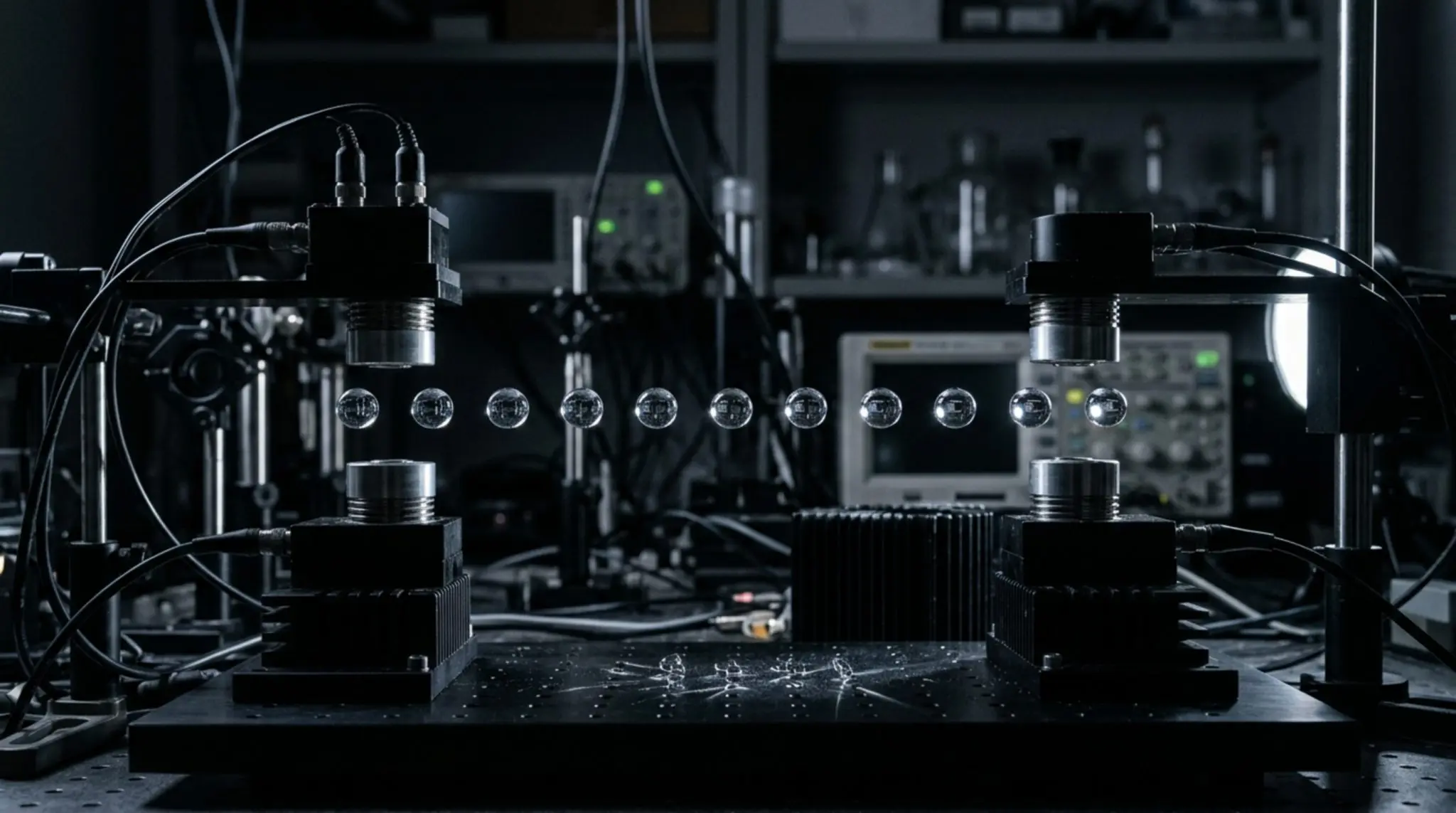
Silicon nanoparticles are now stably trapped within the intensity minima of an optical standing wave, unlike silica particles which cannot be held in this way. The technique utilises resonant meta-atoms, particles exhibiting strong Mie resonances, to manipulate microscopic objects using light. These resonances occur when particle size is approximately a few hundred nanometers, enabling stronger and more tunable optical forces than previously possible.
Bin Lu and colleagues have achieved stable three-dimensional trapping of silicon nanoparticles within areas of low light intensity using an optical standing wave; conventional materials such as glass do not allow for this stable capture. This advance depends on silicon’s unique ability to support Mie resonances, enhanced light scattering occurring at around 300 nanometres, which alters the optical forces acting upon objects.
An optical standing wave can be visualised like ripples meeting after dropping two pebbles into water, creating calm points alongside large waves, but employing light instead of water. The breakthrough relies on exploiting these Mie resonances, enhanced light scattering when particles reach a few hundred nanometers in size; consider blowing across empty bottles where specific shapes resonate at certain frequencies producing louder sounds, similarly these nanoparticles ‘resonate’ with particular wavelengths depending on their material and dimensions.
Deep ultraviolet lithography defines nanoscale silicon resonators upon sacrificial layers
Fabrication began with an ultraflat silicon wafer and a thin layer of deposited silicon nitride acting as a base for subsequent layers. A polycrystalline silicon film, ultimately forming the nanoparticles, was then applied and patterned using deep ultraviolet lithography, a technique employing light to define microscopic structures on a surface. The top-down approach allowed precise control over particle geometry because well-defined silicon particles are not readily available commercially unlike their silica counterparts.
This method provides advantages in creating consistent nanostructures compared to relying solely on naturally occurring materials. Following etching away unwanted material, isolated resonant ‘meta-atoms’ were released from a sacrificial layer via wet chemical processing ready for experimentation; these meta-atoms exhibit unique optical properties due to their shape and composition. Polycrystalline silicon particles with heights ranging from approximately 604.4±11.2 nanometres and radii between 145, 225 nanometres were fabricated using this process involving a silicon nitride sacrificial layer.
Experiments conducted at moderate vacuum utilised an optical standing wave to trap the nanoparticles alongside silica spheres for direct comparison, allowing observation of differences in trapping dynamics. High-refractive-index materials enable strong Mie resonances within the visible to near-infrared spectrum when particle dimensions reach just a few hundred nanometers.
Resonant scattering enables stable optical trapping in regions of minimal intensity
Stable three-dimensional trapping of silicon nanoparticles within an optical intensity minimum has been achieved; it represents an advance over silica particles which cannot be stably held in such a regime. Previously, stable trapping relied on positioning particles at points of peak light intensity but exploiting resonant meta-atoms, particles around a few hundred nanometres exhibiting strong Mie resonances, allows manipulation via areas of low intensity. This breakthrough parallels blue-detuned atom trapping techniques used in atomic physics, opening new avenues for controlling microscopic objects using light fields without requiring specialised beam shaping or feedback mechanisms.
Silicon particles experienced force inversion due to interference between electric and magnetic multipoles, altering their effective polarizability and enabling attraction towards darkness instead of brightness. Analysis revealed optical forces scaling differently for silicon versus silica, highlighting fundamental differences in how each material responds within an optical standing wave. While offering potential benefits for precision sensing and ground state cooling, experiments were conducted under moderate vacuum conditions; further work is needed to demonstrate strong trapping performance in more complex environments such as those with higher particle densities.
Stable nanoparticle manipulation unlocks potential for advanced nanophotonic architectures
Although silicon nanoparticles now appear controllable within light’s darkest points, a feat previously impossible with silica, scaling up this technique presents considerable hurdles. Currently, single particles are manipulated under moderate vacuum conditions which may not translate to denser environments or larger assemblies. Maintaining stable three-dimensional confinement becomes exponentially more difficult as particle numbers increase due to interparticle interactions and competing forces like van der Waals attraction that weren’t fully addressed in these experiments; future investigation into mitigating their effects is therefore essential.
Success with silicon offers pathways to build more complex optical systems utilising meta-atoms for applications such as advanced sensing or novel photonic devices near surfaces. The demonstration of stable silicon nanoparticle confinement expands the set of tools available for manipulating microscopic objects because conventional optical trapping relies on attracting particles to bright spots, whereas this research achieves control through darkness instead. This contrasts sharply with silica which cannot be stably held in low-intensity regions owing to differing responses to electromagnetic forces at small scales.
The researchers successfully trapped resonant silicon nanoparticles within the dark minima of an optical standing wave, a capability not observed with standard silica particles. This demonstrates that high refractive index materials respond differently to light’s electromagnetic fields and enables new methods for controlling these tiny objects. The findings establish meta-atoms as a means to expand techniques used for optical manipulation beyond traditional approaches reliant on attraction towards areas of high intensity. Experiments were performed using single particles under moderate vacuum conditions, and further work is needed to assess performance with increased particle density.
👉 More information
🗞 3D trapping of a meta-atom in an intensity minimum
✍️ Bin Lu, Adeel Afridi, Nadine Meyer and Romain Quidant
🧠 ArXiv: https://arxiv.org/abs/2608.19016




See today’s quantum computing news on Quantum Zeitgeist for the latest breakthroughs in qubits, hardware, algorithms, and industry deals.