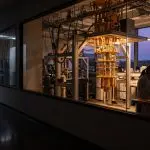
Rice University will receive $900,000 in research funding over five years through the U.S. Department of Energy’s Quantum Science Center, focusing on error correction, a critical challenge hindering the development of practical quantum computers. Assistant professor of computer science Tirthak Patel will lead Rice’s effort, developing and evaluating quantum error-correction decoding methods on high-performance computing platforms to address issues of latency, throughput, and data movement essential for real-time correction. “Reliable error correction is one of the biggest challenges in making quantum computing useful for accelerating scientific discovery,” Patel said. This collaboration with Oak Ridge National Laboratory and other industry partners aims to build fault-tolerant quantum computers capable of tackling scientific problems beyond the reach of current technology, furthering the DOE’s mission of achieving this goal by 2028.
Patel’s research group is specifically contributing to the QSC’s work on quantum-accelerated high-performance computing (QHPC) architectures, with a focus on extracting, decoding, and correcting error signals from diverse quantum applications. The team is actively addressing practical engineering hurdles such as latency, throughput, and data movement, factors essential for achieving real-time quantum error correction. Collaboration is central to this endeavor, with Patel working alongside Jack Lange at Oak Ridge National Laboratory, who leads the QHPC Controls Project. “Advancing quantum computing requires the combination of expertise across the DOE and academia in both quantum systems and high-performance computing,” Lange said. “This partnership between ORNL and Rice brings together important strengths in both.” Established in 2020 under the National Quantum Initiative Act, the QSC aims to create a fault-tolerant ecosystem for hybrid QHPC and recently secured renewed funding through 2030, with $125 million planned over five years, including $25 million allocated for the first year.
Advancing quantum computing requires the combination of expertise across the DOE and academia in both quantum systems and high-performance computing.
Jack Lange at ORNL
Rice University’s commitment to addressing a core challenge in quantum computing has been solidified with research funding of $900,000 over five years through the U.S. Department of Energy’s Quantum Science Center. This practical emphasis distinguishes the research, aiming to move beyond simulations toward functional quantum systems capable of accelerating scientific breakthroughs. The work centers on developing methods capable of scaling to accommodate increasingly complex future quantum systems and supporting diverse scientific applications, a critical need as quantum computers move beyond proof-of-concept stages. Researchers will demonstrate the extraction, decoding, and correction of error signals from various quantum applications, evaluating multiple error-correction technologies and building hierarchical decoding methods designed to function across multiple HPC architectures.
Rice University brings valuable expertise that will assist the QSC in advancing scalable quantum error correction and fulfilling DOE’s mission of developing a fault-tolerant quantum computer by 2028.


See today’s quantum computing news on Quantum Zeitgeist for the latest breakthroughs in qubits, hardware, algorithms, and industry deals.