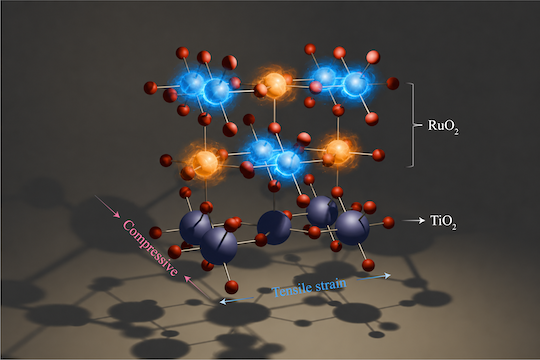
Researchers at Rice University have discovered that ruthenium dioxide, previously considered non-magnetic in its standard form, potentially exhibits altermagnetism when crafted into films only a few atoms thick. The team, led by Ming Yi, used spin-resolved angle-resolved photoemission spectroscopy to measure the spin texture of the ultrathin material, revealing unconventional magnetism.
“Ruthenium dioxide was one of the first materials to be proposed as an altermagnetic candidate, but studies on its bulk form didn’t return evidence of magnetism,” Yi, an associate professor of physics and astronomy, said. This finding, published in Science Advances, could advance the design of more efficient RAM architecture in computers.
Ultrathin Ruthenium Dioxide Exhibits Altermagnetism via Spin Texture
Ruthenium dioxide, despite initial assessments, demonstrates unconventional magnetism when reduced to a film only a few atoms thick; this surprising behavior challenges previous understandings of the material’s magnetic properties. Researchers at Rice University, collaborating with the University of Minnesota and the Paul Scherrer Institute, detailed their findings in Science Advances, revealing that the quantum material exhibits characteristics of altermagnetism, a recently proposed magnetic state with potential for advanced computing.
While bulk ruthenium dioxide consistently showed no magnetism, the ultrathin film presented a stark contrast, prompting a re-evaluation of its potential. This difference in behavior between the bulk material and the ultrathin film highlights the importance of atomic layer number in achieving altermagnetism.
Yichen Zhang, the first author on the paper and a recent Rice graduate, explained the analysis: “After analyzing our measurements, including informing our interpretation with theoretical calculations, we found that, in our experimental conditions, the ruthenium dioxide shows spin textures consistent with unconventional magnetism.” Further investigation revealed that applying lattice strain, essentially putting the material under pressure, was crucial for inducing these altermagnetic spins. Without this strain, the electron spins did not exhibit the necessary characteristics. “The strain-dependent nature suggests that we may be able to use lattice strain as a tuning knob to induce or control altermagnetism,” Zhang said, highlighting the potential for manipulating this property.
This control is particularly relevant for developing spintronic devices and improving random access memory (RAM) architectures. The ability to finely tune the magnetic properties through strain opens avenues for creating more efficient and compact memory storage. The research builds on the emerging concept of altermagnetism, which proposes a unique arrangement of electron spins that could overcome limitations in conventional magnetic materials.
“This work shows just how complex these questions can be,” Yi said, acknowledging the challenges inherent in understanding these materials. High-quality material preparation and careful measurement protocols were essential to observing the correct electron spin properties and determining a potential method for manipulation in future quantum materials.
After analyzing our measurements, including informing our interpretation with theoretical calculations, we found that, in our experimental conditions, the ruthenium dioxide shows spin textures consistent with unconventional magnetism.
Yichen Zhang, First Author on the Paper and a Recent Rice Graduate



See today’s quantum computing news on Quantum Zeitgeist for the latest breakthroughs in qubits, hardware, algorithms, and industry deals.